
MRR is moving from a promising photonic concept to a practical engine for next-generation optical interconnects. As AI clusters grow larger and cloud traffic rises faster, data centers need more bandwidth in less space. At the same time, operators must control power consumption, thermal load, and deployment cost. Because of that, the industry is shifting from conventional electrical scaling toward dense optical integration.
In this transition, wavelength division multiplexing no longer belongs only to long-haul transport. Instead, it is becoming essential inside data centers, on boards, and even near advanced packaging. This shift creates a clear demand for compact, low-power, and highly integrated optical devices. MRR answers that demand with precision and efficiency, so it now stands at the center of the DWDM roadmap.
The Pressure Behind the Shift
Modern data centers face a structural problem. Traffic between servers, switches, storage systems, and AI accelerators keeps growing, yet physical space does not. Every interface must therefore carry more data without adding excessive power or cabling complexity. Traditional electrical links struggle in this environment, especially when distance, speed, and density rise together.
Optical interconnects address many of these limits. However, conventional optical architectures still consume valuable footprint and system power. They also create packaging and scaling challenges when designers push toward higher density. For that reason, the market now favors solutions that bring more wavelength channels into smaller photonic areas. MRR fits this trend extremely well, because it supports dense wavelength handling on a compact silicon photonics platform.
What Makes MRR Different
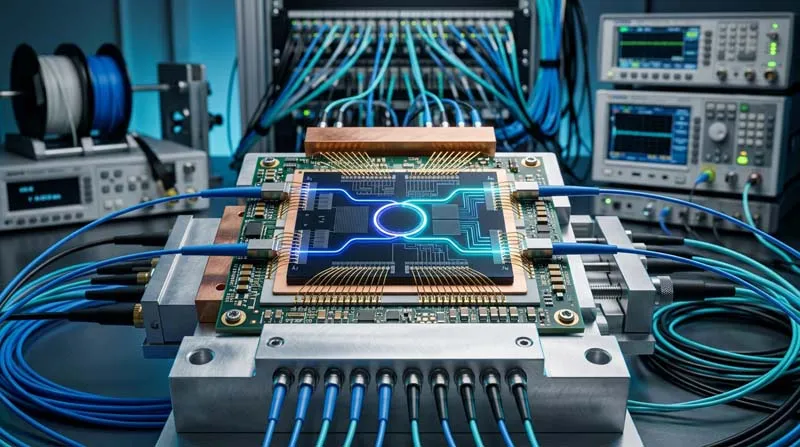
At its core, MRR is a ring-shaped waveguide structure that resonates at selected wavelengths. When light at the target wavelength enters the device, the ring couples and filters that signal with high selectivity. By tuning the refractive index, designers can shift the resonant wavelength and use the device for modulation, filtering, multiplexing, or demultiplexing.
This operating principle gives MRR a major system advantage. Rather than relying on large optical structures, engineers can place many rings on a single chip and assign each one to a specific wavelength channel. As a result, one compact photonic circuit can manage multiple channels with impressive spectral efficiency. That is why the technology matters so much for dense wavelength division multiplexing in short-reach and intra-data-center environments.

Compact Size Creates Real Commercial Value
The first major strength of MRR is scale. In high-density optical design, area matters as much as raw performance. Smaller photonic devices allow tighter layouts, shorter optical paths, and greater channel concentration. As a result, a compact resonant structure does more than save space. It improves the economics of integration as well.
This matters across modern platforms. In switch systems, front-panel density continues to rise. For co-packaged optics, proximity to the compute engine has become crucial. Within optical I/O designs, every square millimeter affects thermal and packaging choices. Because MRR occupies so little chip area, it supports all of these directions. Moreover, it allows designers to place more wavelength channels where larger modulators or filters would quickly become impractical.
Why Low Power Is No Longer Optional
Power efficiency now shapes every data center technology decision. Operators want more throughput, yet they cannot allow interconnect power to scale linearly with bandwidth. Consequently, photonic devices must reduce energy per bit while maintaining signal quality and manageable control overhead.
Here, MRR shows strong potential. Its compact structure helps shorten device interaction length and improve integration efficiency. That, in turn, supports low-power optical transmission architectures. In AI and cloud environments, this benefit becomes even more valuable, because network fabrics run continuously under demanding traffic loads. While total system power still depends on lasers, drivers, control loops, and packaging, MRR gives architects a strong foundation for more efficient DWDM transceivers.

A Native Fit for Silicon Photonics
Another reason the industry values MRR is its natural compatibility with silicon photonics. Today, silicon photonics has moved well beyond laboratory curiosity. It now offers a path toward standardized manufacturing, higher yield, and better integration with electronic design flows. Devices that align with this ecosystem gain a clear commercial edge.
MRR belongs to that class. Designers can build arrays of rings, each tuned to a different wavelength, on a common chip platform. In turn, one photonic engine can support dense wavelength multiplexing without relying on bulky external structures. This capability directly supports the evolution of compact DWDM transceivers for data centers, cloud networks, and emerging optical I/O systems. In other words, MRR is not just an elegant device. It is a scalable building block for future photonic architectures.
Beyond Components: A System-Level Shift
The larger impact of MRR goes beyond the component level. In fact, it helps redefine how data centers think about optical connectivity. Older network models treated optics mainly as a link between large external modules. However, future systems will push optics closer to switch silicon, accelerator packages, and advanced compute fabrics.
That shift changes the design priorities. Device size, wavelength density, power efficiency, and integration flexibility now influence the entire system roadmap. Because MRR supports high-density multi-wavelength transmission in a compact footprint, it helps bridge the gap between discrete optics and deeply integrated photonic systems. Therefore, its importance extends into co-packaged optics, board-level optical links, and next-generation disaggregated compute infrastructure.
The Main Engineering Challenges
Despite its promise, MRR is not a frictionless solution. The most discussed challenge is thermal sensitivity. Resonant wavelength shifts with temperature, so designers must maintain alignment under dynamic operating conditions. In data centers, where thermal fluctuations are unavoidable, this issue directly affects channel stability and long-term reliability.
Manufacturing variation creates another challenge. Small dimensional changes can shift resonance behavior, especially in large ring arrays. Therefore, process control and calibration become critical at scale. In addition, tuning circuits, monitoring logic, and control algorithms add complexity to the total solution. So, the real competition is no longer about who can fabricate a ring. It is about who can turn MRR into a robust, low-power, volume-ready system platform.
How the Industry Is Responding
The good news is that the ecosystem is already addressing these problems. Engineers continue to improve thermal tuning efficiency, electrical control strategies, and wavelength locking methods. Meanwhile, foundry platforms keep maturing, which helps reduce device variation and improve repeatability across wafers and production lots.
System integration is also improving. Designers now treat optics, electronics, packaging, and control software as one coordinated stack rather than isolated disciplines. As a result, MRR deployment looks increasingly realistic in commercial transceiver and transport designs. The next phase of market adoption will depend less on theoretical capability and more on manufacturability, stability, and deployment economics.

Broader Market Relevance
Although data center interconnects drive much of the current momentum, the relevance of MRR extends further. The same push for higher bandwidth density and lower energy consumption also affects metro aggregation, cloud backbone scaling, and next-generation service provider infrastructure. Therefore, photonic technologies that succeed in compact DWDM environments may influence wider transport architectures over time.
In this broader context, system-level solution providers play an important role. HTF, for example, focuses on fiber optic products and WDM system solutions for global data centers, 5G networks, cloud computing, metro networks, and access networks. Backed by a team with more than ten years of experience in optical communication product development, fiber solutions, device engineering, and manufacturing, HTF supports network construction, optimization, and expansion with practical delivery capability.
HTF and Practical WDM Deployment
Its HT6000 platform reflects that system-oriented approach. Built as a compact, high-capacity, and cost-effective OTN transport system, HT6000 adopts a universal CWDM/DWDM platform design and supports transparent multi-service transmission, flexible networking, and efficient access. For IDC and ISP operators that need scalable WDM expansion beyond 1.6T nodes, this type of platform offers a strong commercial path from photonic innovation to real deployment value.
Conclusion
MRR is opening a new stage in ultra-compact DWDM transmission. Its small footprint, low-power potential, and strong fit with silicon photonics make it one of the most important building blocks in the future of optical interconnects. More importantly, it supports the larger shift from modular optics to deeply integrated photonic systems.
The path ahead still requires better thermal management, tighter process control, and stronger system integration. Yet the direction is clear. As bandwidth density becomes the defining metric of modern infrastructure, MRR will move from advanced device technology to core network capability. For companies that want to lead the next generation of optical transmission, that shift is not theoretical anymore. It is already underway.