
China’s National Development and Reform Commission (NDRC) has announced a landmark infrastructure plan, projecting a total direct investment of 4 trillion yuan in national computing power network construction throughout the 15th Five-Year Plan period. As a market-driven infrastructure initiative dominated by corporate investment, the new computing power network blueprint unlocks enormous development space for private capital and global industrial participants. To fuel steady industrial growth, the NDRC will roll out targeted planning guidance, full-factor resource guarantees, and a premium business environment to boost private investment in digital infrastructure.
What Is a National Computing Power Network?
The computing power network is widely regarded as a national power grid for digital computing resources, serving as the core foundational infrastructure of the AI and big data era. Different from traditional decentralized data center operations, this nationwide network integrates and interconnects scattered data centers, supercomputing hubs, and edge computing nodes across the country to realize unified resource scheduling and intelligent allocation.
Similar to how public power grids eliminate the need for independent household generators, the standardized computing power network enables enterprises and institutions to purchase computing resources on demand with pay-as-you-go pricing. This innovative model effectively cuts idle resource waste, reduces overall operational costs, and significantly improves the utilization efficiency of national digital computing resources.
Token Cost & Computing Efficiency: Core Metrics for AI Industrial Development
In the intelligent computing era, Token acts as the basic unit for AI information processing and model operation. The total Token consumption directly reflects the application depth, innovation vitality, and large-scale deployment of AI agents, intelligent applications, and industrial intelligent systems. Meanwhile, unit Token cost serves as a key benchmark for evaluating algorithm performance and computing power transmission efficiency.
With the continuous iteration of optical transmission technology and the continuous optimization of national computing power supply systems, the unit cost of Token consumption will maintain a steady downward trend, laying a solid foundation for the large-scale popularization of commercial AI and industrial digital transformation.
Multiplier Economic Effect: Empowering Full Industrial Chain Upgrading
As a core digital infrastructure, the computing power network delivers powerful economic multiplier effects, equivalent to high-speed railway networks and 5G mobile communication infrastructure. Beyond meeting public digital service demands, its large-scale construction drives upstream and downstream industrial development, comprehensively boosting the upgrading of artificial intelligence, big data, industrial internet, and cloud computing industrial chains. It has become a core engine for stabilizing domestic economic growth and promoting digital industrialization.
Six Major National Networks: 7 Trillion Yuan Infrastructure Layout for 2026
The computing power network is a key component of the NDRC’s strategic Six Major Networks infrastructure system, which covers water conservancy networks, new-type power grids, computing power networks, next-generation communication networks, urban underground pipeline networks, and modern logistics networks. The total investment in these six key infrastructure sectors is expected to exceed 7 trillion yuan in 2026, focusing on expanding domestic demand, optimizing industrial structure, and sustaining high-quality economic development.
Instead of independent and isolated construction, the Six Major Networks adopt a collaborative integration development model. Each network has clear construction priorities and strategic goals, realizing resource complementarity, cross-industry linkage, and efficient operational synergy to build a comprehensive modern infrastructure system.
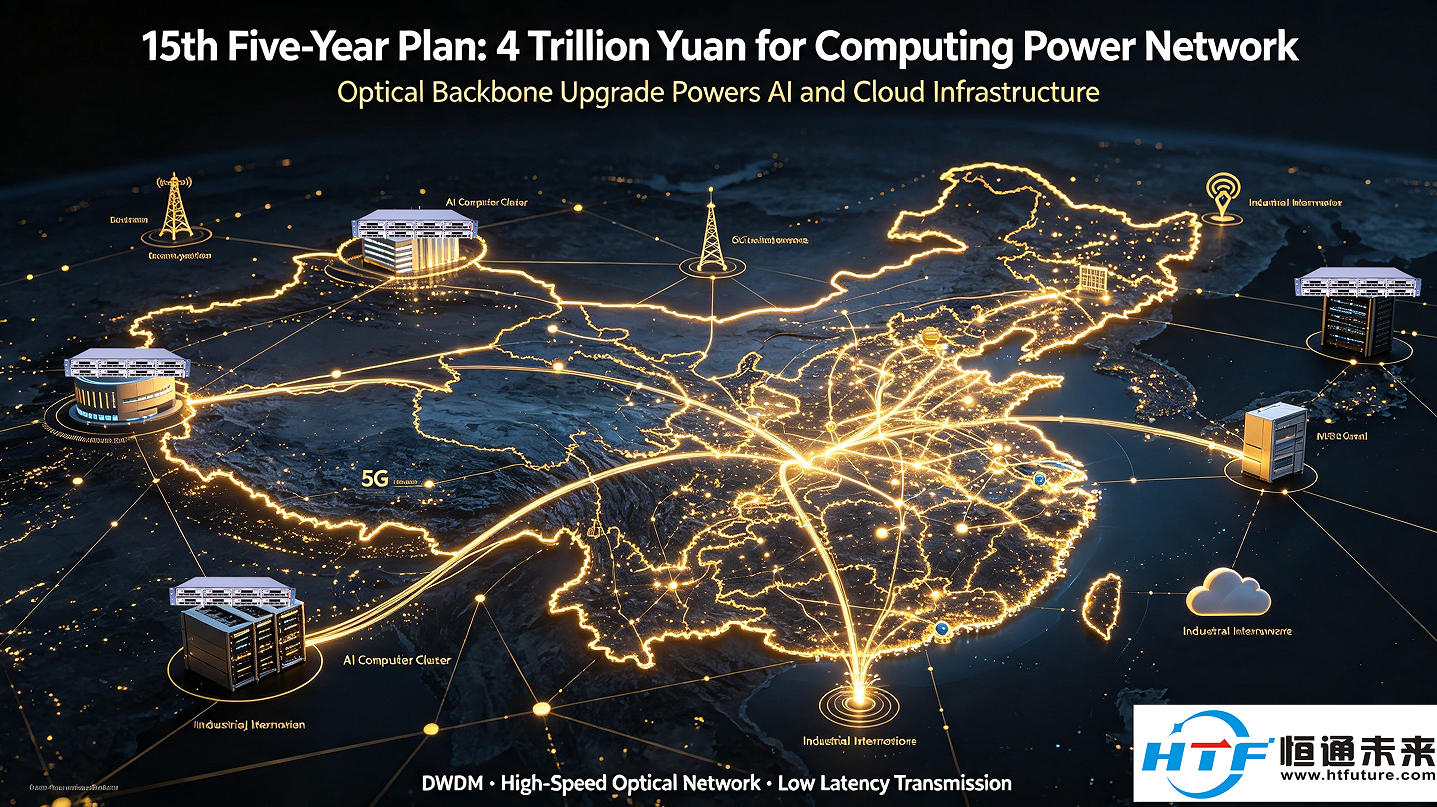
How DWDM Technology Supports Next-Gen Communication & Computing Power Network Development
The large-scale construction of national computing power networks and next-generation communication networks puts forward higher requirements for backbone optical transmission bandwidth, transmission stability, network latency, and scalable expansion. As the core optical transmission solution for modern backbone networks,DWDM (Dense Wavelength Division Multiplexing) technology perfectly matches the construction demands of new digital infrastructure.
Professional DWDM optical backbone solutions maximize single-fiber bandwidth utilization, support 100G/400G+ high-speed transmission and flexible bandwidth scaling, and build redundant, ultra-low-latency, high-reliability network architecture. By enabling efficient interconnection and real-time scheduling of cross-region data centers and computing nodes, DWDM optical transmission technology effectively underpins the stable operation of national computing power networks, accelerates the iteration of next-generation communication networks, and provides solid high-speed optical infrastructure support for China’s digital economy and global cross-border data transmission services.
Key Takeaways
The 4-trillion-yuan computing power network investment marks a new stage of China’s digital infrastructure construction. Driven by the Six Major Networks strategic layout, next-generation communication and computing infrastructure will achieve rapid upgrading. As a foundational optical transmission technology, DWDM plays an irreplaceable role in supporting high-capacity, low-latency, and scalable computing power network operation, bringing huge market opportunities for global optical communication infrastructure suppliers.