
2U DCI Box brings high-capacity optical transport into a compact data center form factor. It helps data centers connect faster, scale further, and use fiber resources with greater efficiency. Today, cloud computing, AI training, video traffic, financial backup, and distributed storage all demand massive data movement. Therefore, data center interconnect is no longer a simple network link. It has become a core layer of digital infrastructure.
A modern enterprise may run services across several sites. Meanwhile, a cloud provider may need to synchronize workloads between campuses, cities, and regions. As a result, the interconnect network must deliver high bandwidth, low latency, and stable performance. The 2U DCI Box meets this demand by combining DWDM, coherent optics, service aggregation, protection, and intelligent management in one compact platform.
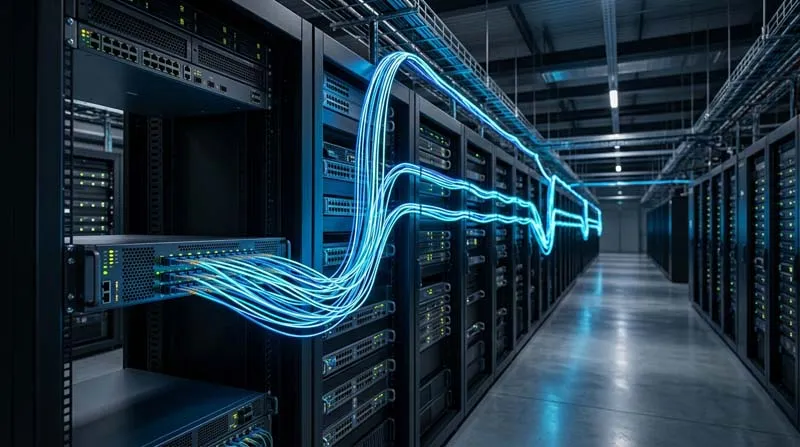
What Is a 2U DCI Box?
A 2U DCI Box is a high-density optical transport device for data center interconnect. The term “2U” refers to its rack height. It fits into a standard 19-inch cabinet and saves valuable space in dense equipment rooms. “DCI” means Data Center Interconnect. In practice, it connects data centers through high-speed optical links.
Unlike a normal Ethernet switch, this device works mainly at the optical transport layer. It sits between routers or switches and the fiber line system. Its key task is clear. The platform converts, aggregates, and carries high-speed services over DWDM wavelengths. Because of this role, the 2U DCI Box supports long-distance and high-capacity transmission with fewer fiber pairs.
Why Data Centers Need Higher Optical Capacity
Data centers now handle more traffic than ever before. AI clusters exchange huge datasets. Cloud platforms move workloads across regions. Financial institutions replicate critical records for disaster recovery. Also, carriers link IDC sites, edge nodes, and metro cloud pools.
However, traditional point-to-point links can quickly reach their limits. Fiber resources may become scarce. Expansion may take too long. In addition, long-distance transmission may require better signal quality. Therefore, operators need a platform that can expand bandwidth without adding excessive fiber or rack space.
The 2U DCI Box solves this problem through compact integration. It can carry multiple high-speed services across one fiber pair through DWDM. As capacity grows, users can add wavelengths, modules, or service cards. This makes network growth more flexible and more cost-effective.
DWDM: More Bandwidth from the Same Fiber
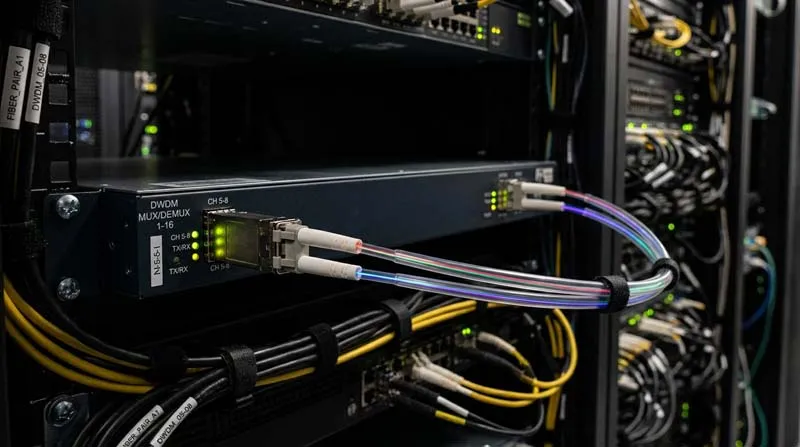
DWDM is one of the most important technologies inside a 2U DCI Box. It allows many wavelengths to travel over the same fiber. Each wavelength can carry 100G, 200G, 400G, or even higher-speed traffic. Therefore, one fiber pair can support far more capacity than a simple single-channel link.
This advantage matters in metro and data center environments. Fiber leasing and construction can be expensive. Moreover, space inside ducts and facilities may be limited. With DWDM, operators can increase capacity while keeping the physical fiber footprint under control. In many cases, this becomes the most direct path to scalable data center interconnect.
Coherent Optics for Distance and Stability
Coherent optical technology gives the 2U DCI Box stronger transmission capability. It improves spectral efficiency and helps high-speed signals travel farther. Advanced modulation and powerful error correction also strengthen link performance. As a result, the network can handle longer routes and more complex fiber conditions.
For 400G and 800G applications, coherent optics plays a critical role. It helps maintain signal quality across metro, regional, and long-haul links. In addition, tunable coherent modules simplify wavelength planning. Network teams can adjust wavelengths more easily and deploy services faster.
Service Aggregation and Flexible Access
A strong 2U DCI Box should support multiple client-side interfaces. These may include 10GE, 25GE, 100GE, 200GE, 400GE, and 800GE services. This flexibility allows one platform to connect switches, routers, storage devices, and security appliances.
Transponders and muxponders add more value. A transponder converts signals for optical line transmission. A muxponder aggregates several client services into a higher-rate line signal. For example, four 100G services may map into one 400G wavelength. Therefore, users can simplify the line side and improve bandwidth efficiency.
Reliability for Mission-Critical Services
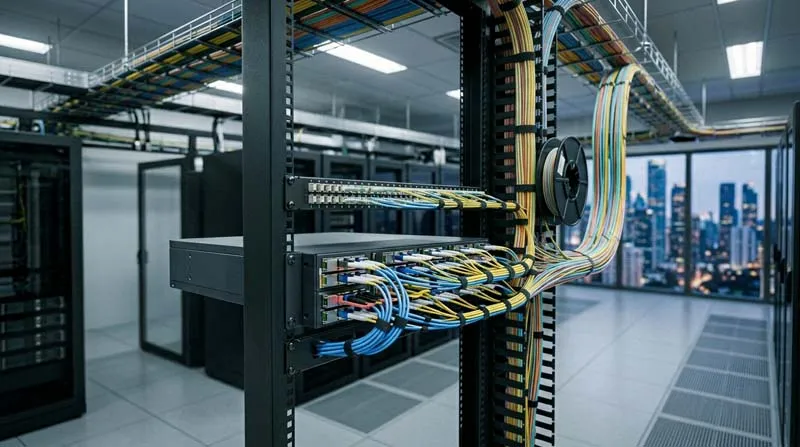
Data center interconnect must remain stable. A short interruption can affect cloud services, financial systems, backup tasks, and user experience. For this reason, the 2U DCI Box often includes redundant power, hot-swappable fans, optical line protection, and real-time alarms.
In addition, management tools help teams detect risks early. Operators can monitor optical power, temperature, link status, and performance data. They can also use Web, CLI, SNMP, or NETCONF for operation and maintenance. Therefore, the platform supports both daily management and automated network control.
Typical Application Scenarios
The 2U DCI Box fits many high-value network scenarios. For metro active-active data centers, it links two sites for resource sharing and service continuity. Financial disaster recovery networks use it to support secure and stable data replication. Across AI computing campuses, the platform helps GPU clusters and storage pools exchange data at high speed.
Carriers and cloud providers also benefit from this platform. They can connect IDC rooms, metro backbone nodes, edge clouds, and regional cloud pools. Moreover, enterprises can use it to connect headquarters, private clouds, backup centers, and dedicated network access points.
Key Factors for Product Selection
Choosing the right platform requires a full technical view. First, users should check total system capacity and single-slot capacity. Then, they should review client-side ports, line-side rates, and coherent module options. Transmission distance also matters. Teams must evaluate fiber loss, OSNR margin, dispersion, and amplifier requirements.
In addition, long-term operation costs deserve attention. Power consumption, cooling needs, module cost, and expansion cost all affect the final value. Furthermore, an open management interface can improve automation and reduce manual work. A future-ready 2U DCI Box should support smooth evolution toward 400G, 800G, and higher-speed services.
HTF Support for Optical Infrastructure Growth
HTF provides professional fiber products and WDM system solutions for large-scale data transmission. Its team brings more than ten years of experience in optical communication product development, fiber solutions, component design, and manufacturing. Therefore, HTF helps customers build, connect, and optimize fiber infrastructure with practical engineering support.
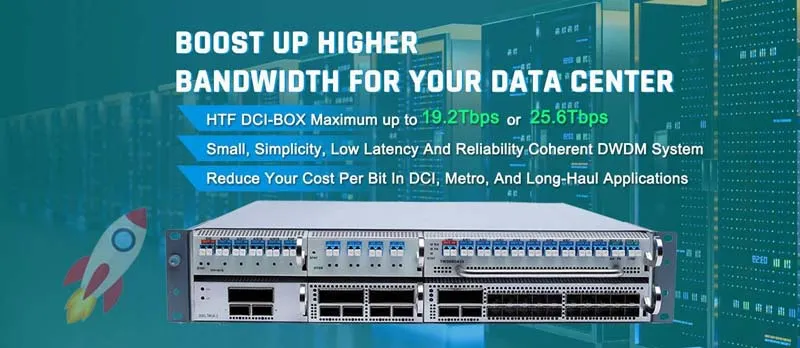
HTF serves global data centers, 5G networks, cloud computing platforms, metro networks, and access networks. Its HTF HT6000 platform offers a compact, high-capacity, and cost-effective OTN optical transport system. Based on a universal CWDM/DWDM platform design, the system supports transparent multi-service transmission and flexible network access.
For backbone, metro backbone, and core network applications, HTF HT6000 can meet large-capacity node requirements above 1.6T. As a result, IDC and ISP operators can build scalable WDM expansion solutions with better cost control. Looking ahead, the 2U DCI Box will continue to connect data, cloud, storage, and computing power. It will also help future data centers move from simple connectivity to intelligent optical interconnection.