
XFP Optical Modules and SFP+ Optical Modules play a crucial role in modern fiber-optic networks. Although higher-speed technologies such as 25G, 40G, 100G, and even 400G Ethernet continue to evolve, 10G solutions remain widely deployed due to their balance of performance, cost, and reliability. Therefore, understanding the differences between these two common 10G form factors is essential for network planning and upgrades.
In practice, many users ask whether XFP Optical Modules and SFP+ Optical Modules are interchangeable, how they differ in structure, and which option best fits specific network scenarios. This article provides a clear and structured explanation to help answer those questions.
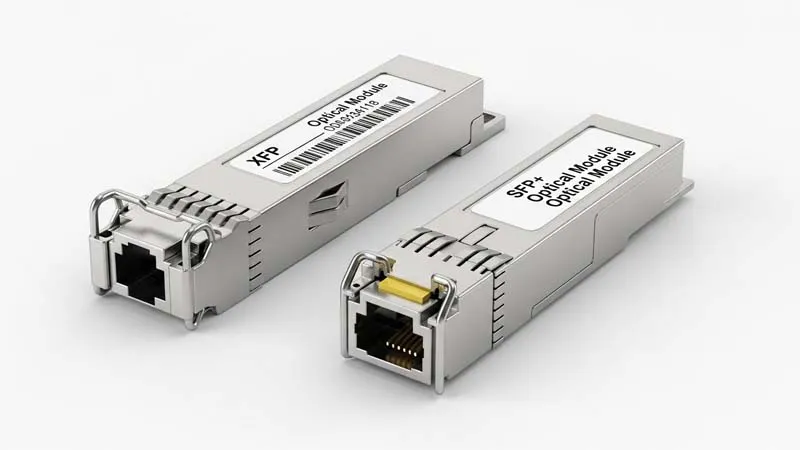
Overview of XFP Optical Modules and SFP+ Optical Modules
Before comparing details, it is important to understand how each module is defined and where it is typically used.
What Are XFP Optical Modules?
XFP Optical Modules are defined by the XFP Multi-Source Agreement (MSA). They support hot-swappable operation and protocol-independent transmission, which makes them suitable for a wide range of 10G applications. Moreover, these modules commonly operate at wavelengths of 850 nm, 1310 nm, and 1550 nm.
In addition, XFP Optical Modules are used in 10G Ethernet, 10G Fibre Channel, OC-192 digital transmission, STM-64 SDH, and 10G OTN systems. Due to their larger size, they also offer better heat dissipation, which can be valuable in certain environments.
What Are SFP+ Optical Modules?
SFP+ Optical Modules are an enhanced version of the original SFP standard and are defined by the SFP+ MSA. They follow IEEE 802.3ae as well as SFF-8431 and SFF-8432 specifications. As a result, they support hot-swappable 10G transmission in a much smaller form factor.
Furthermore, SFP+ Optical Modules operate at the same common wavelengths as XFP modules and support applications such as 10G Ethernet, 10G Fibre Channel, SONET/SDH, OTN, CPRI wireless networks, and even higher-speed Fibre Channel standards. Because of their compact design, they are widely used in high-density network equipment.
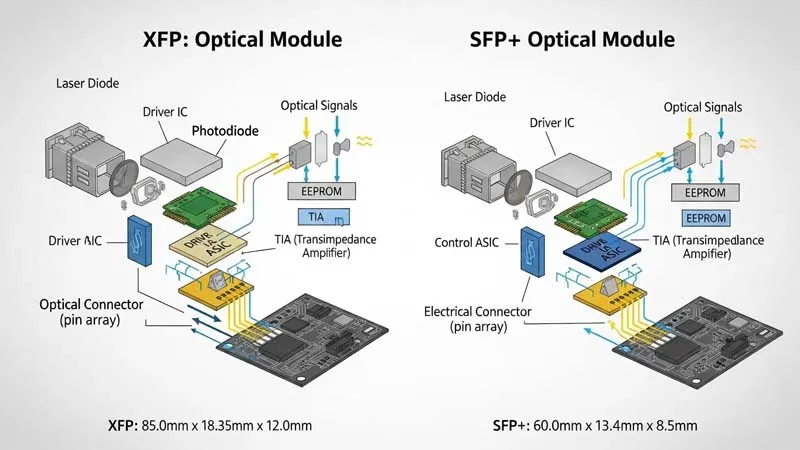
Key Differences Between XFP Optical Modules and SFP+ Optical Modules
Although both modules support 10 Gbps transmission, several technical differences affect their performance, deployment, and cost.
Size and Heat Dissipation
First, XFP Optical Modules are physically larger than SFP+ Optical Modules. This larger size allows better heat dissipation, which can improve thermal stability. However, SFP+ Optical Modules compensate for their smaller size through optimized system-level thermal design.
Internal Structure and Signal Processing
Another important difference lies in module construction. XFP Optical Modules integrate more signal processing functions within the module itself. In contrast, SFP+ Optical Modules shift many functions—such as CDR, MAC, and EDC—to the host motherboard. Consequently, SFP+ solutions reduce module complexity and overall cost.
Compatibility and Port Support
Compatibility is also a critical factor. XFP Optical Modules can only operate in XFP ports, while SFP+ Optical Modules are designed specifically for SFP+ ports. In some cases, SFP+ ports can support standard SFP modules, but XFP ports do not support SFP+ modules. Therefore, direct interchangeability is not possible.
Cost and Market Adoption
Finally, cost and popularity differ significantly. SFP+ Optical Modules are generally less expensive and easier to scale in dense network environments. As a result, they have become the mainstream choice in the 10G market, while XFP Optical Modules are now less common.

Can XFP Optical Modules and SFP+ Optical Modules Work Together?
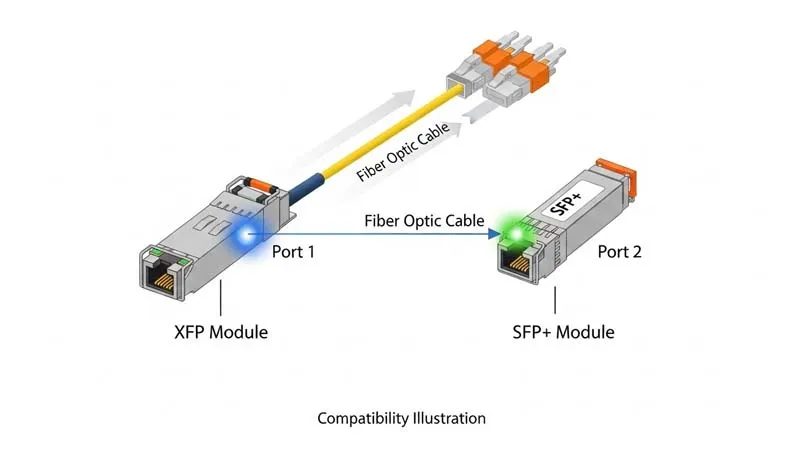
Although XFP Optical Modules and SFP+ Optical Modules are not physically interchangeable, they can coexist in the same Ethernet network. For example, a 10G XFP module operating at 1310 nm can communicate with a 10G SFP+ module at the same wavelength and transmission distance.
However, it is important to note that this compatibility applies only at the network level. The modules themselves must still be installed in their respective ports, and direct replacement is not possible.
Which Module Should You Choose?
When choosing between XFP Optical Modules and SFP+ Optical Modules, network density, cost, and equipment compatibility should guide the decision. In most modern deployments, SFP+ Optical Modules offer greater flexibility, lower power consumption, and better scalability. Nevertheless, XFP Optical Modules may still be suitable for legacy systems or specific thermal requirements.
Conclusion
In summary, XFP Optical Modules and SFP+ Optical Modules both support reliable 10 Gbps transmission, but they differ significantly in size, structure, compatibility, and cost. While they can communicate within the same network under matching parameters, they are not interchangeable at the hardware level. Understanding these distinctions helps ensure efficient network design and long-term scalability.