
In the high-stakes world of optical networking, where terabits of data flow over a single fiber via Wavelength Division Multiplexing (WDM), network uptime is paramount. Pinpointing faults swiftly and accurately isn’t just convenient; it’s critical for business continuity. This is where the Optical Time Domain Reflectometer (OTDR) transforms from a simple test tool into an indispensable strategic asset for managing WDM infrastructure. Here’s why:
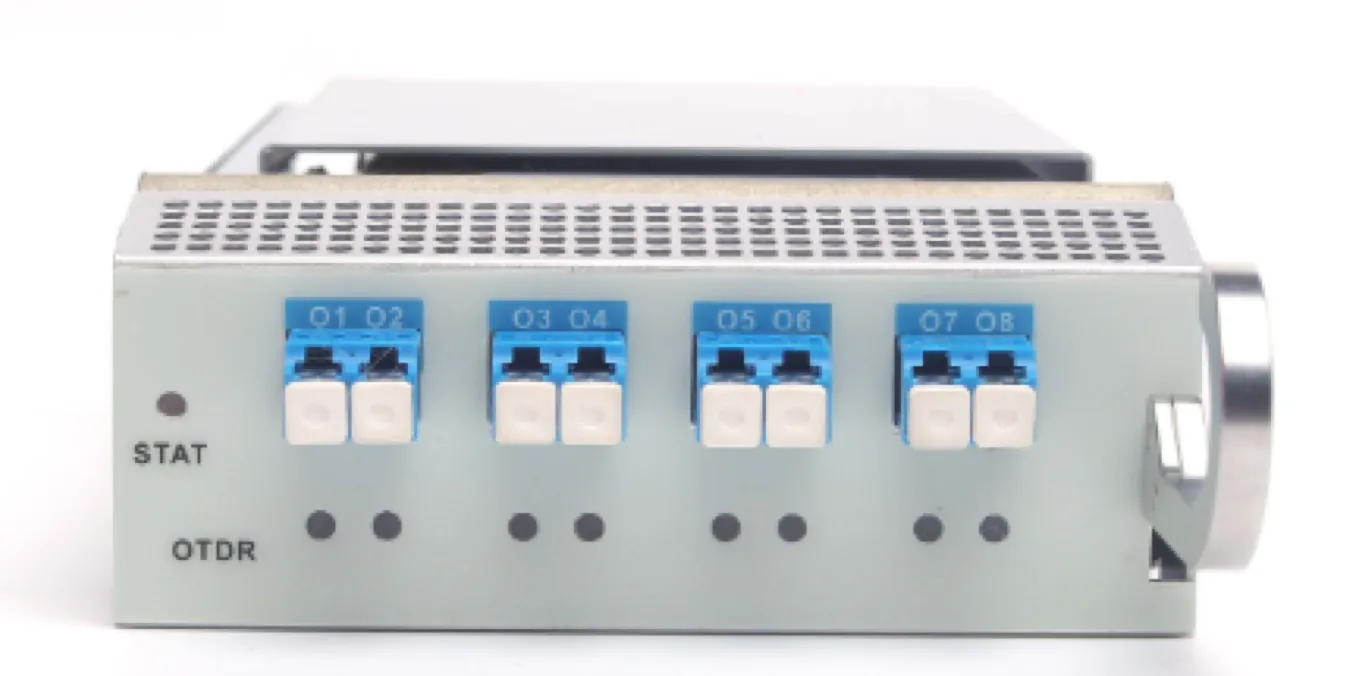
Pinpoint Precision in a Crowded Fiber: WDM systems pack dozens or hundreds of wavelengths onto one fiber. When loss or reflection occurs, traditional power meters tell you something is wrong, but not where or what. An OTDR acts like a diagnostic radar, sending a high-power pulse down the fiber and analyzing backscattered light. It precisely locates faults (breaks, bends, bad splices, dirty connectors) by distance, even amidst the complex landscape of multiplexers, demultiplexers, and optical amplifiers, saving hours of manual searching.
In-Service Testing Capability (Selective Wavelengths): Modern, sophisticated OTDRs offer wavelength selectivity. Operators can test specific, unused (“dark”) wavelengths or carefully chosen live wavelengths without significantly disrupting active traffic on other channels. This enables proactive maintenance and rapid troubleshooting without costly service outages, a game-changer for maintaining SLAs.
Characterizing Passive Infrastructure: The true performance of a WDM link depends heavily on the passive fiber plant – the spans between active equipment. OTDRs provide comprehensive characterization of this infrastructure:
End-to-End Loss Verification: Measures total span loss accurately, crucial for ensuring optical power budgets are met across all channels.
Splice & Connector Loss Measurement: Identifies and quantifies losses at every junction point, highlighting potential weak spots.
Reflection Analysis: Pinpoints high-reflective events (like dirty connectors or breaks) that can degrade signal quality and destabilize lasers in WDM systems.
Differentiating Fiber Issues from Equipment Failures: Is the problem a failing transponder or a damaged fiber span? An OTDR trace provides definitive proof. A clean fiber trace shifts focus squarely onto the terminal equipment, preventing unnecessary hardware swaps and accelerating resolution.
Optimizing Installation & Commissioning: During WDM system deployment or upgrades, OTDRs are vital for:
Verifying fiber continuity and quality before connecting expensive DWDM/CWDM line cards.
Certifying splice quality within splice trays or patch panels.
Providing baseline documentation (“fiber fingerprints”) for future comparison during troubleshooting.
Proactive Maintenance & Reduced MTTR: Regular OTDR testing establishes performance baselines. Subtle degradation trends (increasing loss at a splice, growing reflectance) can be detected before they cause service-impacting failures. When failures do occur, the OTDR’s precise fault location drastically reduces Mean Time To Repair (MTTR), minimizing costly downtime.
Long-Haul & Complex Link Confidence: WDM networks often span vast distances with multiple amplifier stages (EDFAs, Raman). OTDRs equipped with sufficient dynamic range can characterize these long, complex spans effectively, ensuring signal integrity across the entire optical path.
Beyond Basic Testing: The OTDR Advantage
While power meters and Optical Spectrum Analyzers (OSAs) are essential for monitoring channel power and wavelength health, the OTDR uniquely addresses the physical integrity of the fiber medium itself. In the dense, high-capacity environment of WDM, where a single fiber fault can impact multiple high-value services, this capability is not just an advantage – it’s a necessity.
Investing in OTDR capability is investing in network resilience, operational efficiency, and customer satisfaction. It transforms fiber troubleshooting from a time-consuming guessing game into a precise, data-driven science, safeguarding the backbone of your critical WDM infrastructure. Ensure your toolkit includes this unseen guardian.