
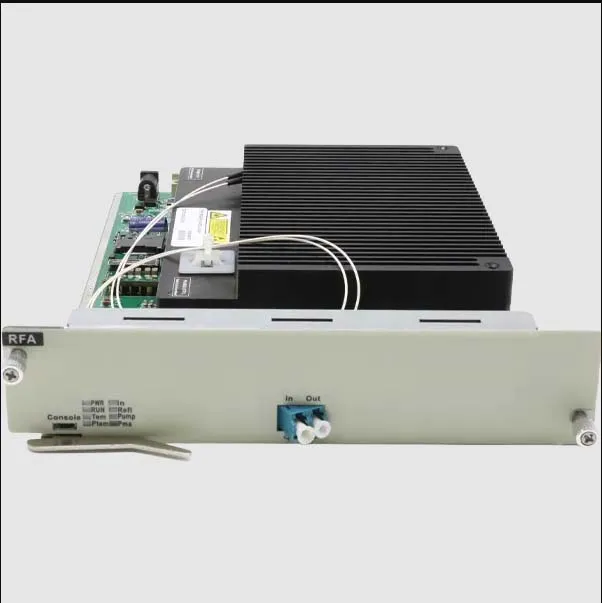
An RFA (Raman Fiber Amplifier) is a distributed amplifier that can be used at both the transmitting end (forward amplification) and the receiving end (backward amplification).
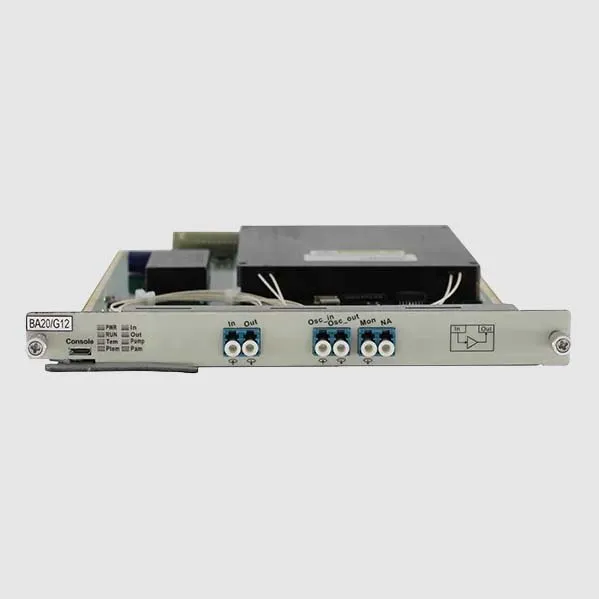
An EDFA (Erbium-Doped Fiber Amplifier) is a centralized amplifier that uses erbium-doped fiber (EDF) as the gain medium.
Advantages of Raman Amplifiers:
- Ultra-wideband Fiber Amplifier: Because the gain wavelength of a Raman amplifier is determined by the wavelength of its pump light, it can theoretically amplify signals of any wavelength as long as the pump source wavelength is appropriate.
- Low Noise Figure: Using a Raman amplifier in conjunction with an EDFA can effectively reduce the overall system noise and improve the system signal-to-noise ratio, thereby extending both the unrelayed transmission distance and the total transmission distance.
- Wide Application: The gain medium of a Raman amplifier is the transmission fiber itself. Because amplification occurs distributed along the fiber rather than concentrated, the signal power at each location in the fiber is relatively low. This reduces nonlinear effects, especially interference from four-wave mixing (FWM). This enables long-distance, repeater-free transmission and remote pumping, making it particularly suitable for locations like the ocean floor and deserts where relay stations are inconvenient.
Raman amplifier disadvantages:
- Low gain: The gain of a typical RFA is less than 15dB, requiring its use in conjunction with an EDFA.
- High pump power, requiring safety considerations during delivery.
- Requires high fiber quality, making delivery difficult.