
VOA plays a critical role in optical communication systems where higher optical power does not always mean better performance. Instead, stable and well-controlled optical power is essential. Therefore, VOA functions as a precise regulator that ensures reliable and balanced system operation across complex fiber networks .
In modern optical infrastructures, VOA is widely used to manage signal strength, protect sensitive components, and maintain long-term network stability.
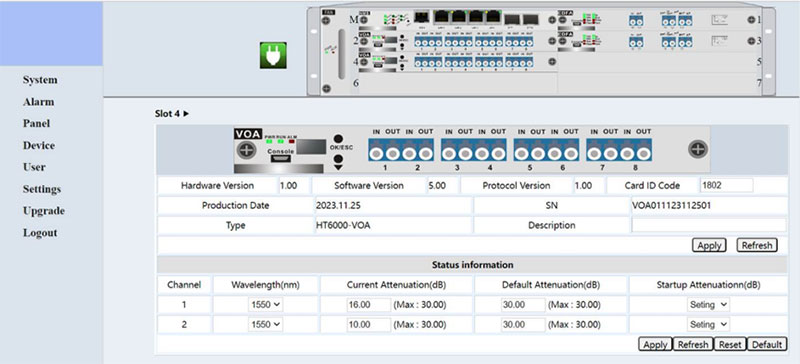
Why VOA Is Necessary in Fiber Optic Systems
Balancing Channel Power in WDM Networks
In wavelength division multiplexing systems, optical signals at different wavelengths often experience unequal gain after fiber transmission and amplification. VOA, however, can independently fine-tune each wavelength channel. As a result, all channels maintain consistent optical power, preventing stronger signals from dominating weaker ones .
Preventing Receiver Overload
Excessive optical power can overload or permanently damage photodetectors. Therefore, VOA ensures that the optical power entering the receiver remains within a safe and optimal range. In this way, system reliability and component lifespan are significantly improved.
Simulating Fiber Link Loss in Testing
In laboratory and production environments, It is commonly used to simulate the attenuation caused by long-distance fiber links. Consequently, engineers can accurately test system performance without deploying actual long fiber spans.
Enabling Automatic Optical Gain Control
In dynamic optical networks, VOA works together with monitoring and control circuits. As network conditions change, It automatically stabilizes optical power. Thus, consistent signal quality is maintained even under fluctuating traffic loads.
Understanding VOA Through a Simple Analogy
Imagine an optical fiber as a highway filled with optical trucks of different colors, each color representing a wavelength. Over long distances, some trucks move faster and carry stronger signals, while others slow down and weaken.
VOA acts like a smart speed limiter at key intersections. It slows down overly strong optical signals and aligns them with weaker ones. As a result, all signals arrive at the destination in a balanced and orderly manner, ensuring stable and accurate reception .
In essence, VOA functions as the “traffic police” of fiber networks, preventing signal chaos and system failure.
Key Performance Indicators of VOA
To evaluate a VOA, several technical parameters must be considered:
- Attenuation Range
The adjustable attenuation span, typically from 0 dB to a specified maximum value. - Insertion Loss
The inherent loss introduced by the device at 0 dB attenuation. Lower values indicate higher efficiency. - Response Speed
The time required for VOA to adjust from one attenuation level to another. - Wavelength-Dependent Loss (WDL)
The consistency of attenuation across different wavelengths. - Polarization-Dependent Loss (PDL)
The stability of attenuation across various polarization states.
These indicators directly affect system accuracy, stability, and scalability.
Typical Application Scenarios of VOA
Because of its precision and flexibility, VOA is widely deployed in multiple optical environments, including:
- Long-haul backbone fiber networks
- Metropolitan area networks
- Data center interconnect systems
- Optical line terminals (OLT)
- Laboratory and production test equipment
In addition, any application requiring accurate optical power control can benefit from VOA integration .
Why VOA Is Indispensable
It is far more than a simple attenuator. Instead, it is a core control component that ensures optical networks operate safely, efficiently, and reliably. By balancing signal power, protecting receivers, enabling testing, and supporting automatic gain control, VOA has become indispensable in modern fiber-optic communication systems.
As optical networks continue to grow in speed and complexity, the importance of VOA will only increase.