
In today’s interconnected world, red and blue light amplifiers stand at the core of Wave Division Multiplexing (WDM) systems.
They enhance bandwidth, strengthen signal integrity, and make global communication faster and more reliable.
By expanding the usable optical spectrum, these amplifiers help industries move toward broader, smarter, and more sustainable networks.

1. The Heart of WDM: Amplifying Critical Wavelengths
WDM technology multiplies data capacity by transmitting multiple wavelengths through one optical fiber.
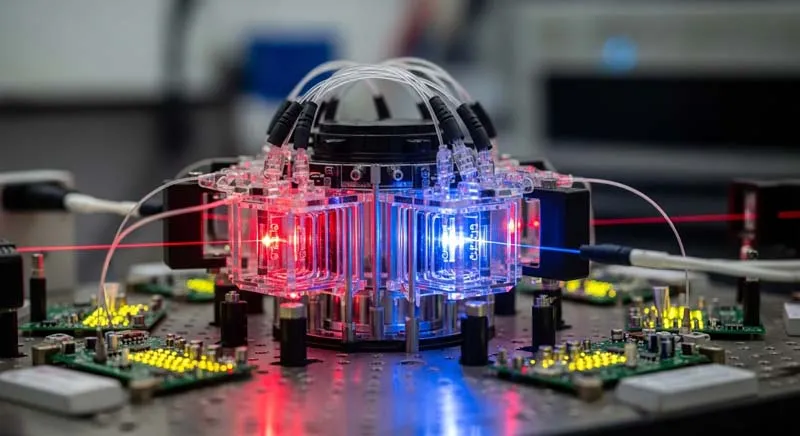
While traditional systems rely on the C-band and L-band, red and blue light amplifiers open new frontiers in visible-light communication and sensing.
- Blue Light Amplifiers (450–495 nm):
Because of their short wavelength and high energy, blue lasers excel in short-range links, precise data transmission, and RGB multiplexing.
They are ideal for medical imaging, industrial automation, and compact optical networks. - Red Light Amplifiers (622–780 nm):
Red wavelengths are essential in phototherapy and fiber sensing.
When integrated into WDM, they support multiplexed sensing systems and improve fiber-laser efficiency.
Together, red and blue light amplifiers extend spectral coverage, which is crucial for applications from telemedicine to immersive digital experiences.
2. Core Technologies: EDFA and RFA Evolution
Modern WDM systems rely on two main technologies to amplify red and blue light efficiently.
- Erbium-Doped Fiber Amplifiers (EDFA):
Traditionally designed for the C-band, advanced EDFAs now reach red-shifted wavelengths, improving biomedical and sensing performance. - Raman Fiber Amplifiers (RFA):
Using nonlinear scattering, RFAs offer flexible gain across customizable bands.
As a result, they enable hybrid systems that combine conventional C/L-band with visible-light channels.
These technologies overcome natural fiber attenuation, ensuring long-distance signal transmission without loss.
3. Transformative Industry Applications
Telecommunications – Blue light amplifiers enhance short-reach interconnects in data centers, while red light variants enable distributed fiber sensing for network monitoring.
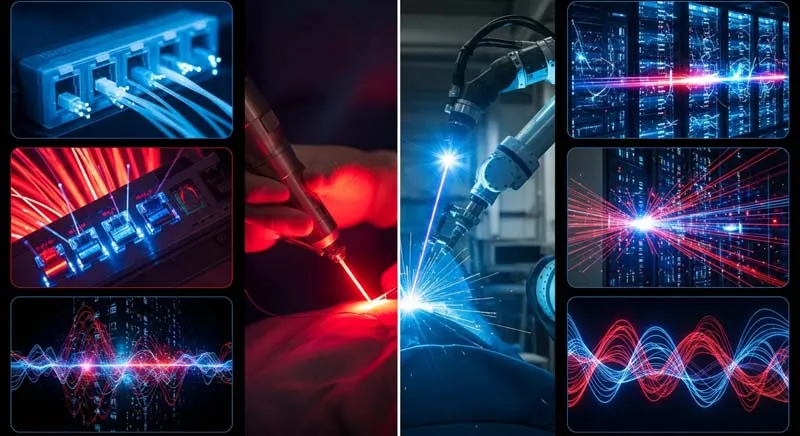
Healthcare – Red light amplifiers power LED-based therapy devices and diagnostic tools, whereas blue lasers enable surgical precision and imaging clarity.
Industrial Manufacturing – Blue lasers at 450 nm deliver high-energy cutting and welding.
Combined with red-light calibration sensors, WDM simplifies smart-factory processes.
Thus, red and blue light amplifiers are shaping the digital, medical, and industrial ecosystems simultaneously.
4. Advantages of Red and Blue Light Amplifiers in WDM
- Expanded Capacity:
Networks achieve higher channel density without new fiber installations. - Low Latency:
The short wavelength of blue light allows faster processing, ideal for real-time AI, AR, and autonomous systems. - Energy Efficiency:
Semiconductor technologies, such as GaN-based blue lasers, reduce power use while maintaining strong output. - System Flexibility:
Combining red and blue amplification covers visible and infrared regions, creating full-spectrum communication solutions.
These benefits make red and blue light amplifiers key components of next-generation optical infrastructure.

5. The Road Ahead: Integration and Innovation
As bandwidth demand continues to grow, amplifier research focuses on integration, miniaturization, and cost efficiency.
- Broadband Gain Modules:
New designs merge red, blue, C, and L bands to achieve complete optical utilization. - Miniaturization:
Compact, high-power modules enable portable and space-constrained deployments. - Material Innovation:
Gallium-nitride technology is reducing the cost of blue-light amplification and improving device stability.
Moving forward, red and blue light amplifiers will connect optical networks, data centers, and intelligent devices with unmatched precision and efficiency.
📞 Contact Information
Tel: +86 18126409950
Email: sales9@htfuture.com
Brand: HTF – Building the Future of Optical Networks