
The Rise of Optical Interconnection marks a decisive turning point in the evolution of AI infrastructure. As artificial intelligence enters an era defined by massive model training and large-scale deployment, computing demand is expanding beyond the physical and economic limits of single data centers.
As a result, the industry is undergoing a structural shift toward geographically distributed AI supercomputing architectures. At the center of this transformation, optical interconnection—particularly DWDM—has emerged as the foundational technology enabling AI to scale across domains.

AI Computing Is Redefining Infrastructure Boundaries
Over the past decade, AI computing architectures primarily relied on vertical scaling. In other words, organizations added more GPUs and increased server density within a single campus to meet performance needs. However, this approach is now reaching its limits.
Power availability, cooling efficiency, land constraints, and regulatory requirements increasingly restrict further expansion. Consequently, AI providers are distributing GPU clusters across multiple data centers and regions. For this reason, The Rise of Optical Interconnection has become inevitable rather than optional.
More importantly, distributed AI computing requires networks that behave as a unified system. High bandwidth alone is insufficient. Instead, AI workloads demand deterministic latency, stable synchronization, and long-term reliability across distance.
From Scale-Up to Scale-Across: A New AI Network Paradigm
Why Traditional Data Center Networks Fall Short
Traditional data center interconnect (DCI) architectures were not designed to support tightly coupled AI workloads across regions. Specifically, electrical interconnects face hard limits in distance, power consumption, and signal integrity.
Therefore, extending AI clusters across cities or regions requires a fundamentally different approach. This is precisely why The Rise of Optical Interconnection has gained strategic importance.
Understanding Scale-Across AI Computing
Scale-across architecture enables geographically separated AI clusters to function as a single logical supercomputer. Through this model, high-performance optical networks allow GPUs in different locations to collaborate on training and inference tasks in real time.
As a result, AI infrastructure is no longer constrained by physical campus boundaries. Instead, it expands horizontally through optical connectivity.

Why Optical Interconnection Is the Only Viable Path Forward
Electrical transmission technologies struggle to maintain performance over long distances. By contrast, optical interconnection offers several decisive advantages.
First, it enables extended reach across tens or even hundreds of kilometers.
Second, it delivers ultra-high bandwidth with scalable capacity.
Additionally, it provides lower power consumption per transmitted bit.
Finally, it ensures superior signal stability and integrity.
Because of these advantages, The Rise of Optical Interconnection represents a logical and unavoidable response to AI’s physical scaling challenges. Furthermore, optical networking allows infrastructure planners to decouple computing logic from geographic constraints, thereby reshaping how data centers are designed and interconnected.
DWDM as the Core Foundation of Cross-Domain AI Networks
The Strategic Role of DWDM
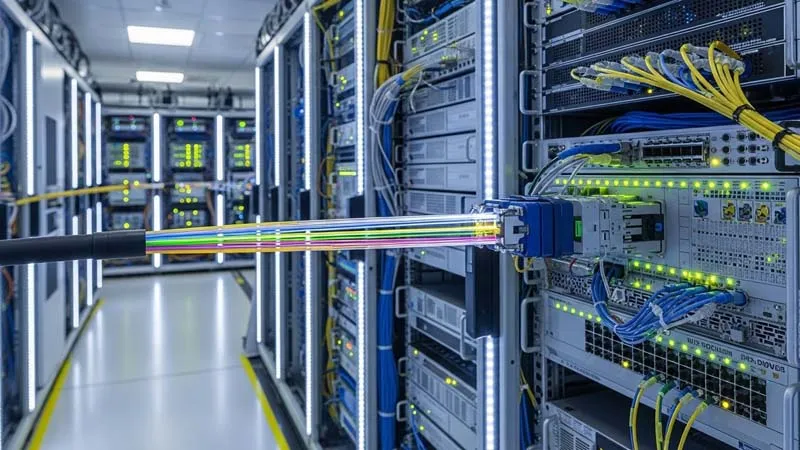
Dense Wavelength Division Multiplexing (DWDM) enables dozens or even hundreds of wavelengths to travel simultaneously over a single fiber. As a result, DWDM is uniquely suited for large-scale AI interconnection.
Rather than deploying multiple parallel fibers, operators can scale capacity efficiently while maintaining deterministic performance. Consequently, DWDM has become central to The Rise of Optical Interconnection.
From Telecom Backbone to AI Computing Fabric
Historically, DWDM served long-haul telecom and backbone networks. Today, however, its role has expanded significantly. AI workloads now require optical networks that behave more like computing fabrics than simple transport layers.
Accordingly, modern DWDM systems increasingly support flexible modulation, intelligent ROADM architectures, and dynamic bandwidth allocation tailored to AI traffic patterns.
New Technical Requirements Driven by AI Workloads
Beyond Bandwidth: Latency and Determinism
AI training workloads are highly sensitive to latency variation. Even small fluctuations, for example, can reduce training efficiency and synchronization accuracy. Therefore, optical networks must deliver predictable and stable performance.
This requirement further accelerates The Rise of Optical Interconnection, since optical layers provide superior control compared with electrical alternatives.
Optical Module Evolution
At the same time, AI-driven networks are pushing optical module speeds higher. While 400G remains widely deployed, 800G and emerging 1.6T technologies are becoming increasingly relevant.
Meanwhile, tighter integration between optical and electrical layers continues to improve. As a result, end-to-end AI networking efficiency increases.
Challenges in Cross-Domain Optical AI Interconnection
Despite its advantages, optical interconnection introduces new complexities. For instance, network planning across regions becomes more demanding. In addition, fault isolation requires closer coordination with AI schedulers. Moreover, operational teams must span both optical and computing domains.
Nevertheless, these challenges do not slow adoption. On the contrary, they reinforce the long-term importance of The Rise of Optical Interconnection. Industry-wide standardization and ecosystem collaboration are already addressing these issues.
Optical Networks Are Becoming AI Infrastructure
A profound industry shift is underway. Optical networks are no longer passive transport layers. Instead, they are becoming active components of AI computing infrastructure.
Because of this shift, data center location strategies, capacity planning, and investment decisions are changing. In this context, The Rise of Optical Interconnection reflects a deeper convergence between networking and computing.
As AI models continue to grow, optical connectivity will increasingly define how far and how efficiently AI systems can scale.
Industry Perspective: Supporting the Optical AI Era
Within this evolving landscape, experienced optical solution providers play a crucial role. HTF, a professional fiber optic product and WDM system solution provider, has built deep expertise in large-scale data transmission and optical networking.
Backed by a team with over ten years of experience in optical communication R&D, fiber solutions, and component manufacturing, HTF supports global data centers, 5G networks, cloud computing platforms, and metropolitan networks.
In particular, HTF’s HT6000 OTN transmission system demonstrates this capability. Designed as a compact, high-capacity, and cost-efficient platform, HT6000 supports both CWDM and DWDM architectures. Moreover, it offers flexible networking and transparent multi-service transmission, meeting node capacity demands exceeding 1.6T.
Such solutions align naturally with The Rise of Optical Interconnection, enabling scalable, reliable, and future-ready AI transport networks.

Looking Ahead: Optical Interconnection Defines AI’s Future
As AI continues to expand, infrastructure must evolve accordingly. In the future, cross-domain AI supercomputing will become standard rather than exceptional.
Under these conditions, The Rise of Optical Interconnection will define the practical boundaries of AI capability. DWDM-based optical networks will connect distributed resources into unified computing systems, thereby unlocking unprecedented scale and efficiency.
Ultimately, optical interconnection is no longer an accessory to AI. Instead, it is the foundation upon which next-generation intelligence will be built.