
The exponential growth of global data traffic, fueled by 5G, AI, and hyperscale cloud services, is pushing optical networks to their limits. In response, a quiet but transformative shift is underway in DWDM (Dense Wavelength Division Multiplexing) systems: the large-scale adoption of QSFP-DD (Quad Small Form-Factor Pluggable Double Density) optical modules.

Originally designed for 400G Ethernet in data centers, the QSFP-DD form factor has evolved into a critical enabler for high-density, cost-effective DWDM deployments. Its ability to combine high bandwidth, coherent technology, and pluggability is revolutionizing how network operators scale capacity while simplifying infrastructure.
Why QSFP-DD Modules Are Gaining Traction in DWDM
The QSFP-DD’s rise in DWDM applications can be attributed to several key advantages:
High Density and Scalability: With an 8-lane electrical interface, QSFP-DD modules support data rates up to 400G and beyond (including 800G), allowing operators to maximize fiber capacity without increasing physical space .
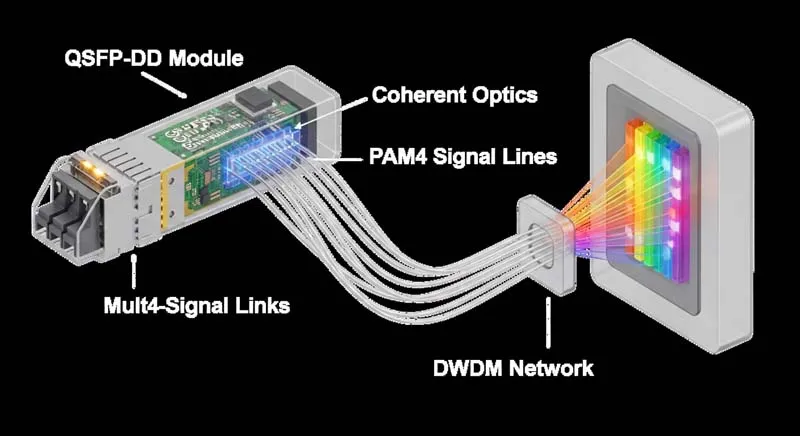
Coherent Technology Integration: Modern QSFP-DD modules incorporate coherent optics and advanced DSPs, enabling long-haul transmission over DWDM systems. For example, 400G-ZR/+ and 800G-ZR variants can transmit up to 120 km without external amplifiers, making them ideal for Data Center Interconnects (DCI) and metro networks .
Backward Compatibility: Unlike OSFP, the QSFP-DD form factor is backward-compatible with existing QSFP28/QSFP56 infrastructure, simplifying upgrades and reducing costs .
Power and Thermal Efficiency: Despite supporting higher speeds, QSFP-DD modules consume 10W–15W, with optimized thermal designs ensuring reliability in dense configurations .
Key Drivers for DWDM Adoption
Hyperscale Data Center Demand: Cloud providers like Microsoft Azure and AWS are deploying QSFP-DD coherent modules for DCI, leveraging their plug-and-play simplicity to replace traditional transponders .
5G and Metro Network Expansion: Telecom operators use QSFP-DD-based DWDM links to aggregate traffic from cell sites and metro cores, achieving multi-terabit capacity with reduced latency .
Cost Efficiency: By integrating transceiver functions directly into routers (IP-over-DWDM), QSFP-DD modules eliminate the need for separate wavelength management hardware, cutting capital and operational expenses .
Technical Innovations Enabling DWDM Deployment
Coherent Optics: QSFP-DD coherent modules leverage DP-16QAM modulation and silicon photonics to transmit 400G/800G over a single wavelength, optimizing spectral efficiency in C-band DWDM systems .
PAM4 Modulation and DSP: High-order PAM4 signaling and advanced DSP chips enable robust error correction, compensating for fiber impairments in long-haul DWDM links .
Standardization: Compliance with MSA, OIF 400ZR, and OpenZR+ standards ensures interoperability across multi-vendor environments .
Real-World Applications and Milestones
Data Center Interconnects (DCI): Hyperscale operators report 30% cost savings by replacing CFP2 coherent modules with QSFP-DD-400G-ZR for distances up to 120 km .
Telecom Metro Networks: Deutsche Telekom and China Mobile have tested QSFP-DD-800G modules for metro DWDM, achieving 800Gbps per wavelength over 500 km with ROADM-based flexibility .
Subsea and Long-Haul Trials: In a landmark demonstration, QSFP-DD coherent optics enabled 400G transmission over 4,600 km on the Indigo subsea cable, signaling potential for undersea DWDM .

Overcoming Deployment Challenges
While QSFP-DD modules offer compelling benefits, their integration into DWDM systems requires addressing:
Thermal Management: High power density (up to 15W) demands efficient cooling solutions, especially in densely packed router line cards .
Fiber Compatibility: Legacy fiber may require upgrades to support coherent 400G/800G signals over long distances .
Interoperability Testing: Rigorous validation is essential to ensure seamless operation with existing DWDM infrastructure .
The Future: From 800G to 1.6T and Beyond
The QSFP-DD ecosystem is already evolving toward 800G and 1.6T speeds. With emerging technologies like co-packaged optics and LPO (Linear Pluggable Optics), future QSFP-DD variants will further reduce power consumption while doubling capacity. As DWDM networks evolve, the form factor’s flexibility and density will solidify its role as the cornerstone of next-generation optical transport.

The widespread adoption of QSFP-DD modules in DWDM marks a pivotal shift toward more integrated, efficient, and scalable optical networks. By combining high performance, pluggability, and coherent technology, these transceivers empower enterprises and service providers to meet the demands of the Terabit era—without compromising on cost or complexity.
To explore how QSFP-DD DWDM solutions can transform your network, contact our experts for a customized consultation.
TEl: +86 18126409950 Email: sales9@htfuture.com