
Single-Chip DWDM Optical Engine is quickly becoming a defining technology in the race for faster AI infrastructure. Large model training, inference clusters, and high-performance computing now push network links as hard as compute chips. As GPU density rises, traffic between GPUs, switches, and memory-rich nodes grows at an even faster pace. Therefore, interconnect efficiency now shapes overall system value. Bandwidth, latency, power, and thermal limits no longer sit at the edge of the design. They sit at the center.

Traditional optical interconnects helped data centers scale for years. However, AI clusters expose the weakness of discrete architectures. Many separate optical parts increase loss, packaging complexity, and thermal pressure. They also make large-scale deployment harder to optimize. In contrast, the Single-Chip DWDM Optical Engine compresses critical optical functions into a tighter and more coordinated platform. That shift matters because AI infrastructure now rewards integration, consistency, and manufacturability as much as raw performance.
Why AI Infrastructure Needs a New Optical Architecture
AI systems consume data at astonishing speed. Training clusters constantly exchange model states, gradients, and feature maps across thousands of accelerators. As a result, the interconnect layer often decides whether expensive compute resources stay busy or sit idle. Faster chips alone cannot solve that problem. If data moves slowly, system efficiency drops quickly.
Moreover, electrical links struggle as reach, density, and bandwidth demands climb. Signal loss, heat, and power draw become serious design constraints. Optical links solve many of these issues, yet older optical module structures still rely on multiple separate components. That design adds packaging burden and increases tuning complexity. The Single-Chip DWDM Optical Engine addresses these issues with a more compact, more unified approach. It turns optical interconnect from a component chain into a coordinated optical platform.
What Makes a Single-Chip DWDM Optical Engine Different
At its core, the Single-Chip DWDM Optical Engine integrates key optical and optoelectronic functions into one tightly engineered unit. These functions include 8 or 16 wavelength DWDM arrays, lasers, and photodetectors. Instead of spreading transmission and reception tasks across many discrete elements, the design brings them together. Consequently, the signal path becomes shorter and the system becomes more controllable.
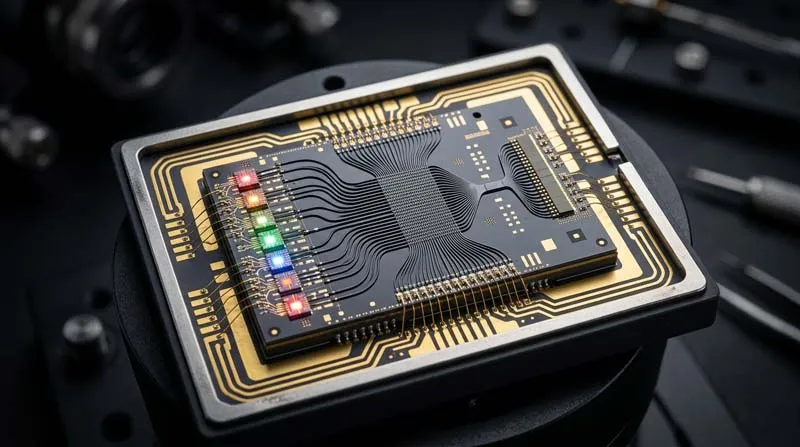
This difference is not just about miniaturization. It is about system-level integration. Designers can optimize optical coupling, electrical routing, thermal behavior, and performance consistency in a unified way. In addition, fewer external interfaces often mean lower insertion loss and fewer alignment steps during packaging. That matters in real manufacturing environments. A strong architecture must scale from prototype to production, and the Single-Chip DWDM Optical Engine moves much closer to that goal.
Multi-Wavelength Integration Raises Bandwidth Density
Bandwidth density now defines competitiveness in modern AI networks. Space inside switches, accelerator trays, and dense server platforms remains limited. Therefore, operators need more throughput from every optical interface. Multi-wavelength transmission offers a direct path forward. By integrating 8 or 16 DWDM wavelengths on one chip, the Single-Chip DWDM Optical Engine supports high parallel capacity in a very small footprint.
This gain is important at several levels. It benefits board-to-board links, rack-to-rack connections, and high-speed GPU cluster fabrics. Furthermore, it helps architects expand aggregate throughput without multiplying connector count and front-panel complexity. In practical terms, more wavelengths per chip can translate into more useful bandwidth per unit area and per unit power. That is why the Single-Chip DWDM Optical Engine does not simply improve an optical module. It changes the bandwidth economics of AI interconnect design.
Why 100/200GHz Channel Spacing Matters
Channel spacing plays a central role in DWDM performance and manufacturability. A tighter spacing can improve spectral efficiency, but it also raises demands on stability, thermal control, and channel isolation. Therefore, a design that supports 100/200GHz spacing shows a balance between high capacity and practical deployment. This balance is essential in production-grade systems.
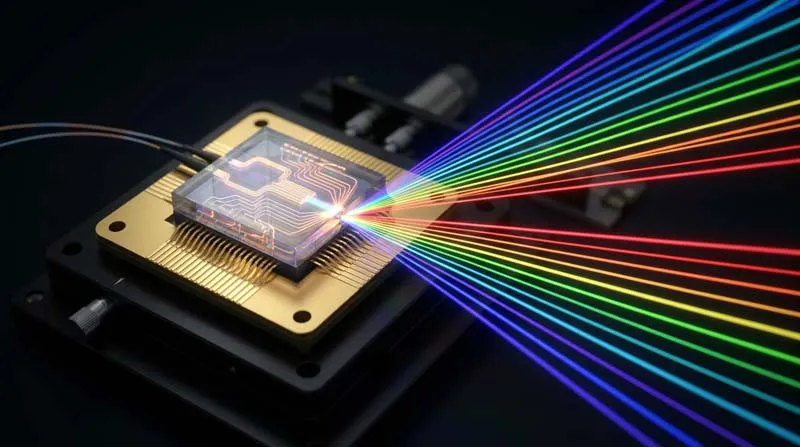
For example, 100GHz spacing can serve applications that need higher wavelength density and stronger capacity scaling. Meanwhile, 200GHz spacing offers wider margins for tolerance, packaging control, and thermal drift management. That flexibility helps vendors align product design with real deployment conditions. The Single-Chip DWDM Optical Engine gains value here because it supports both system ambition and engineering discipline. Markets do not reward laboratory records alone. They reward stable, repeatable, high-yield products that operators can deploy at scale.
Integrated Lasers and Detectors Improve System Efficiency
Lasers and photodetectors are not minor supporting elements. They sit at the heart of optical transmission and reception. When a design integrates them more closely with the wavelength engine, it reduces the need for extra optical interfaces and repeated alignment steps. As a result, designers can cut loss, simplify packaging, and improve overall consistency.
Moreover, integrated architecture helps create a cleaner path for co-optimization. Thermal design, power delivery, optical path control, and signal integrity can evolve together rather than in isolation. That gives system builders more confidence in large-volume deployment. The Single-Chip DWDM Optical Engine stands out here because integration directly supports efficiency at both device and system levels. In AI data centers, small efficiency gains scale into major savings. Lower power per transmitted bit and better consistency can shape total cost of ownership across the full network lifecycle.
From Telecom Transport to AI Cluster Fabric
DWDM once belonged mainly to long-haul, metro, and core transport networks. Its historical strength came from carrying large volumes of traffic across long distances. However, the rise of AI has expanded its relevance. Today, data centers need many of the same advantages that made DWDM powerful in transport networks: high capacity, efficient fiber use, and scalable architecture. The difference lies in distance, density, and integration priority.
Therefore, DWDM is now moving closer to the compute layer. The Single-Chip DWDM Optical Engine captures this transition with unusual clarity. It brings DWDM value into shorter-reach, high-density, high-speed environments where power and footprint matter as much as throughput. This shift also changes how the market views optical innovation. The focus no longer stays on transmission reach alone. It now includes cluster efficiency, GPU utilization, and the architecture of next-generation AI fabrics.

Why Mass Production Changes the Industry Conversation
A promising lab result can attract attention, but volume manufacturing changes the market. Once a Single-Chip DWDM Optical Engine reaches mass production, the conversation moves from possibility to deployment. That step signals progress in process control, packaging maturity, performance consistency, and cost management. In other words, it shows that the technology can support real infrastructure growth.
Furthermore, mass production improves supply predictability and speeds ecosystem adoption. System vendors, cloud operators, and optical solution providers all need reliable component roadmaps. They need products that support repeatable integration across many platforms. Because of that, the industrial significance of a Single-Chip DWDM Optical Engine extends well beyond the chip itself. It points to a broader shift in optical interconnect strategy, where dense integration and manufacturable design become central requirements rather than premium options.
A Broader Path Toward Optical-Native AI Infrastructure
Looking ahead, the Single-Chip DWDM Optical Engine may become a foundation for deeper optical integration across data center systems. It fits naturally with trends such as silicon photonics, advanced packaging, co-packaged optics, and high-density accelerator interconnects. Therefore, its strategic value reaches beyond one product cycle. It points toward a future in which optical connectivity moves closer to compute resources and supports much larger AI clusters with better efficiency.
At the system level, this direction could reshape network topology, rack design, and bandwidth allocation strategy. Meanwhile, it may reduce the gap between communication capacity and compute growth. That is crucial because modern AI infrastructure depends on both. Performance comes from powerful chips, but sustained value comes from balanced systems. The Single-Chip DWDM Optical Engine represents that balance. It joins capacity, integration, and manufacturability in one highly relevant technology path.
Conclusion
The AI era demands a new class of optical interconnect. It must deliver higher bandwidth density, tighter integration, lower power, and stronger production readiness. The Single-Chip DWDM Optical Engine answers that demand with a clear technical logic. By integrating multi-wavelength DWDM arrays, lasers, and detectors on a compact platform, it improves how data moves inside modern compute infrastructure. More importantly, it helps remove a growing bottleneck between expanding compute power and limited interconnect efficiency.
Finally, real market impact depends on more than innovation alone. It also depends on solution depth and deployment experience. HTF, as a professional supplier of fiber-optic products and WDM system solutions, continues to support global data centers, 5G networks, cloud platforms, metro networks, and access networks with practical transmission solutions. Its HT6000 compact OTN platform, built on a CWDM/DWDM universal design, offers flexible networking, transparent multi-service transport, and cost-effective expansion for IDC and ISP operators. In that wider industry context, advanced platforms and the Single-Chip DWDM Optical Engine together point toward a faster, denser, and more scalable optical future.