
Ultra-long-distance, repeaterless fiber transmission has become a practical need in modern power communication networks. In many regions, lines cross mountains, deserts, forests, and lakes, so building powered relay sites is expensive and difficult. Therefore, operators increasingly prefer architectures that extend reach without intermediate power. As a result, ultra-long single-span transmission improves reliability, lowers construction cost, and reduces ongoing maintenance workload.
In this context, ROPA (Remote Optical Pumping Amplifier) stands out as a proven solution. It extends the optical budget by placing a passive gain unit in the field, while keeping the pump lasers inside terminal equipment rooms. Moreover, it fits harsh corridors where power is inconvenient or unavailable.
Why Ultra-Long Single Spans Matter in UHV Networks
Ultra-high voltage (UHV) projects push transmission distances to new levels, and communication links must keep pace. For example, several UHVDC projects span over 1,000 km end to end, while single communication spans are still constrained by optical loss and OSNR. Consequently, improving single-span reach is a direct way to simplify network topology and cut relay complexity.
Since 2010, repeaterless transmission has advanced quickly. In 2016, one UHV section achieved 377 km transmission of 2.5G services without remote pumps, which was a milestone for single-span engineering at the time. Shortly after, remote pumping schemes appeared in operational projects, pushing span capability even further.
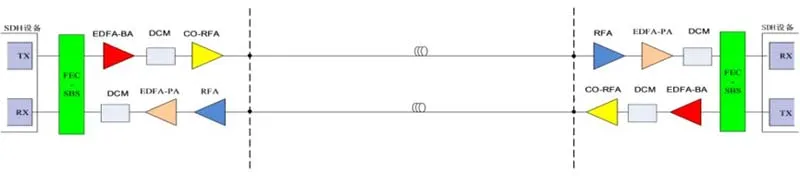
What ROPA Is and How It Works
A ROPA system has two main parts:
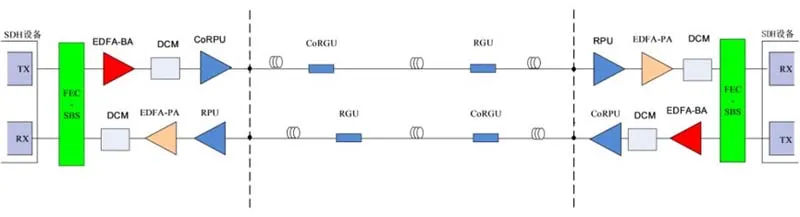
- Remote Pump Unit (RPU): placed in the terminal equipment room, generating high-power pump light.
- Remote Gain Unit (RGU): placed in the field (often on a transmission tower), using erbium-doped fiber (EDF) as the gain medium.
The pump light travels through the transmission fiber to the EDF segment. Then, the erbium ions get excited and amplify the signal light inside the EDF. Therefore, the system behaves like a passive optical repeater, because the gain unit has no local electrical power.
Key engineering idea
Without ROPA, the preamplifier “effective position” stays closer to the terminal. With remote pumping, that position extends outward, so the system tolerates more span loss before the receiver limit is reached. As a result, operators can push longer single-span distances.
Proven Benefits of ROPA in Long-Haul Deployment
1) Extends reach with strong power-budget gains
In practical engineering discussions, backward remote pumping can improve span loss tolerance by about 10 dB compared with some bidirectional Raman approaches. Consequently, this budget gain can translate into meaningful distance extension on ultra-low-loss fiber.
2) Enables “no-power” field amplification
Because the RGU is passive in terms of electrical supply, ROPA supports corridors where powering a mid-span site is unrealistic. Moreover, it reduces the number of physical stations that need security, maintenance, and backup power.
3) Supports higher-rate services on long spans
Remote pumping moved from earlier 2.5G service cases to 10G system applications in later UHV deployments. For instance, a bidirectional remote pumping scheme was applied on a ~398.9 km span for 10G SDH services, showing that the technique can scale with system evolution.
4) Works best when combined with Raman amplification
ROPA does not need to replace distributed Raman. Instead, it can complement it. Additionally, combining different ROPA forms with Raman amplification can maximize transmission distance and improve the overall power budget, especially in repeaterless designs.
Real-World Deployment Snapshots in UHV Projects
Field adoption accelerated after 2016:
- A backward remote pumping scheme supported a 397 km single-span section carrying 2.5G SDH services.
- Later, bidirectional remote pumping was used in a ~398.9 km section for 10G SDH, which was an early 10G remote pumping application.
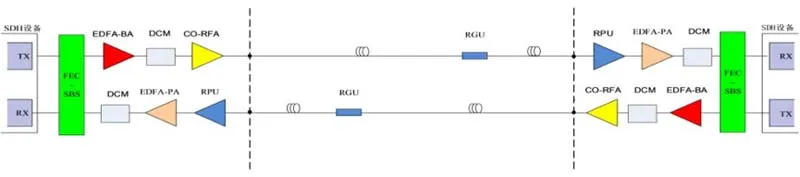
These examples show a clear pattern. As project spans grew, engineers turned to ROPA-style remote pumping to unlock additional margin. Therefore, single-span communication links can better match the physical scale of UHV transmission corridors.
Practical Considerations and Common Challenges
Although ROPA is powerful, it requires careful field execution.
Splicing and on-tower installation
The RGU typically sits in series on the line and often shares a junction box with the splice tray. Therefore, technicians must splice fiber in the field and then place the enclosure on a tower. As a result, deployment demands skilled staff and strong on-site supervision.
OTDR visibility and fiber testing
Many operators test fiber quality regularly, often at least annually. However, because the RGU sits in series, standard OTDR probe light may not pass through it. Consequently, a remote pumping section can become “invisible” to routine OTDR checks. That said, some equipment designs allow OTDR test light to pass through the RGU, which improves maintainability.
Where ROPA Fits Best
You get the most value from ROPA when these conditions apply:
- Ultra-long single spans with high loss risk
- Harsh terrain where mid-span power is difficult
- High reliability goals with fewer field sites
- Need for more margin beyond Raman-only reach
Moreover, as UHV grids continue to expand across provinces, the demand for extreme single-span communication grows as well. In response, ROPA remains a practical tool for extending reach without building powered repeater huts.
Implementation Tips for a Cleaner Engineering Outcome
- Plan the RGU position carefully. Placement determines how effectively the pump power turns into usable gain.
- Standardize field procedures. Clear splicing, sealing, and tower-mount rules reduce failure risk.
- Design for testing. If OTDR pass-through matters, select solutions that support it.
- Balance Raman and ROPA. Start with Raman for distributed help, and then add ROPA where margin is still tight.
- Document the power budget. A clean budget model prevents surprises during commissioning.
ROPA is a proven approach for ultra-long, repeaterless optical transmission, especially in power communication networks that cross challenging geography. It extends span capability, reduces reliance on powered field sites, and pairs well with Raman amplification. However, it also demands disciplined installation and thoughtful maintenance planning. Ultimately, when engineered well, ROPA helps networks unlock long-haul potential with fewer constraints and stronger reliability.