
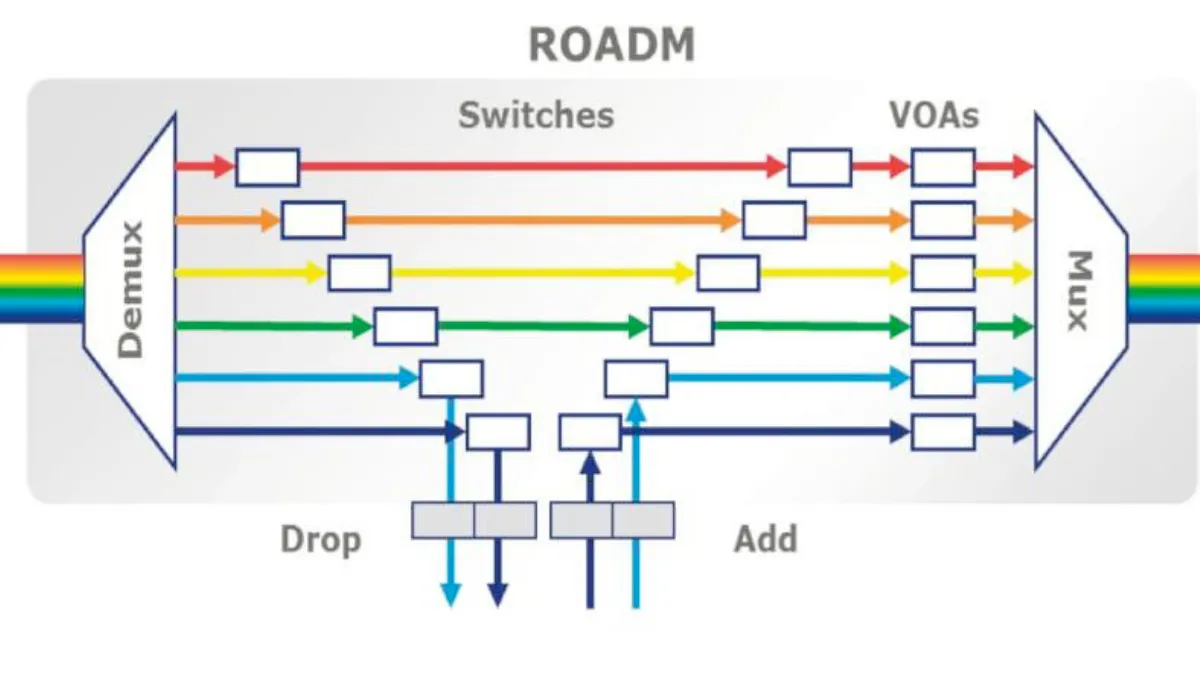
ROADM stands for Reconfigurable Optical Add-Drop Multiplexer. It is a device which which is used to change the traffic path in the wavelength level. Now ROADM can remotely add, block, pass or redirect the light wave without converting into electrical signals. This all happens in the wavelength of the optical fiber.
Now a days, WDM also known as Wavelength Division Multiplexing is used to carry the traffic through the optical fiber. WDM is the technology which transmits the data into the optical fiber in the form of the light, but being in wavelength domain. It means, data we sent are converted into the fixed wavelength before transmitting via the fiber optics.
In early days before the development of the ROADM, if we want the optical links then at first, the optical (light) wave is converted into electrical signals, then the required bandwidth is taken and again the remaining bandwidth is transmitted to the optical fiber by converting to the light wave. This optical-electrical-optical mechanism using add drop multiplexers have been tedious and costly.
Now, using this technology, users can extract one frequency of light from a stream. This made ROADM technology a better solution for long haul WDM network where bandwidth is always increasing.
Analogy of ROADM concept
In highway road, there is speed of vehicle. Along the highway, there are joint of road where smaller road joined the highway for the services. Smaller roads allows the traffic to be directed where necessary i.e they allows the vehicles to be joined in the highway or the vehicles can be out of the highway. But without disturbing the other vehicles running through the highway. Thus it helps to service the vehicles.
In telecom network also, ROADM works like this. The main highway is the WDM link or the main link from where traffic flows. Like smaller joint roads, ROADM also allows the traffic to be diverted in or out of the main fiber. But it will not disturb the main traffic. Here, the traffic is added or removed without converting into electrical signals. It all happens in the wavelength level.
ROADM consist of 3 device:
- Wavelength selective switch (WSS): an active component that performs the actual wavelength switching. The WSS enables the user to dynamically route any wavelength to and from any port and then seamlessly change connectivity as needed.
- Optical channel monitoring (OCM): monitors the optical power of each wavelength.
- Variable optic attenuators (VOAs): configures the attenuation of optical power in each wavelength
How ROADM Works?
A ROADM generally consists of two major functional elements: A wavelength splitter and a wavelength selective switch (WSS). Take a look at the block diagram below: An optical fiber pair at network interface No. 1 is connected with the ROADM module.

Fig: ROADM Architecture / Source: Tutorialspoint
The fiber carrying the incoming data (from the network) is fed to the wavelength splitter. Now, all the wavelengths are available at all output ports of the splitter, in this case 8. Local add/drop traffic (wavelengths) can be multiplexed/de-multiplexed with an Arrayed Wave guide Filter (AWG). Using an AWG implies a fixed wavelength allocation and direction.
The Wavelength Selective Switch (WSS) selectively joins the various wavelengths and feeds them to the output of network interface #1. The remaining splitter ports are connected with other network directions, for example, three other directions at a 4-degree junction node.
Key Features and Benefits of ROADMs:
Flexibility and Dynamic Routing:
ROADMs allow for dynamic reconfiguration of optical paths, enabling network operators to quickly adapt to changing traffic demands.
Remote Provisioning:
Network operators can remotely add, drop, or reroute wavelengths without physically changing the network.
Increased Network Efficiency:
By allowing for flexible wavelength routing, ROADMs contribute to increased network efficiency and capacity.
Scalability:
ROADMs enable the creation of scalable optical networks that can easily accommodate growth in traffic and bandwidth demands.
Cost-Effectiveness:
ROADMs can help reduce operational expenses (OPEX) by allowing for more efficient network management and resource utilization.
How ROADMs Work:
Wavelength Division Multiplexing (WDM):
ROADMs work with WDM technology, which allows multiple optical wavelengths to be transmitted over a single fiber.
Wavelength Selective Switching (WSS):
ROADMs use WSS to selectively switch and reroute wavelengths of light, allowing for dynamic routing and add/drop operations.
Reconfigurable Nature:
ROADMs are reconfigurable, meaning that their settings and routing paths can be changed remotely and dynamically.
Applications of ROADMs:
Data Center Interconnects (DCIs):
ROADMs are used in DCIs to enable high-capacity and flexible optical connectivity between data centers.
Long-Haul Optical Networks:
ROADMs are used in long-haul optical networks to provide dynamic routing and add/drop capabilities across long distances.
Metropolitan Area Networks (MANs):
ROADMs are used in MANs to provide flexible optical connectivity within metropolitan areas.
Optical Access Networks:
ROADMs are used in optical access networks to provide dynamic routing and add/drop capabilities for access networks.
DWDM Project solution design and price quotation info:
WhatsApp link: 0086 18126400550