
Raman Amplifiers are a powerful way to boost optical signals inside the transmission fiber. Unlike discrete amplifiers that add gain at a node, this approach can spread gain along the span. As a result, systems can improve OSNR while maintaining flexible bandwidth. Moreover, the same physical principle can support multiple wavelength bands when you choose pump wavelengths wisely.
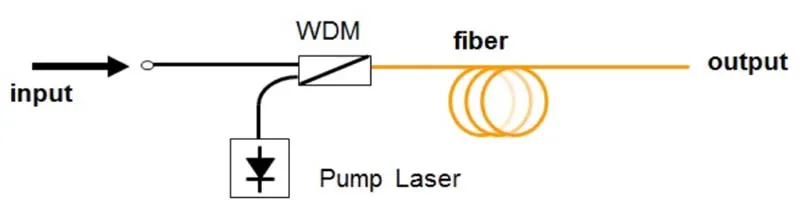
How Raman Amplifiers work
Raman Amplifiers rely on stimulated Raman scattering (SRS). In practice, you launch a strong pump and a weaker signal into the same fiber. Then, the pump interacts with the fiber and transfers energy to the signal at a longer wavelength.
Therefore, the fiber itself becomes the gain medium, which is why Raman gain is often described as “distributed.”
Pump–signal spacing and the gain window
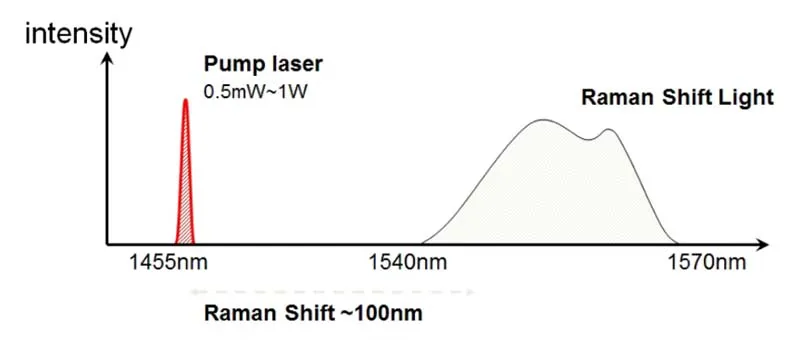
A common question is whether any incoming signal can be amplified. The key is the frequency offset between pump and signal. For a given pump frequency, the signal needs to sit near the peak Raman gain shift, which is about 13.2 THz. In many link diagrams, that corresponds to roughly ~100 nm of spectral offset.
However, you do not need a single exact wavelength. Instead, the signal only needs to lie within the Raman gain bandwidth around that peak.
Extending bandwidth with multiple pumps
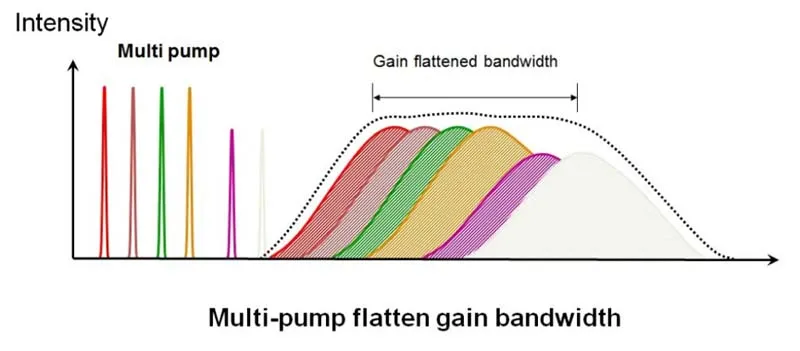
Because the gain window depends on pump wavelength, you can broaden coverage by using multiple pump wavelengths. Consequently, Raman Amplifiers can support very wide effective gain ranges when the pump plan is designed for the target channels.
In addition, multi-pump designs help flatten gain, which reduces per-channel power variation across the band.
Gain, fiber length, and why pump power is high
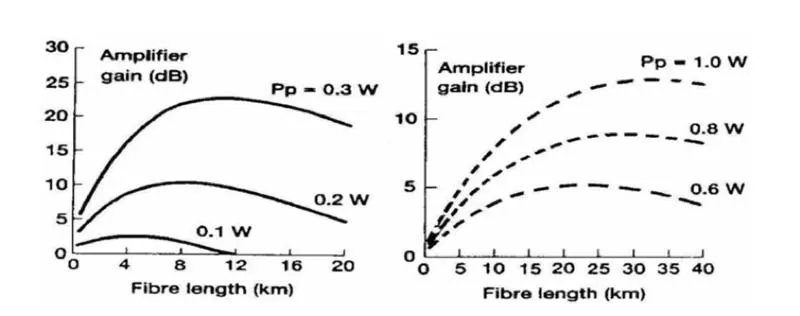
Raman gain does not behave like a simple linear knob. Instead, gain varies with fiber parameters, attenuation, and pump distribution along the span. When pump power is low, the gain can look strong at first, but it can drop quickly with distance. Therefore, practical Raman Amplifiers use high pump power to sustain useful gain along the span.
As a result, safety and handling procedures matter, especially during lab work and field maintenance.
Typical gain level and noise behavior
Raman Amplifiers often provide moderate gain, commonly up to around 15 dB in many practical designs.
However, the real advantage is noise. Because the amplification is distributed, Raman Amplifiers can produce low ASE (amplified spontaneous emission) compared with many high-gain discrete stages.
Therefore, they are frequently used to improve OSNR margins, especially on long spans, high-capacity links, or challenging fiber routes.
Raman + EDFA: a common pairing
In many transport systems, engineers pair Raman Amplifiers with EDFAs. The logic is straightforward: EDFAs can provide higher gain, while Raman can improve noise performance and reduce effective span loss. Therefore, the combination can deliver both reach and capacity benefits.
Moreover, this hybrid approach can help stabilize performance across changing span conditions, such as aging fiber or varying connector loss.
Practical design checklist
1) Start from the channel plan
First, list the channel band, spacing, and target per-channel launch power. Then, map where you need gain most: near the transmitter, evenly along the span, or closer to the receiver. Consequently, your pump strategy becomes much clearer.
2) Choose pumps to match the band
Next, select pump wavelengths so the Raman gain window overlaps the signal band. If you need broader coverage, add pumps to extend and flatten gain. In addition, validate that the combined profile meets tilt and ripple targets.
3) Balance gain versus safety and complexity
Higher pump power can deliver more distributed gain, but it also increases operational constraints. Therefore, you should balance performance with safety, monitoring, and failure-mode handling.
4) Decide how it integrates with EDFA stages
If the link already has EDFAs, you can use Raman to lower the effective noise figure and reduce EDFA stress. As a result, you may gain reach or improve margin without redesigning the entire chain.
Summary
Raman Amplifiers create gain through stimulated Raman scattering in the transmission fiber, using strong pumps to transfer energy to the signal.
They require a pump–signal offset near the Raman gain peak and can cover wide bandwidths using multiple pumps.
Although their gain is often moderate (around 15 dB), their low ASE makes them ideal for OSNR-sensitive links, and they commonly complement EDFAs in real networks.