
Raman Amplifiers have become essential in Dense Wavelength Division Multiplexing (DWDM) networks. They utilize stimulated Raman scattering (SRS)—a quantum optical process where high-energy pump photons transfer energy to weaker DWDM signal photons. Unlike conventional EDFAs, they amplify signals directly within the transmission fiber, offering broader bandwidth, lower noise, and greater flexibility.
1. Distributed Optical Signal Amplification
The first key function of Raman Amplifiers is distributed amplification. Unlike EDFAs, which amplify at discrete points, Raman systems boost signals continuously along the optical fiber.
A high-power pump laser (typically 1420–1480 nm) injects energy into the fiber, either in the same or opposite direction as the signal. Through SRS, pump photons transfer part of their energy to DWDM signals, amplifying them gradually.
Why it matters: This continuous process eliminates signal fading between amplifier nodes, reduces cumulative noise, and extends the unregenerated reach of DWDM links from about 800 km to 1500 km. Consequently, it is ideal for transoceanic or continental optical backbones where regeneration is costly.
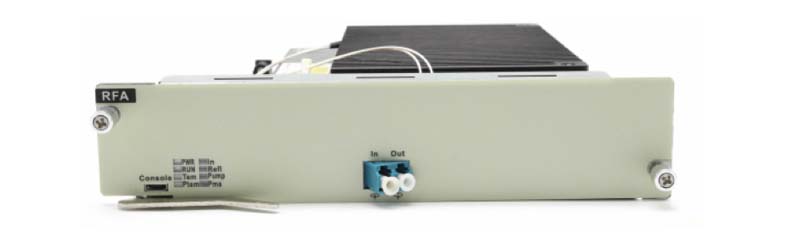
2. Ultra-Broadband Spectral Coverage
Another advantage of Raman Amplifiers lies in their ultra-wide spectral reach. While EDFAs are limited to C/L-bands, Raman systems can amplify across the entire near-infrared region (1200–1700 nm).
By simply tuning the pump wavelength—such as 1420 nm for S-band and 1480 nm for C-band—one Raman amplifier can handle multiple spectral bands simultaneously.
Why it matters: This flexibility enables S + C + L + U band DWDM operation, supporting more than 200 channels. As a result, network operators can double or even triple fiber utilization without additional hardware, simplifying infrastructure and reducing costs.
3. Low-Noise Signal Enhancement
Raman Amplifiers are also known for their low noise figure (NF). Because amplification occurs continuously, signal power stays more stable and lower in peak intensity compared to EDFAs.
Typical noise figures range from 3 dB – 5 dB, which helps maintain a strong signal-to-noise ratio for high-order modulation formats such as 64QAM (800 G) and 256QAM (1.6 Tbps).
Why it matters: Low-noise amplification ensures bit-error-rate (BER) ≤ 10⁻¹² over long distances, even for densely spaced channels (25 GHz grid). Therefore, Raman technology is crucial for high-speed, high-capacity DWDM systems.
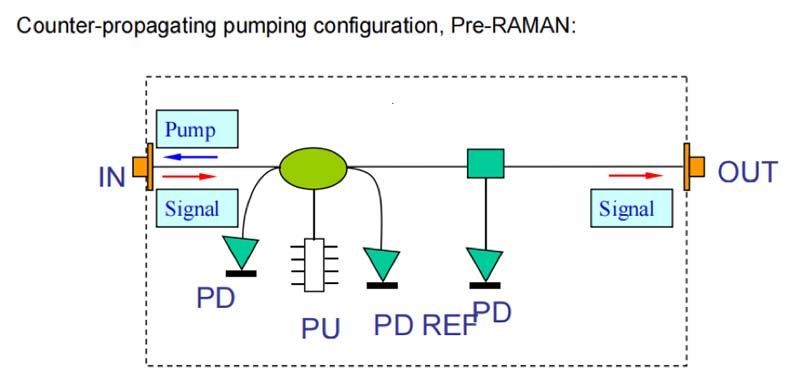
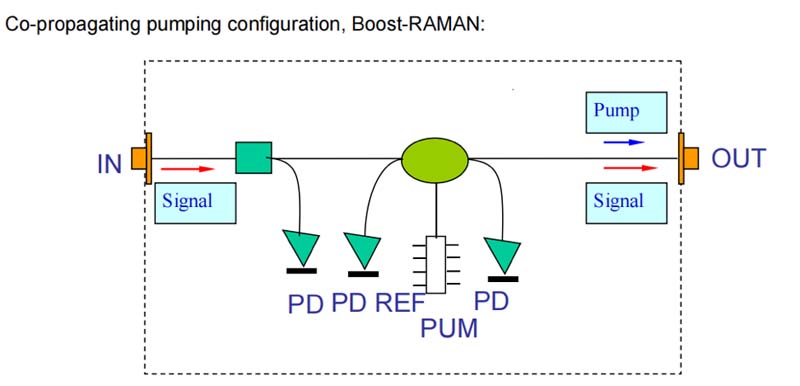
4. Nonlinear Distortion Mitigation
In addition, Raman Amplifiers significantly reduce nonlinear optical effects, such as self-phase modulation (SPM) and four-wave mixing (FWM). Because amplification is distributed, signal power remains low and uniform, avoiding the high peaks that trigger distortion.
Counter-pumping—sending pump light in the opposite direction of the signal—further balances power and minimizes nonlinearities.
Why it matters: This enables networks to pack more channels within a narrow frequency grid (e.g., 96+ channels at 25 GHz spacing) without interference, thus improving spectral efficiency in both metro and long-haul networks.
5. Support for Next-Generation DWDM Technologies
Lastly, Raman Amplifiers support advanced optical architectures such as Space-Division Multiplexing (SDM), pluggable transceivers, and flexible-grid DWDM.
They amplify signals in multi-core or few-mode fibers without requiring separate doped amplifiers. Moreover, miniaturized Raman pumps can be embedded into QSFP-DD or OSFP transceivers, enabling compact 400 G/800 G data-center interconnects.
Why it matters: This adaptability future-proofs DWDM systems, supporting scalable capacities beyond 2 Tbps and ensuring compatibility with evolving transmission technologies.
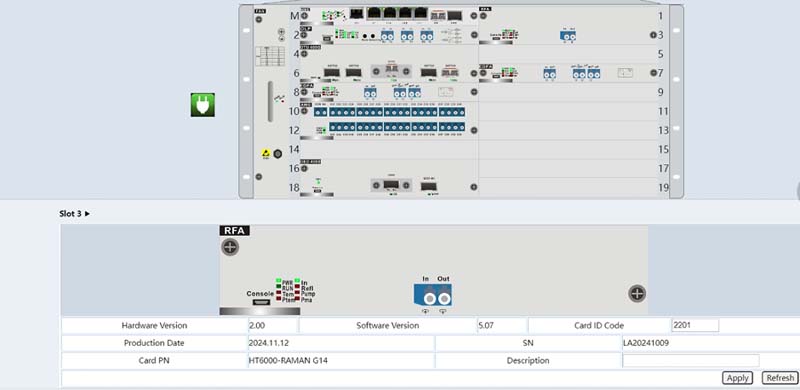
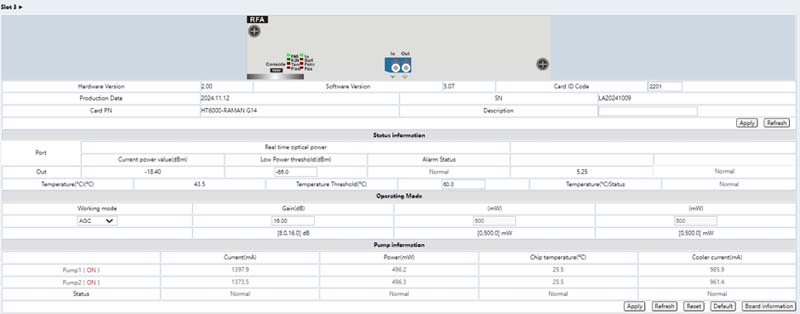
Comparison: Raman Amplifiers vs. EDFAs
| Function | Raman Amplifiers | EDFAs |
| Amplification type | Distributed along fiber | Discrete at nodes |
| Spectral range | 1200–1700 nm (S/C/L/U bands) | 1530–1625 nm (C/L bands only) |
| Noise figure | 3–5 dB (lower) | 4–6 dB (higher) |
| Nonlinearity mitigation | Strong (low, consistent power) | Limited (high peak power) |
| Next-gen DWDM support | SDM, pluggable modules, flexible grid | Limited to traditional systems |
In conclusion, Raman Amplifiers are far more than simple signal boosters. They extend reach, broaden bandwidth, lower noise, and mitigate nonlinearities—all while preparing networks for next-generation scalability. Therefore, they have become indispensable for modern DWDM infrastructures that demand both capacity and efficiency.
Here’s the optimized SEO metadata in English based on your requirements:
- Title (≤50 characters):
- Keywords:
, DWDM systems, optical amplification, low noise, broadband coverage, nonlinear reduction, SDM, EDFAs comparison - Description (≤140 characters):
Explore how