
Why 800G Optical Connectivity Has Become Essential
As artificial intelligence, cloud computing, and high-performance computing continue to scale rapidly, data center networks face unprecedented bandwidth pressure. Massive AI model training, real-time data synchronization, and distributed workloads all demand faster, more efficient optical interconnects.
OSFP 800G DR8 Transceiver solutions address these challenges directly. By combining ultra-high bandwidth, low power consumption, and outstanding scalability, this transceiver has become a foundational building block for next-generation AI-driven data center architectures.
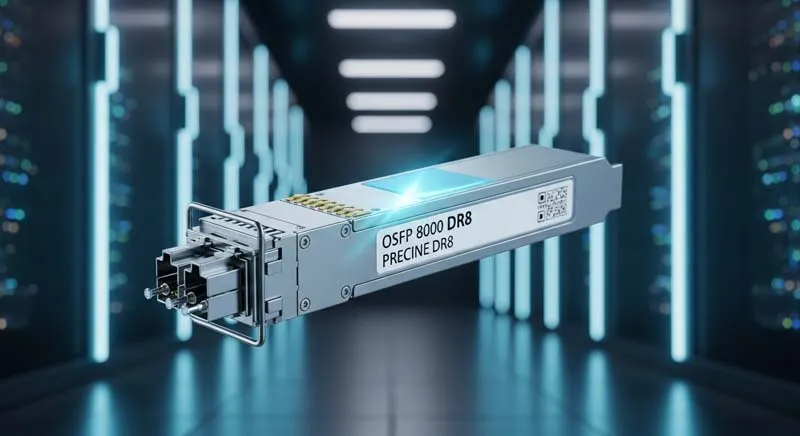
Architectural Innovation: 8×100G Parallel Design for Maximum Flexibility
At the heart of the OSFP 800G DR8 Transceiver lies an advanced 8×100G parallel optical architecture. Using mature PAM4 modulation, each channel operates at 106.25Gbps, delivering a total bandwidth of 800Gbps.
Moreover, this parallel design enables exceptional port flexibility. A single OSFP 800G DR8 interface can be split into two 400G DR4 links or eight 100G DR1 links. As a result, data center architects can easily adapt network designs to mixed-speed environments without replacing existing infrastructure.
Compared with QSFP-DD modules, the OSFP form factor provides a larger physical footprint. Therefore, it supports higher power density and superior thermal performance, which is critical for hyperscale AI clusters. In addition, compliance with OSFP MSA and CMIS 5.0 standards ensures seamless interoperability across modern switching platforms.
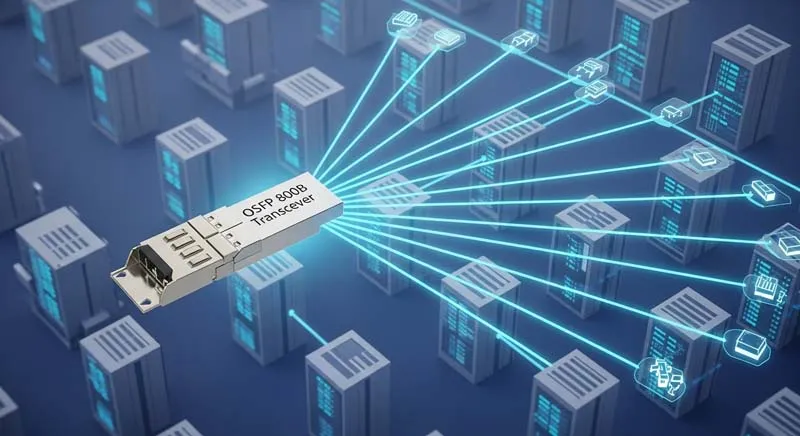
Energy Efficiency and Reliability: Lower Power, Lower TCO
Energy efficiency has become a decisive factor in large-scale data center operations. The OSFP 800G DR8 Transceiver adopts Linear-drive Pluggable Optics (LPO) technology, eliminating traditional DSP chips. Consequently, typical power consumption remains below 8W at room temperature.
This represents nearly a 50% reduction compared with conventional DSP-based solutions. Moreover, energy efficiency can reach approximately 0.2W per Gbps, significantly reducing cooling and electricity costs. Therefore, operators can achieve a lower total cost of ownership while supporting sustainable, low-carbon data center strategies.
From a reliability perspective, the module integrates high-performance EML lasers and PIN/TIA receiver arrays. It achieves an ultra-low bit error rate below 2.4×10⁻⁴ and complies with GR-468 reliability standards. In addition, reduced operating temperatures help lower failure rates, while hot-swappable capability ensures minimal service disruption.
Application Scenarios: 500m Reach for Modern Data Centers
With a transmission distance of up to 500 meters over single-mode fiber, the OSFP 800G DR8 Transceiver supports more than 90% of intra–data center connectivity requirements. These include intra-rack connections, inter-rack switching, and spine–leaf architectures.
In AI computing clusters, it enables low-latency RDMA communication between GPU nodes. As a result, distributed training workloads achieve faster synchronization and higher efficiency. Meanwhile, cloud data centers benefit from high port density and flexible bandwidth allocation, supporting large-scale virtual machine migration.
For enterprise core networks, the combination of high reliability and low power consumption makes this transceiver a dependable foundation for mission-critical services.
Future-Proof Design: From 800G Toward 1.6T and Beyond
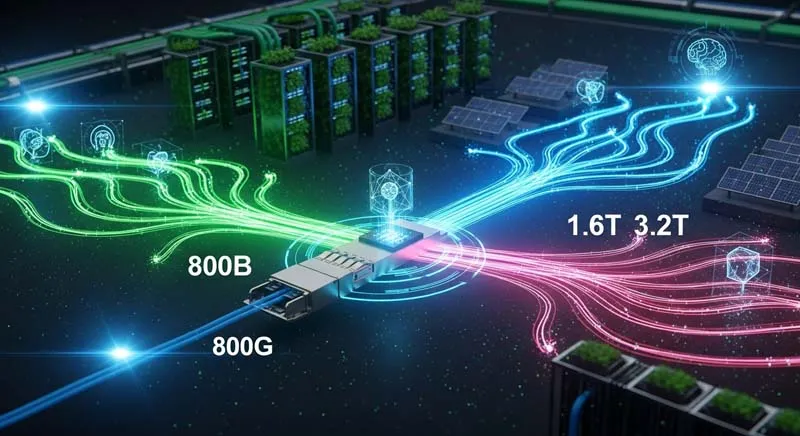
The OSFP 800G DR8 Transceiver is not only designed for today’s networks. Its scalable architecture positions it as a transitional platform toward future 1.6T and even 3.2T optical modules.
As silicon photonics and co-packaged optics technologies mature, the OSFP form factor will continue to demonstrate clear advantages in thermal management and power support. Therefore, investing in OSFP-based solutions today helps protect network upgrades well into the future.
Conclusion: A Core Backbone for Intelligent Networks
In the era of digital intelligence, data has become the most valuable production resource. The OSFP 800G DR8 Transceiver removes bandwidth bottlenecks, reduces operational costs through energy efficiency, and supports long-term scalability with flexible architecture.
As a result, it has become the preferred solution for 800G data center upgrades and a critical backbone for future intelligent networks. By enabling faster, more reliable, and more cost-effective data transmission, it empowers the next wave of AI-driven innovation.