
OSC (Optical Supervisory Channel) plays a vital role in modern optical communication systems. In large-scale WDM and DWDM networks, OSC provides an independent, reliable channel for monitoring, management, and control. Therefore, even when the main service traffic experiences disruption, network visibility and operational control remain intact .
Unlike service wavelengths that carry user data, OSC focuses on network supervision. As a result, it becomes a foundational element for stable, intelligent, and manageable optical transmission infrastructures.
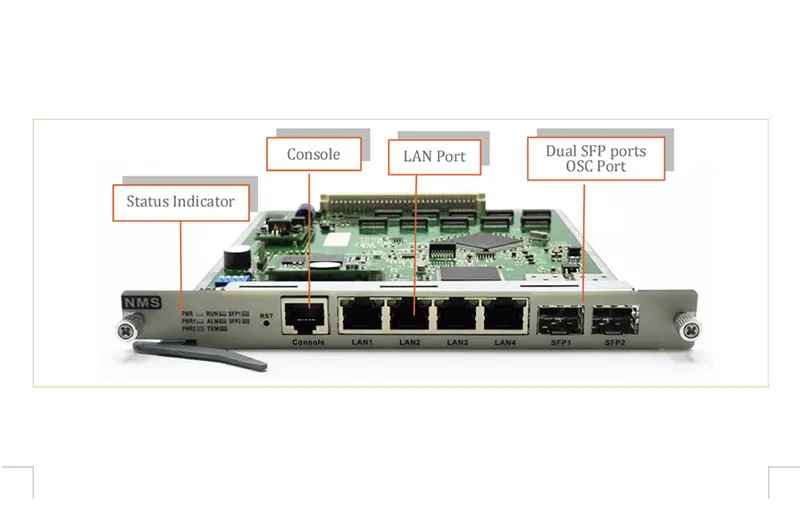
What Is OSC in Optical Communication?
OSC refers to a dedicated optical channel designed specifically for network management and supervision. It operates independently from service channels and carries management information using SDH or Ethernet formats.
Moreover, OSC enables continuous communication between network elements such as optical amplifiers, multiplexers, and ROADMs. Consequently, operators can issue commands, collect alarms, and analyze performance data in real time.
Core Functions of OSC
1. Management and Control Information Transmission
First, It establishes an out-of-band management path between optical network elements. This channel supports command delivery, alarm reporting, and equipment status feedback.
In addition, OSC provides a reliable link to the Network Management System (NMS). Therefore, even if service traffic is interrupted, operators can still access remote devices and locate faults efficiently.
2. Real-Time Performance Monitoring
Second, It continuously monitors key optical parameters. These include optical power levels, OSNR, laser temperature, and bias current.
As a result, performance degradation can be detected early. Moreover, when a fault occurs, It usually remains operational, enabling rapid fault localization and significantly reducing maintenance time.
3. Automatic Control and Network Protection
Third, It supports automatic network control mechanisms. Based on OSC feedback, optical amplifiers can adjust gain or attenuation to maintain system stability.
Furthermore, in ROADM-based networks, wavelength configuration commands are transmitted through OSC. Consequently, protection switching can be triggered immediately when fiber cuts or performance issues are detected.
Technical Characteristics of OSC
Independent Wavelength and Transmission Rate
Typically, OSC uses a dedicated wavelength that does not overlap with service channels. Common wavelengths include 1510 nm, 1625 nm, and 1310 nm.
Because these wavelengths sit outside the EDFA amplification band, interference with service traffic is avoided. In addition, OSC usually operates at low data rates such as 2 Mbps, 10 Mbps, or 100 Mbps, which is sufficient for management traffic.
Out-of-Band and High-Reliability Design
It functions as a physically and logically independent channel. Therefore, it ensures management continuity even during service outages.
Moreover, due to its critical role, It is designed with high reliability. It often uses dedicated transceivers, redundant power supplies, and priority protection mechanisms.
The Role of OSC in DWDM Transmission Systems
In a typical DWDM link, It follows a structured process:
- At the transmitting end, the OSC signal is inserted into the multiplexed optical signal.
- At each optical amplifier site, the OSC signal is extracted, processed, and updated with local monitoring data.
- Then, the refreshed OSC signal is reinserted and forwarded downstream.
- Finally, at the receiving end, the OSC completes the collection of supervisory data across the entire link.
As a result, full-link visibility is achieved without impacting service channels.

Why OSC Is Critical to Optical Networks
Simply put, It functions as the nervous system of an optical backbone network.
While service channels act like highways carrying massive data traffic, It serves as the control and monitoring infrastructure. Therefore, without it, the network becomes operationally blind.
Moreover, a stable OSC directly improves fault response speed, operational efficiency, and overall network reliability. Consequently, It forms the foundation of intelligent and manageable optical communication systems.
Conclusion: OSC as the Backbone of Network Intelligence
Although it does not transmit user data, its importance cannot be overstated. Its stability determines how effectively an optical network can be monitored, controlled, and maintained.
Therefore, a robust it design is essential for modern DWDM and WDM deployments. In conclusion, It is not merely an auxiliary channel, but a critical enabler of reliable, scalable, and intelligent optical networks.