
OLP Optical Line Protection Equipment plays a vital role in maintaining the stability and continuity of modern optical fiber networks. As optical infrastructures expand rapidly, network operators face growing pressure to ensure uninterrupted service. Therefore, OLP solutions have become essential for providing fast and reliable protection at the physical fiber layer.
Unlike higher-layer protection mechanisms, It operates independently from transmission systems. As a result, it delivers transparent signal switching while maintaining high reliability and security.
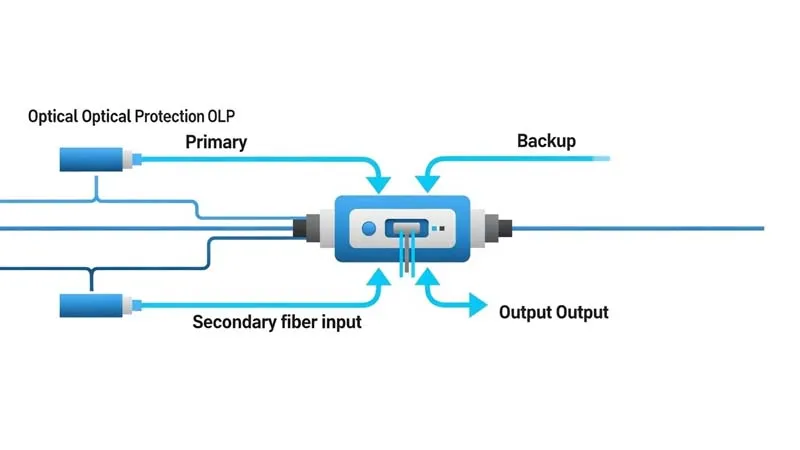
Understanding OLP Optical Line Protection Equipment
What Is OLP Optical Line Protection Equipment?
It is an automatic fiber switching system built entirely on the physical optical link. It works directly at the optical layer, rather than relying on protocols or service types. Consequently, it supports various transmission formats without modification.
Moreover, the system continuously monitors optical signal power on both the working and protection fibers. When the primary link experiences degradation or failure, It switches traffic within milliseconds. As a result, it prevents service interruption effectively.
Core Benefits of OLP Optical Line Protection Equipment
Transparent and Independent Signal Transmission
It transmits optical signals without altering wavelength, bit rate, or protocol. Therefore, it supports data, voice, and video services seamlessly.
Rapid Fault Detection and Switching
The system detects fiber breaks and signal loss in real time. Then, it immediately activates the backup path. As a result, networks maintain high availability even during unexpected failures.
Enhanced Network Reliability and Security
By protecting links at the physical layer, It increases resistance to fiber cuts and environmental damage. In addition, it strengthens overall network resilience.
Protection Modes Supported by OLP Systems
1+1 Optical Line Protection Mode
In the 1+1 protection mode, It transmits identical signals over both primary and standby fibers. The receiver continuously selects the higher-quality signal. Therefore, this mode delivers extremely high reliability.
However, this approach consumes more optical power. As a result, operators typically deploy it in mission-critical environments where reliability outweighs power efficiency.
1:1 Optical Line Protection Mode
The 1:1 protection mode uses selective transmission and reception. Under normal conditions, traffic flows through the working fiber only. When a fault occurs, the system switches to the protection fiber automatically.
Compared with 1+1 protection, It in 1:1 mode introduces lower insertion loss. Consequently, long-distance transmission networks often prefer this method.
Typical Application Scenarios
It is widely used in backbone networks, metro networks, and enterprise optical systems. These environments require continuous service and rapid fault recovery.
In daily operation, the system monitors both main and backup fiber links continuously. When the primary link fails, it switches traffic to the standby link immediately. As a result, the network maintains stable performance and service continuity.

Why Choose OLP Optical Line Protection Equipment?
As optical networks grow in scale and complexity, physical-layer protection becomes increasingly important. Therefore, OLP Optical Line Protection Equipment provides a practical and cost-effective solution.
Moreover, its protocol-independent design allows easy integration into existing infrastructures. As a result, operators can enhance network reliability without redesigning their transmission architecture.
Conclusion
It delivers fast, reliable, and intelligent protection for modern optical fiber networks. Through real-time monitoring and automatic switching, it minimizes downtime and strengthens network resilience.
Consequently, It remains a key component in building secure, high-availability optical communication systems.