
In modern optical networks, even a brief service interruption can result in serious financial loss and operational risk. Therefore, network designers increasingly rely on deterministic protection mechanisms at the physical layer. OLP 1+1 Card technology has become a trusted solution in this context, offering ultra-fast, protocol-transparent protection for critical optical links.
By combining concurrent transmission with intelligent signal selection, It ensures uninterrupted service continuity even when fiber failures occur.
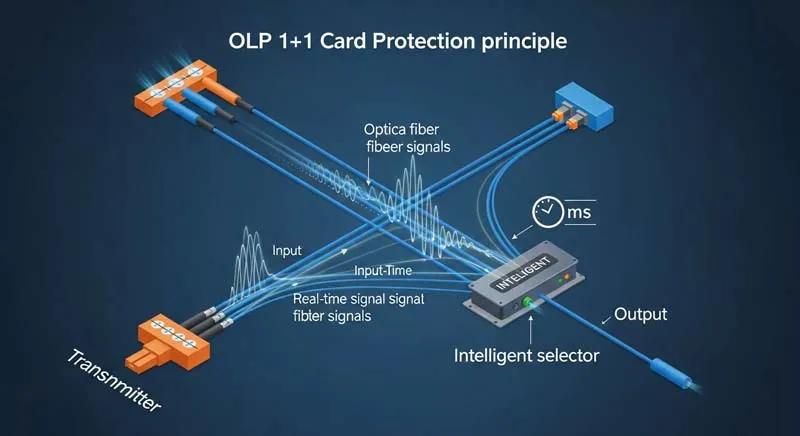
How OLP 1+1 Card Protection Works
Concurrent Transmission at the Transmitting End
At the transmitting side, It simultaneously sends the same service signal through two optical fibers. These fibers are routed along independent physical paths to eliminate common points of failure. As a result, the working path and protection path remain fully synchronized at all times.
Selective Reception at the Receiving End
Meanwhile, the receiving end continuously evaluates both incoming signals. It compares optical power levels and signal quality in real time. When degradation occurs on the primary path, It instantly selects the better signal without interrupting the service.
Notably, the switchover time is typically between 10 and 20 milliseconds, which is almost imperceptible to upper-layer services.
Key Workflow of the OLP 1+1 Card
The protection process follows a clear and reliable sequence:
- Dual Signal Transmission
Service signals are duplicated and transmitted simultaneously via an optical splitter. - Real-Time Optical Monitoring
Both fiber paths are continuously monitored for power and quality variations. - Intelligent Switchover
When the active signal falls below the predefined threshold, traffic switches instantly to the backup path. - Seamless Restoration
Once the primary fiber recovers, traffic reverts based on preset policies, either automatically or manually.
Because the entire process operates at the physical layer, the OLP 1+1 Card remains independent of higher-layer protocols.
Technical Advantages of the OLP 1+1 Card
Ultra-Fast Protection Response
First and foremost, It provides extremely fast switching performance. With a response time as low as 10–20 ms, service disruptions are effectively eliminated.
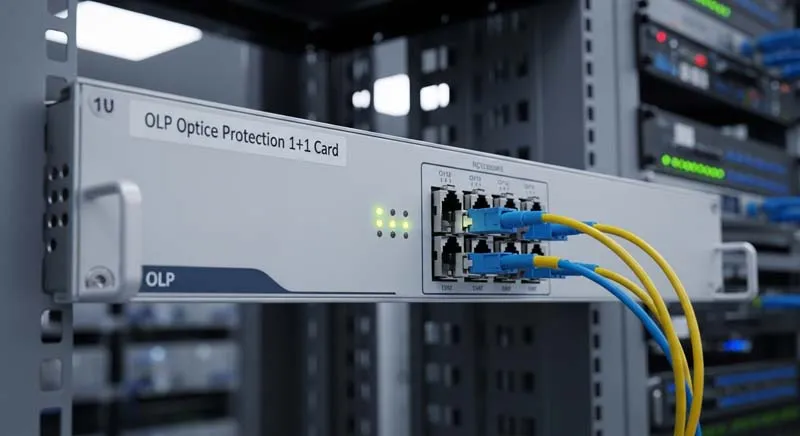
Complete Protocol Transparency
In addition, It supports all optical signals transparently, including SDH, OTN, and Ethernet. Since it operates purely at the physical layer, no protocol configuration or service adaptation is required.
High Reliability Hardware Architecture
Moreover, the protection logic is implemented entirely in hardware. This simple architecture minimizes failure points and significantly improves long-term operational reliability.
Flexible Network Deployment
Finally, the OLP 1+1 Card works independently of transmission equipment. Therefore, it integrates easily into existing networks and supports smooth capacity upgrades without service disruption.
Typical Application Scenarios
Because of its deterministic behavior, It is widely deployed in scenarios with strict availability requirements.

Financial Trading Networks
In financial environments, even milliseconds matter. The OLP 1+1 Card guarantees uninterrupted delivery of trading instructions and market data.
Data Center Interconnect (DCI)
For data centers, continuous synchronization is critical. Therefore, the OLP 1+1 Card ensures stable, real-time data exchange between geographically separated facilities.
Government and Enterprise Leased Lines
Many government and enterprise networks demand high SLA compliance. In these cases, It provides robust physical-layer protection against accidental fiber cuts.
Core Backbone Network Segments
In backbone networks, fiber damage caused by construction or natural events is unavoidable. Consequently, deploying OLP 1+1 Card protection significantly reduces service risk.
Implementation Best Practices
To maximize protection effectiveness, several deployment considerations should be addressed:
- Physical Route Separation
Working and protection fibers must follow different routes to avoid shared risks. - Optical Power Budget Planning
Splitter insertion loss must be accounted for to maintain sufficient received optical power. - Regular Switchover Testing
Switchover tests should be conducted at least every six months. - Continuous Status Monitoring
Ongoing optical power monitoring enables early detection of potential degradation.
Overall Value of the OLP 1+1 Card
In summary, the OLP 1+1 Card delivers deterministic, millisecond-level protection through its straightforward “dual transmission, optimal selection” design. For networks where downtime costs far exceed equipment investment, it represents a highly cost-effective solution.
As a foundational safeguard, the OLP 1+1 Card plays a crucial role in building highly available optical networks.
Ideal Use Cases:
Critical links with low tolerance for service interruption and high return on reliability investment.
Less Suitable Scenarios:
Non-critical services with extreme cost sensitivity or environments where equipment failure, rather than fiber failure, is the primary risk factor.