
OCS Optical Circuit Switch is transforming how modern high-speed networks are built and optimized.
Today, computing power grows faster than ever. Meanwhile, bandwidth demand keeps expanding, and energy efficiency becomes a strict constraint. Traditional electrical switching architectures increasingly struggle with latency, power consumption, and scalability. Therefore, network architects are looking for a more efficient alternative.
OCS Optical Circuit Switch introduces an all-optical switching approach that eliminates unnecessary optical-electrical-optical conversions. As a result, data flows directly through the optical layer with lower latency, reduced energy usage, and higher determinism. This makes OCS Optical Circuit Switch an ideal solution for data centers, AI computing networks, and next-generation optical infrastructures.
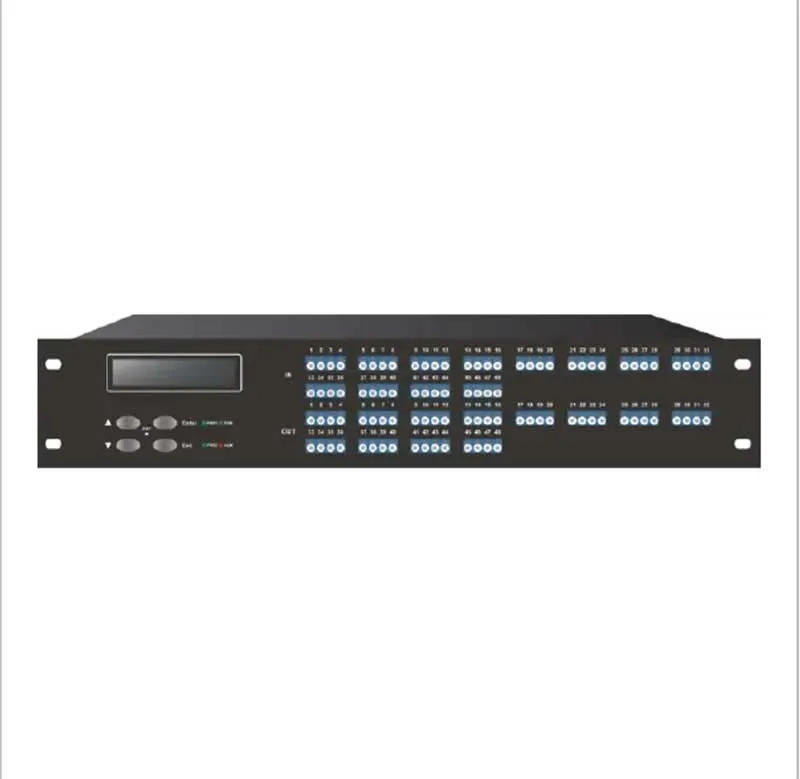
Core Highlights of OCS Optical Circuit Switch
All-Optical Switching for Maximum Efficiency
At its core, It operates as a fully optical, non-blocking circuit switching system. Instead of processing traffic electronically, it establishes direct optical paths between input and output ports. Consequently, signal degradation and energy waste caused by repeated conversions are avoided.
Moreover, this architecture ensures consistent performance even under heavy traffic loads. For large-scale networks, fewer conversions directly translate into higher throughput and lower operational cost.
Strictly Non-Blocking Optical Cross-Connections
Another key advantage of OCS Optical Circuit Switch is its strictly non-blocking bidirectional switching capability. Any input port can connect to any output port without contention. Therefore, bandwidth remains predictable, and latency stays stable.
This feature proves especially valuable for GPU clusters, distributed computing platforms, and latency-sensitive workloads. In such environments, deterministic behavior at the physical layer becomes critical for overall system efficiency.
High Reliability and Scalable Port Configurations
In addition, It delivers low insertion loss, minimal crosstalk, and fast switching speed. These characteristics ensure long-term operational stability, even in demanding environments.
The platform supports multiple port scales, including 16×16, 32×32, 48×48, and larger configurations. As network requirements grow, operators can scale their optical switching capacity without redesigning the entire architecture.
Intelligent Management and Network Control
It also integrates practical management features. It supports RJ45 and RS232 interfaces and works with standard protocols such as SNMP and TELNET. Meanwhile, a local LCD interface allows quick configuration and monitoring.
As a result, operators gain both centralized control and local visibility. This combination simplifies deployment, maintenance, and long-term operation.
Application Scenarios of OCS Optical Circuit Switch
AI Training Clusters and GPU Optical Interconnects
In large-scale AI training environments, GPU clusters exchange massive volumes of data with extremely tight latency requirements. However, traditional electrical switching layers often introduce unpredictable delays.
Here, It acts as an optical-layer scheduler between GPU pods. When a training task starts, the switch establishes dedicated optical circuits between GPUs. Once the task ends, those optical paths are released and reassigned.
Therefore, the network no longer behaves as a shared bottleneck. Instead, it becomes a task-oriented optical resource pool. As a result, training jobs complete faster, GPU utilization improves, and overall energy consumption decreases.
East-West Traffic Optimization in Large Data Centers
Inside modern data centers, most traffic flows east-west between servers. As computing density increases, this internal traffic places enormous pressure on switching fabrics.
OCS Optical Circuit Switch provides a powerful optimization layer. By offloading high-bandwidth, persistent flows onto dedicated optical circuits, data centers reduce congestion on electrical switches. Meanwhile, existing network architectures remain intact.
This hybrid approach combines the flexibility of packet switching with the efficiency of optical circuits. Consequently, operators achieve better performance without excessive capital investment.

Optical Circuit Scheduling in DCI and Metro Networks
In data center interconnect and metro network environments, fiber resources are both expensive and limited. Therefore, efficient utilization becomes essential.
OCS Optical Circuit Switch enables dynamic optical path scheduling based on service priority. Operators can quickly allocate high-reliability circuits for financial transactions, database synchronization, or disaster recovery.
Compared with fixed optical paths, this approach increases flexibility. Compared with electrical switching, it delivers lower latency and higher stability. As a result, network resources generate greater long-term value.
Optical Testing, Monitoring, and Network Maintenance
OCS Optical Circuit Switch also plays an important role in testing and maintenance environments. Engineers use it to perform multi-channel optical power monitoring, aging tests, and fault isolation.
Because optical paths can be switched precisely and repeatedly, testing efficiency improves significantly. Meanwhile, troubleshooting becomes faster and more accurate.
Value Summary: More Than Switching, It Is an Architectural Upgrade
The true value of OCS Optical Circuit Switch goes beyond individual specifications. It introduces a new way to design networks from the physical layer upward.
Lower energy consumption, predictable latency, and flexible optical path control empower architects to rethink connectivity strategies. Therefore, OCS Optical Circuit Switch becomes a foundational component for AI networks, hyperscale data centers, and future optical infrastructures.
HTF: A Long-Term Partner in Optical Communication
OCS Optical Circuit Switch is one of HTF’s flagship products. HTF is a professional supplier of optical fiber products and WDM system solutions, specializing in large-scale data transmission.
With a team that has over ten years of experience in optical communication R&D, system design, and manufacturing, HTF delivers reliable and scalable solutions worldwide. Moreover, HTF supports data centers, 5G networks, cloud computing platforms, metro networks, and access networks with complete service coverage.
As data volumes continue to grow, competitive advantage depends on smarter connectivity.
OCS Optical Circuit Switch makes optical paths simpler, faster, and more powerful.