
When it comes to connecting computers and sharing information, LAN vs MAN Network is a common topic. Both are essential for data communication, but they differ greatly in scope, scale, and application. Understanding their differences helps you select the most efficient setup for your home, office, or organization.

What Is a LAN Network?
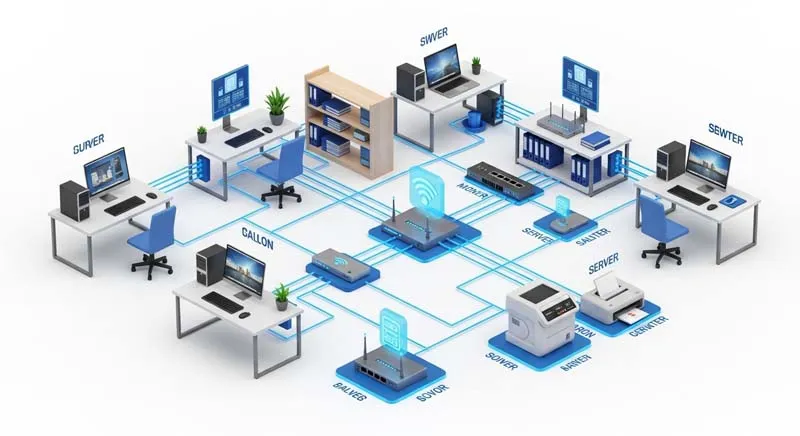
A LAN (Local Area Network) connects multiple computers and devices within a limited space, such as a home, classroom, or office building.
It allows users to share files, printers, and internet access quickly and securely.
Because it covers a small physical area, a LAN is easy to set up, manage, and maintain.
Main features of LAN:
- Covers a small geographic area (single building or office).
- Offers high-speed data transmission, typically up to gigabit levels.
- Ideal for personal use, small businesses, and school networks.
In short, a LAN focuses on fast, local communication between nearby devices.
What Is a MAN Network?
A MAN (Metropolitan Area Network) covers a larger area — usually a city or a cluster of nearby locations.
It connects several LANs together using high-speed fiber or wireless connections.
Organizations use MANs to link different offices, campuses, or government departments within the same metropolitan area.
Main features of MAN:
- Spans multiple kilometers, connecting distant sites.
- Supports hundreds or thousands of users simultaneously.
- Often built using fiber-optic backbone networks.
A MAN helps companies maintain efficient inter-branch communication while reducing latency and improving reliability.

LAN vs MAN Network: Key Differences
|
Feature |
LAN (Local Area Network) | MAN (Metropolitan Area Network) |
| Coverage Area | Small (building or campus) | Large (city or metro region) |
| Speed | Very high (up to 10 Gbps) | Moderate to high |
| Cost | Low setup and maintenance | High infrastructure cost |
| Ownership | Usually private | Often public or shared |
| Use Cases | Homes, offices, schools | Universities, governments, enterprises |
The LAN vs MAN Network comparison shows that while LANs are simpler and cheaper, MANs are designed for larger-scale connectivity and collaboration.
Advantages and Use Cases
Advantages of LAN:
- High data speed for local transfers
- Simple installation and low cost
- Easy to troubleshoot and secure
Advantages of MAN:
- Connects multiple LANs across wide areas
- Enables resource sharing between branches
- Supports modern business and academic operations
Use Cases:
- LAN: Home networking, small business data sharing, campus labs
- MAN: City-wide surveillance, university networks, enterprise headquarters
Which Network Should You Choose?
Choosing between a LAN vs MAN Network depends on your needs.
If your goal is to connect devices in a single building, a LAN offers simplicity and affordability.
If you need to link multiple sites or campuses across a city, a MAN provides the scale and reliability you need.
Both networks are essential in today’s digital world, and understanding their differences helps you plan more effectively.
Conclusion: LAN vs MAN Network in the Modern World
In summary, LAN vs MAN Network comparison highlights one key idea — scale matters.
A LAN gives you local speed and control, while a MAN extends communication power over large distances.
Together, they form the foundation of modern network infrastructure, connecting homes, businesses, and entire cities with speed, reliability, and intelligence.