
IPoDWDM is reshaping the future of high-capacity optical networks. With the emergence of the world’s first L-band 800G ZR/ZR+ pluggable module, the industry is entering a new age of efficiency, scalability, and architectural simplicity. Moreover, this breakthrough strengthens the path toward 64 Tb/s per fiber, enabling networks to respond to massive data growth driven by cloud computing, AI clusters, and global digitalization.
- The Rise of L-Band: Opening the Door to 64T Capacity
For years, the C-band has supported most coherent transmission systems. However, as its spectral resources near exhaustion, operators must turn to the L-band. This expansion adds nearly 4 THz of usable spectrum. As a result, single-fiber capacity can double from 32T to 64T, greatly extending the lifespan of existing fiber infrastructure.
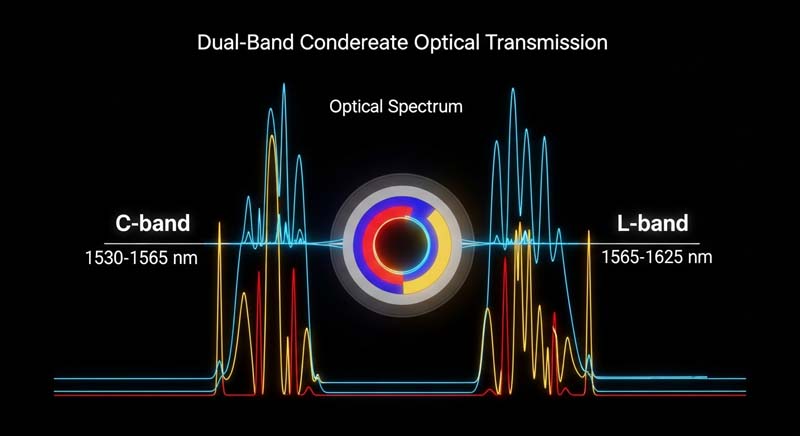
Furthermore, the availability of 800G ZR/ZR+ in the L-band marks a practical transition from concept to deployment. Higher output power, improved OSNR performance, and efficient modulation schemes make L-band coherent services ready for wide commercial use.
- Pluggable 800G: Transforming IP Routing and Optical Integration
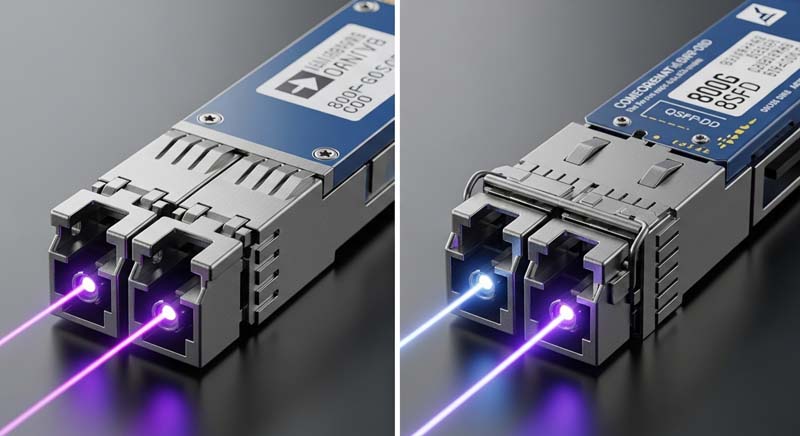
Traditional coherent transport relied on bulky, high-power optical shelves. However, new 800G modules in QSFP-DD and OSFP formats allow coherent capability to move directly into routers.
These pluggable modules deliver several critical advantages:
- High-density 800G ports on standard routers
- Lower power and space requirements
- Integrated DSP and coherent functions
- Direct access to ROADM systems
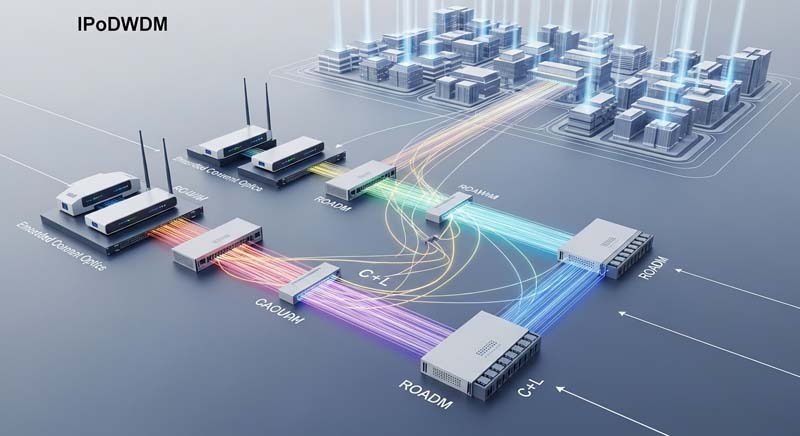
Consequently, IPoDWDM can scale more easily than ever. It reduces the number of intermediate devices, lowers operational burden, and shortens service activation cycles.
- High Output Power: The Key to ROADM Penetration
Earlier ZR modules struggled with multi-hop ROADM traversal due to limited launch power. The new L-band 800G modules solve this issue through improved output levels and optimized coherent processing. Therefore, they can maintain better OSNR across complex optical paths.
They enable:
- Higher ROADM ingress margins
- Multi-node transmission
- Greater dispersion tolerance
- Compatibility with C+L architectures
As a result, operators can dispatch 800G traffic with flexibility similar to legacy 100G/200G services.
- IPoDWDM as a New Network Paradigm
IPoDWDM is not just a technical update. It represents a structural shift toward simpler and more intelligent optical networks.
4.1 Simplified Architecture
Placing coherent optics inside routers eliminates the need for external transponder hardware. Therefore, operators gain:
- Lower CAPEX and OPEX
- Reduced latency
- A smaller hardware footprint
- Easier automation and orchestration
- Streamlined operations
4.2 Designed for the C+L Spectrum Era
Because 800G performs consistently across both C and L bands, IPoDWDM becomes the ideal architecture for large-scale transport. Cloud-to-cloud, region-to-region, and data-center-to-core connections can now be scheduled more freely.
4.3 Pathway to 1.2T and 1.6T Coherent Networks
The philosophy of IPoDWDM—evolving optics through interface innovation—aligns with the development trajectory of future 1.2T and 1.6T generations.
- High-Value Industry Scenarios Enabled by L-Band 800G
5.1 Hyperscale Cloud and AI Data Centers
AI training and cloud workloads create unprecedented east-west traffic. Consequently, operators need higher-capacity inter-cluster links. L-band 800G enables these connections with stability and room for growth.
5.2 Provincial and Metro-Core Backbone Networks
The doubling of spectral capacity eases fiber resource pressure. Moreover, ROADM-based scheduling allows more flexible, software-driven service delivery.
5.3 AI and HPC Fabrics
AI clusters require low-latency and deterministic high bandwidth. L-band 800G combined with IPoDWDM ensures consistent and scalable interconnect performance across large distributed compute systems.
- Challenges and Future Opportunities
Although L-band adoption is accelerating, several considerations remain:
- Power balancing between C and L bands
- Unified wavelength and spectrum management
- DSP heat dissipation and power efficiency
- Automation of C+L planning across multi-vendor networks
However, the strong momentum behind L-band 800G shows that the industry is fully prepared to enter a wider spectral era.
- A New Dawn for High-Capacity Optical Networks
The arrival of L-band 800G ZR/ZR+ represents a major milestone. It strengthens the role of IPoDWDM as the foundation of next-generation networks, enabling higher capacity, lower latency, and greater operational simplicity.
With the 64T era now within reach, global infrastructures will shift toward ultra-broadband, ultra-efficient, and highly flexible all-optical designs.
HTF: Empowering the Shift Toward Next-Generation Optical Transport
As capacity demands rise, strong technology partners become essential. HTF serves this role as a leading provider of optical-fiber products and WDM transmission solutions. Backed by more than ten years of R&D and manufacturing expertise, HTF supports data centers, 5G networks, cloud platforms, metro networks, and backbone infrastructures worldwide.
The HT6000 OTN platform is a prime example. It offers compact, high-capacity, and cost-efficient multi-service transport, supporting more than 1.6T at core nodes. It is widely deployed in national, provincial, and metro backbone networks, as well as in IDC expansion scenarios.
HTF continues to help operators build, connect, and optimize their optical transport layers while supporting the future evolution of IPoDWDM networks.