To choose wavelength division transmission equipment suitable for small enterprises, the following aspects need to be considered:
Clearly define the transmission requirements.
Bandwidth requirements: Evaluate the current and future business requirements of the enterprise, such as bandwidth requirements for video conferencing, data transmission, cloud services, etc., and reserve 30%-50% redundant bandwidth.
Transmission distance: Measure the distance between the enterprise’s sites or computer rooms. CWDM equipment can be considered for short distances (≤40km); DWDM equipment is required for long distances, and is equipped with optical amplifiers, etc.
Consider equipment performance
Wavelength selection: CWDM wavelength interval is 20nm, low cost, simple configuration, suitable for small and medium bandwidth and short distance scenarios. DWDM wavelength interval is small, can carry more signals, and is suitable for long-distance and large-capacity transmission.
Channel isolation: refers to the crosstalk suppression capability of adjacent channels, generally required to be > 25dB to reduce interference between signals.
Polarization-dependent loss: The loss difference under different polarization states should be < 0.2dB to ensure the stability of signal transmission.
Pay attention to equipment features
Scalability: Choose equipment that supports smooth upgrades so that the capacity can be expanded by adding wavelengths or modules when the enterprise business grows.
Management and maintenance: The equipment must support Web or SNMP management protocols, and the equipment status can be monitored, configured and troubleshooted through a visual interface.
Weigh cost factors
Purchase cost: CWDM equipment has a lower cost, while DWDM equipment has a higher cost. Passive wavelength division multiplexers have a low network construction cost, but the number of wavelength channels is limited; active wavelength division multiplexers have a high cost, but have large bandwidth and are easy to manage.
Operation and maintenance costs: Choose equipment with low power consumption to reduce electricity expenses, and equipment that supports hot-swappable modules can be maintained and upgraded without interrupting business.
Investigate manufacturer services
Technical support: Choose a manufacturer that can provide 7×24 hours of technical support so that you can get help in time when the equipment fails.
Training services: The manufacturer should be able to provide equipment operation and maintenance training for enterprise IT personnel so that they can master basic operating skills.
Reference application scenarios
Multi-branch interconnection: If an enterprise has multiple branches, and the distance is short and the bandwidth demand is not high, CWDM equipment can be used; if the distance is long and the bandwidth demand is large, DWDM equipment should be considered.
Data center interconnection: The interconnection between data centers usually requires high bandwidth and long-distance transmission, and DWDM equipment is a better choice; for short-distance data center interconnection, CWDM equipment can also meet the needs.
When choosing wavelength division transmission equipment, you can also refer to the experience and evaluation of other companies to make a more appropriate decision.
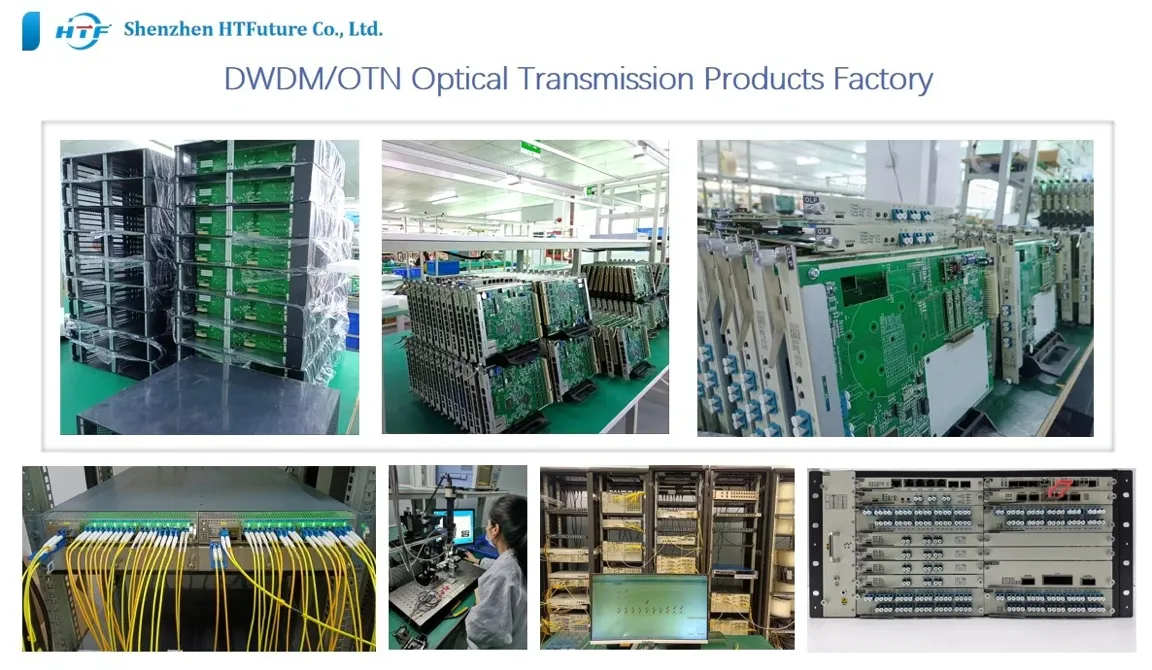
HTF is a professional supplier of WDM systematic solution and optical communication equipment. Was built by a team who has more than 10-year experiences in optical communication product R&D, developing and manufacturing.
HTF specialized in providing fibre optical communication systems product: DWDM/DCI-BOX/OLP/EDFA/SOA/DCM/OTDR/WSS Equipment, QSFP28 and AI Transceivers ( 800G/400G QSFP-DD, OSFP etc) , and customized MPO fiber cable base on customer requirement.
HTF equipment are extensively utilized by telecom operators and private network customers, such as ISP, electric power, IDC, education, radio & television, network security, big data, and cloud service sectors.