
In the grand narrative of global communication, Wavelength Division Multiplexing (WDM) is the celebrated hero, renowned for its ability to multiply the capacity of a single optical fiber by carrying hundreds of data channels on different wavelengths of light. But even the mightiest hero has a silent guardian—a force that empowers its journey against impossible odds. This guardian is the optical amplifier, the unsung workhorse that gives WDM its incredible reach and resilience.
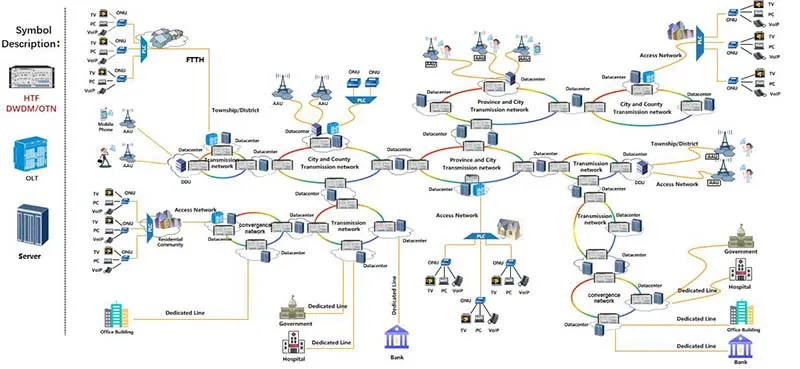
Without amplifiers, the story of modern connectivity would be dramatically shorter, quite literally.
The Inevitable Fade: A Fundamental Challenge
Light, no matter how pure, weakens as it travels through glass. This attenuation—a fundamental property of optical fiber—means that after approximately 80-100 kilometers, the signal becomes too faint and distorted to be detected accurately. For a long-haul network spanning continents and oceans, this posed an existential problem. The traditional solution was to use “repeaters”: electronic devices that would receive the optical signal, convert it back to an electrical one, clean it up, and then re-transmit it as a new, fresh optical signal.
While effective, this process—known as Optical-Electrical-Optical (O-E-O) conversion—is complex, expensive, and becomes a bottleneck for speed and flexibility. Most critically, it must be done for each wavelength individually, making it utterly impractical for dense WDM systems with hundreds of channels.
The Amplifier: A Revolutionary Leap
The advent of the optical amplifier changed everything. Its genius lies in its simplicity: it amplifies light as light.
Think of it like this:
A repeater is like a translator who must listen to a speech in one language, translate it, and then re-deliver it in the same language loudly and clearly.
An optical amplifier is simply a megaphone for light. It takes the entire chorus of wavelengths—the entire WDM signal—and makes it louder in one fell swoop, without needing to understand or manipulate the data it’s carrying.
The Star Performer: The Erbium-Doped Fiber Amplifier (EDFA)
The most pivotal innovation for WDM was the Erbium-Doped Fiber Amplifier (EDFA). This device is the workhorse of modern optical networks. Here’s how it works:
A segment of optical fiber is doped with the rare-earth element Erbium.
A high-power “pump” laser energizes (pumps) the erbium atoms, lifting them to a higher energy state.
When the weak, incoming data signal (in the C- or L-band) passes through this energized fiber, it stimulates the excited erbium atoms.
These atoms release their stored energy as additional photons of light, identical in wavelength and data pattern to the incoming signal. The result: a perfectly replicated, much more powerful optical signal.
The Indispensable Role of Amplifiers in WDM
The EDFA’s ability to simultaneously amplify all channels in a band is what makes large-scale WDM not just possible, but practical and economical. Their role is multifaceted:
Extending Reach: Amplifiers are strategically placed every 60-100 km along a fiber route to boost the signal, enabling transmission over thousands of kilometers. They are the lifeblood of undersea cables and terrestrial long-haul networks.
Enabling Optical Transparency: Because they don’t mess with the data format, amplifiers are “bit-rate transparent.” Whether a channel is carrying 10 Gbps, 100 Gbps, or 400 Gbps, the EDFA amplifies it all the same. This allows network operators to upgrade the speed of individual channels without replacing the entire amplification infrastructure.
Boosting System Budget: Amplifiers compensate for losses not just in the fiber, but also in other components like multiplexers, demultiplexers, and optical switches, allowing for more complex and flexible network designs.
Paving the Way for Coherent Technology: The combination of optical amplifiers and advanced coherent detection techniques (with digital signal processing) is what ultimately defeated dispersion and nonlinearities, unlocking the ultra-high-capacity systems we rely on today.
Beyond the EDFA: A Symphony of Amplification
While the EDFA is the star, other amplifiers play crucial supporting roles:
Raman Amplification: Uses the fiber itself as the gain medium, providing distributed amplification and improving the overall noise performance of the system, often working in tandem with EDFAs.
Semiconductor Optical Amplifiers (SOAs): More compact and integrated, used for specific applications where size and integration are key.
The Silent Enabler of a Connected Planet
The amplifier does not process or route data. It does not create the wavelengths or decode the information. Its job is singular: to give strength. To push the light further.