
Fiber Capacity Multiplication Technology is quickly becoming the most practical expansion path for modern optical networks. Traffic keeps rising across data centers, cloud backbones, and 5G transport. Meanwhile, fiber routes, ducts, and sites face real limits. As a result, many operators now look beyond simple “speed upgrades” and focus on system-level capacity gains.
In that context, Fiber Capacity Multiplication Technology aims to do one thing well: unlock more usable spectrum and throughput from existing fiber, with minimal disruption. Instead of rebuilding the whole network, it adds an intelligent optical layer that reuses what you already run in the field.
This article explains the logic, the architecture, and the engineering trade-offs. It also shows why all-optical wavelength conversion can push single-fiber capacity toward a new ceiling, including a reported 76.8 Tb/s milestone under specific conditions.

Why the Industry Needs Capacity Multiplication, Not Only Faster Waves
For years, the industry expanded bandwidth by increasing single-wavelength rates. We moved from 100G to 400G, and now toward 800G and beyond. However, higher per-wave speed alone cannot solve every bottleneck.
Fiber Capacity Multiplication Technology addresses three daily constraints:
- Construction limits: new fiber builds can take months or longer.
- Site limits: power, space, and cooling often cap new equipment.
- Operational risk: large-scale redesign raises cutover and outage risk.
Therefore, operators value expansion methods that keep the middle of the network stable. They also prefer upgrades that fit existing processes.
The Real C-Band Bottleneck: Where Capacity Starts to Stall
C-band systems carry most of today’s long-haul and metro traffic. Yet many networks already fill much of the available C-band spectrum. Consequently, adding more channels becomes harder each year.
Spectrum becomes scarce
Dense channel grids, guard bands, and filtering margins reduce effective spectrum. Moreover, ROADM filtering creates practical bandwidth boundaries.
Physics pushes back
When you raise launch power, OSNR can improve. However, nonlinear effects also increase. When you pack channels tighter, crosstalk and filtering penalties can rise too.
Engineering constraints dominate
Direct L-band or S-band expansion often requires new amplifiers, multiplexers, monitoring, and operational tooling. In addition, teams must learn new failure modes and new optimization rules.
So, Fiber Capacity Multiplication Technology becomes attractive when you want more capacity without rebuilding the line system.
What Fiber Capacity Multiplication Technology Means in Practice
At a high level, Fiber Capacity Multiplication Technology uses optical-domain techniques to “multiply” usable capacity per fiber. It focuses on spectral reuse and smarter wavelength organization.
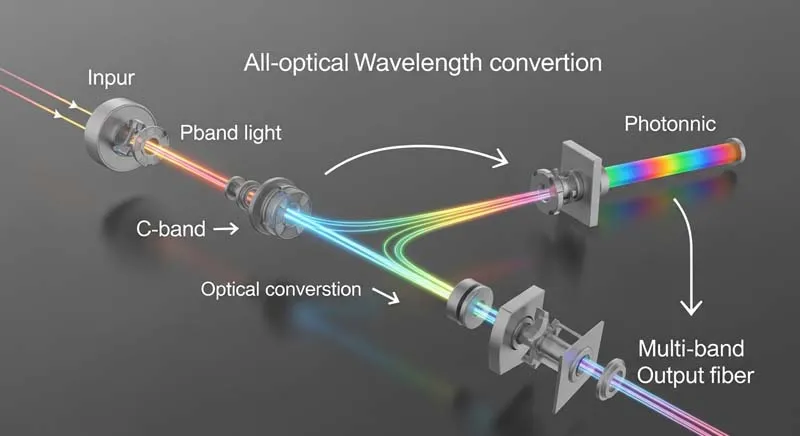
One representative approach relies on all-optical wavelength conversion. This method shifts a signal from one wavelength band to another without converting it into electrical form. As a result, it can preserve the original modulation information while changing where the signal lives in the spectrum.
In simple terms, this strategy turns “unused bands” into usable lanes. It does so with minimal impact on existing C-band transponders and workflows.
All-Optical Wavelength Conversion: The Core Enabler
All-optical wavelength conversion moves light from one wavelength to another in the optical domain. It avoids OEO regeneration in the middle of the link. Therefore, it can reduce latency and hardware complexity.
In a typical design:
- The network generates or receives a C-band coherent signal.
- A conversion module maps that signal into another wavelength region.
- Multiple bands propagate together over one fiber.
- A second conversion module maps the signal back, when needed.
This structure supports Fiber Capacity Multiplication Technology because it expands the effective spectral footprint. At the same time, it limits major upgrades to the network edges.
How “No New L/S-Band Gear” Can Still Make Sense
You may wonder how an operator can use extra bands without adding full L/S-band infrastructure. The key lies in scope and boundaries.
With Fiber Capacity Multiplication Technology, the goal is often to avoid a full parallel line system. That means you try to avoid, or reduce, the following:
- dedicated L/S-band coherent transponders across the fleet
- a complete L/S-band amplification chain across many sites
- separate operational domains for multi-band planning and troubleshooting
Instead, the network adds wavelength conversion at strategic points. Then it uses a controlled multi-band arrangement. Consequently, the upgrade can stay incremental.
That said, the solution still needs careful power management and monitoring. So, engineers must plan the architecture with discipline.
Understanding the 76.8 Tb/s Milestone the Right Way
Peak capacity numbers matter, but context matters more. Single-fiber capacity typically depends on:
- channel count
- per-channel data rate
- channel spacing and spectral efficiency
- end-to-end OSNR and impairment margin
In a reported demonstration, the system reached 76.8 Tb/s on a single fiber under specific conditions. This number reflects a high channel count combined with high per-channel rates, enabled by expanded spectral utilization through optical conversion.
However, you should treat such figures as “best-case” reference points. In practice, reach, ROADM count, fiber type, and amplifier design will change the result. Therefore, planners should use conservative margins during early design.
Even so, Fiber Capacity Multiplication Technology still delivers a strong value proposition: it raises the ceiling without forcing a total rebuild.
Deployment Models That Work in Real Networks
A workable deployment must respect existing ROADM layers, operational rules, and maintenance windows. For that reason, many designs use edge-focused insertion.
Two-end insertion for minimal disruption
You place conversion modules at the ends of a span or domain. Then the middle sites stay mostly untouched. As a result, cutovers become simpler.
Overlay thinking instead of redesign
You treat the new spectral lanes as an overlay. Meanwhile, the legacy C-band services keep running normally.
Monitoring and control must evolve
Conversion adds new parameters to watch. For example:
- conversion efficiency and stability
- pump health and drift behaviors
- band-to-band power balance
- alarms tied to bypass and protection actions
So, Fiber Capacity Multiplication Technology succeeds when observability improves along with capacity.

Key Benefits for Operators and Data Center Networks
When the design aligns with operations, Fiber Capacity Multiplication Technology can offer several clear benefits.
Faster capacity expansion
You can gain throughput without waiting for fiber construction. Therefore, time-to-capacity improves.
Lower disruption risk
You avoid wide changes across the amplification chain. As a result, you reduce cutover scope.
Better asset lifetime
You stretch the value of existing fiber routes and C-band investments. Moreover, you protect earlier spending.
Practical scalability
You can scale by domains and corridors. Then you expand step by step as demand grows.
The Trade-Offs You Must Plan For
Every capacity upgrade has costs. Fiber Capacity Multiplication Technology shifts the cost structure rather than removing it.
OSNR and insertion loss margin
Conversion modules introduce loss and some noise impact. Therefore, engineers must validate end-to-end margins.
Multi-band power interactions
When multiple bands share a fiber, power distribution matters. Consequently, planners must manage tilt and balance.
Reliability and protection strategy
Pump sources and conversion stability require redundancy. In addition, bypass and restoration procedures must be clear.
Interoperability boundaries
Multi-vendor networks need defined interfaces. Therefore, the project should include strict lab validation before field rollout.
If you treat these items as first-class requirements, the deployment becomes much smoother.
How It Compares With Other Expansion Paths
Network teams often consider several expansion options at once. So, it helps to frame trade-offs clearly.
Versus direct C+L expansion
Direct L-band buildouts can deliver large capacity. However, they often demand more field upgrades and more operations change.
Versus higher per-wavelength rates
Higher rates can boost capacity without changing bands. Yet the approach can tighten OSNR and nonlinear budgets quickly.
Versus spatial division multiplexing
SDM can deliver massive gains in the long term. However, it often requires new fiber types and new infrastructure.
Therefore, Fiber Capacity Multiplication Technology fits best when you need near-term gains with controlled network change.
Where Fiber Capacity Multiplication Technology Fits Best
Use this approach when:
- your fiber routes run hot and new builds look slow
- you want capacity gains with limited mid-span changes
- you need a phased plan that matches budget cycles
- you value operational stability and fast activation
Avoid rushed deployment when:
- margins already sit near failure thresholds
- monitoring and automation remain immature
- you cannot validate performance under real traffic mixes
In other words, Fiber Capacity Multiplication Technology works best as a disciplined engineering program, not as a quick patch.
A Practical Closing Note on Delivery and Platforms
Even the best concept depends on execution. At the end of the day, operators need complete transmission design, stable components, and repeatable deployment playbooks.
In that spirit, HTF supports global customers with fiber products and WDM system solutions, built by a team with more than 10 years of optical communications R&D and manufacturing experience. Moreover, HTF focuses on helping customers build, connect, and optimize fiber infrastructure for data centers, 5G, cloud, metro, and access networks.
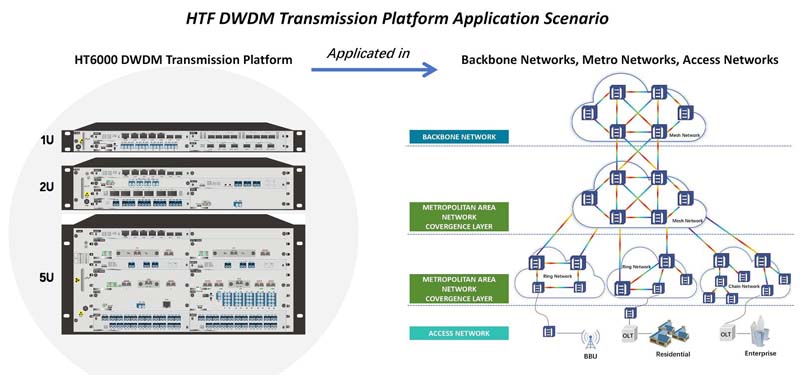
HTF’s HT6000 is a compact, high-capacity, cost-effective OTN optical transport system. It uses a CWDM/DWDM universal platform design and supports transparent multi-service transport. In addition, it offers flexible networking and access capabilities. It suits national backbones, provincial backbones, metro cores, and other critical networks, while supporting large-capacity node needs beyond 1.6T. For IDC and ISP operators, it also provides a cost-efficient path to scalable WDM transport expansion.
Final takeaway
Fiber Capacity Multiplication Technology can reshape capacity planning by turning limited upgrade windows into scalable growth. Therefore, it deserves a serious place in modern optical network roadmaps.