
When you make a video call across continents or stream ultra-high-definition content, vast amounts of data travel as light through optical fibers. However, light does not move endlessly without loss. Instead, it gradually weakens over distance. Therefore, modern optical networks require a reliable way to restore signal strength.
The solution is EDFA, a technology that has become the silent backbone of global optical communication. Without EDFA, today’s internet, cloud services, and submarine cables would simply not function at scale.

Why Optical Signals Need EDFA
As optical signals propagate through fiber, attenuation inevitably occurs. Consequently, signal power drops after dozens of kilometers. In early networks, this problem forced operators to convert optical signals into electrical ones for amplification.
However, this optical-electrical-optical process was inefficient. Moreover, it increased cost, complexity, and latency. As bandwidth demand grew, the industry needed a better approach.
That need directly led to EDFA, which enables amplification without leaving the optical domain.
What Is EDFA and How Does It Work?
The Role of Erbium in EDFA
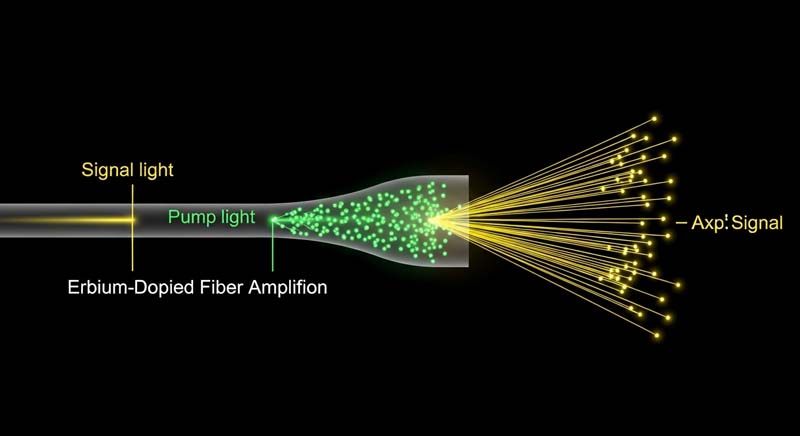
At the core of EDFA lies a rare-earth element called erbium. Engineers dope erbium ions into a short section of optical fiber, creating erbium-doped fiber. This fiber becomes the active medium of EDFA.
When a pump laser injects energy at 980 nm or 1480 nm, the erbium ions absorb this energy. As a result, their electrons enter an excited state, ready to release energy.
Stimulated Emission: The Amplification Mechanism
When an incoming optical signal passes through the erbium-doped fiber, something remarkable happens. The excited erbium ions release photons when stimulated by the signal light.
These emitted photons match the original signal perfectly. They share the same wavelength, phase, and direction. Therefore, the signal grows stronger without distortion.
This process, known as stimulated emission, allows EDFA to amplify signals efficiently and cleanly.
Why EDFA Is Essential in Modern Networks
All-Optical Amplification Efficiency
EDFA operates entirely in the optical domain. As a result, it removes the need for repeated signal conversion. This dramatically reduces system complexity and power consumption.
WDM Compatibility and Signal Transparency
Importantly, it is format-agnostic. It does not depend on data rate or modulation format. Moreover, It can amplify dozens of wavelengths simultaneously.
This capability makes it indispensable for WDM systems and high-capacity backbone networks.
Reliability for Long-Term Deployment
It uses solid-state components and contains no moving parts. Consequently, it offers exceptional stability and longevity. It can operate reliably in harsh environments, including undersea cable systems.
EDFA Applications Across Optical Infrastructure
Today, EDFA is deployed across nearly every optical communication layer. It supports long-haul transmission, metro networks, and submarine cables. Meanwhile, it also plays a critical role in data center interconnects and 5G fronthaul.
By enabling terabit-level transmission over single fibers, It has reshaped global connectivity.

The Future of EDFA in All-Optical Networks
As network demand continues to grow, It remains highly relevant. Although new amplification technologies emerge, It still offers unmatched maturity and cost efficiency.
Therefore, It will continue powering next-generation all-optical networks, cloud infrastructure, and global data exchange.
Conclusion: EDFA as the Heart of Optical Communication
Invisible yet indispensable, It continuously restores the energy of light signals across the world. It quietly sustains the global flow of information that defines modern society.
As optical networks evolve, It will remain the energetic core that keeps the world connected—efficiently, reliably, and at the speed of light.