
- DWDM Technology: Opening a New Era of Data Transmission
DWDM technology (Dense Wavelength Division Multiplexing) has become one of the most transformative forces in optical communication. As global data traffic surges and AI, cloud computing, and big data centers demand higher bandwidth and speed, traditional transmission systems are reaching their limits.

By transmitting multiple wavelengths through a single fiber, DWDM technology greatly increases fiber utilization and has become the backbone of modern network infrastructure.
Today, the development path is clear:
one direction focuses on increasing single-wave speed, the other on expanding spectrum bandwidth.
Together, these two trends are driving global optical networks toward higher capacity, lower latency, and greater intelligence.
- The High-Speed Evolution: From 400G to 2.4 Tbps
In the race for higher speed, DWDM technology has advanced from 100 G and 400 G to 800 G, and now moves into 1.6 Tbps field trials, paving the way for 2.4 Tbps coherent systems.
The key lies in coherent optical transmission. New modulation formats (such as 64QAM and 128QAM) combined with advanced DSP chips allow higher frequency and lower noise, boosting spectral efficiency. Innovations in high-speed modulators, low-noise amplifiers, and precision lasers further strengthen performance.

Leading vendors such as Ciena, Infinera, Huawei, and ZTE are already testing 1.6 Tbps DWDM systems in live networks. These deployments will greatly improve backbone and metro transmission, marking the real beginning of the terabit era.
- Broad Spectrum Expansion: Full Use of the C+L Band
Beyond higher speed, the next frontier of DWDM technology is spectrum expansion. Traditionally, optical transmission used only the C-band (1530–1565 nm). With that range nearing full use, expanding into the L-band (1565–1625 nm) has become the industry consensus. Combining both—C+L transmission—effectively doubles bandwidth and data throughput.
The breakthrough depends on wideband amplification and equalization. New EDFA/Raman hybrid amplifiers can keep gain flat across a wide spectrum. Low-loss fibers and precise filters ensure stable cross-band transmission. Smart wavelength management and dynamic power balancing further enhance reliability and efficiency.

Between 2025 and 2030, C+L-band DWDM systems are expected to become mainstream in national backbones, subsea cables, and hyperscale data center interconnects (DCI).
- Intelligent Integration: The Future of DWDM
The evolution of DWDM technology is moving beyond speed and spectrum toward capacity plus intelligence.
Emerging trends include:
Super-channel design for flexible multi-wave transmission;
AI-powered optical networks with adaptive modulation and real-time optimization;
Silicon photonics integration for low power and high density;
SDN control for dynamic bandwidth allocation and programmable transport.
These innovations will turn DWDM systems into the foundation of intelligent optical networks.
- Industry Landscape and Market Outlook
Across the value chain, DWDM innovation is reshaping the global optical market:
- Upstream – breakthroughs in coherent modules, amplifiers, and optical chips;
- Midstream – system makers competing on capacity, cost, and scalability;
- Downstream – demand driven by cloud computing, AI training clusters, 5G backhaul, and financial data networks.
Market analysts predict the global DWDM market will exceed USD 25 billion by 2030, with an annual growth rate of over 9%.
The competition is shifting from “who transmits faster” to “who transmits smarter, steadier, and cheaper.”

- Conclusion: Lighting the Future of Intelligent Optical Transport
From the C-band to the C+L-band, from 400 G to 2.4 T, the roadmap of DWDM technology is clear and unstoppable. It is not only driving innovation in optical networks but also powering the data infrastructure of the digital age.
DWDM technology represents the perfect fusion of speed, spectrum, and intelligence—the light that carries tomorrow’s data. As AI and big data evolve, DWDM will remain the core engine connecting the intelligent world.
HTF — Making Light Connections Smarter
In this DWDM-driven transformation, HTF continues to provide world-class fiber-optic products and WDM system solutions.
With over ten years of experience in optical R&D and manufacturing, HTF helps global clients build, connect, and optimize their fiber infrastructure—serving data centers, 5G networks, cloud systems, metro and access networks.
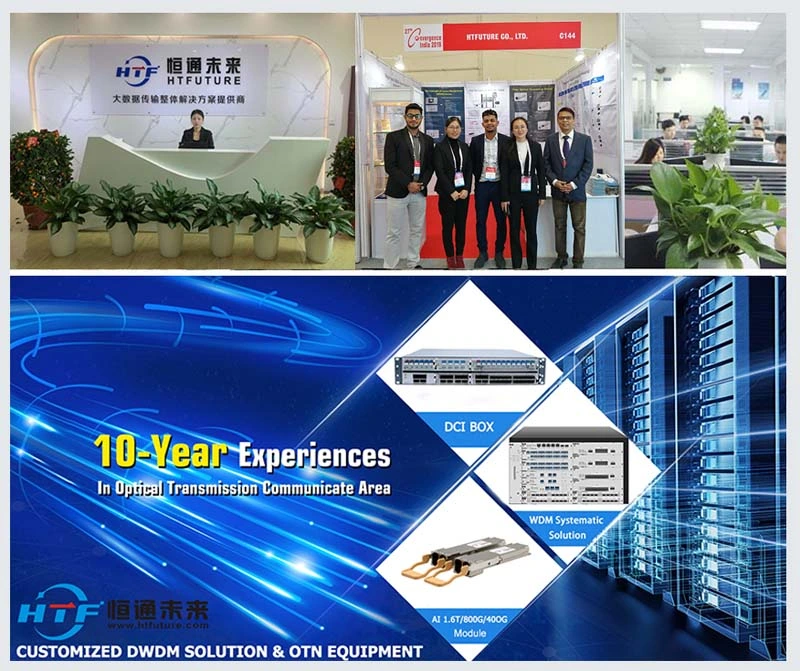
Its flagship product, HTF HT6000, is a compact, high-capacity, and cost-effective OTN optical transport system. Built on a CWDM/DWDM universal platform, it supports multi-service transparent transmission and flexible networking. Designed for national, provincial, and metro backbones, it meets capacities over 1.6 T, delivering efficient and scalable WDM transport for IDC and ISP operators.
In the new era of DWDM technology, HTF continues to expand the boundaries of optical communication—making data flow at the speed of light and connecting the world with intelligence.