
DWDM is redefining how modern data centers handle transmission efficiency in the age of generative AI. As AI model training and inference dramatically increase computing density and rack power consumption, data transmission has become a decisive factor for overall system performance. Therefore, data centers must evolve beyond traditional networking approaches.

As a result, It emerges as a strategic solution. It delivers high bandwidth density, strong energy efficiency, and predictable low latency. Consequently, It is now a foundational technology for next-generation data centers and large-scale interconnection architectures.
DWDM and the New Transmission Pressure from Generative AI
Generative AI workloads place unprecedented pressure on data center networks. Rack power consumption has increased from several kilowatts in the CPU era to 30 kW or more in AI-driven environments. Meanwhile, large-scale model training generates massive east-west traffic due to parameter synchronization and distributed computing.
Therefore, modern data centers face three essential transmission requirements. First, they must support higher throughput within limited physical space. Second, network systems must minimize additional power consumption. Third, latency must remain stable and low to ensure efficient distributed AI operations.
However, traditional parallel optical architectures struggle to meet these demands. As a result, It has regained attention as a more scalable and sustainable transmission model.
DWDM Bandwidth Density as a Response to Computing Growth
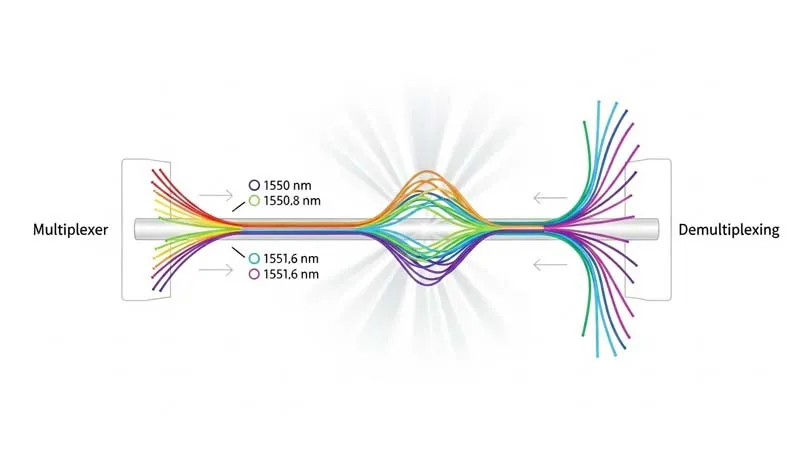
It achieves its core advantage by transmitting multiple high-capacity wavelengths over a single fiber. Consequently, spectral efficiency increases while physical infrastructure complexity decreases. In generative AI environments, this enables higher throughput without excessive fiber expansion.
Moreover, It does not rely solely on increasing single-channel speeds. Instead, it reduces the need for large numbers of parallel optical modules. Therefore, both power consumption and hardware density are significantly optimized. This structural efficiency makes DWDM highly suitable for high-power AI data centers.
DWDM Energy Efficiency and Network Stability
Energy efficiency is critical in AI data centers. It directly impacts operating costs and long-term reliability. By reducing equipment count and simplifying transmission paths, It lowers total network power consumption. As a result, cooling pressure and system complexity are also reduced.
In addition, It has a long history of stable operation in large-capacity transmission networks. Therefore, it provides deterministic performance for AI workloads across campuses or cities. This reliability is essential for maintaining consistent training efficiency in distributed environments.
DWDM Reducing Latency Through Architectural Simplification
Latency often originates from excessive switching layers and repeated optical-electrical conversions. However, It enables flatter transmission architectures with fewer intermediate nodes. Consequently, data paths become more direct and predictable.
As a result, distributed AI training benefits significantly. Parameter synchronization depends on consistent latency. DWDM provides low-jitter links that allow large GPU clusters to operate in tighter coordination and with higher efficiency.
DWDM Expanding from Backbone Networks to DCI
As AI computing becomes more distributed, data center interconnection is no longer optional. Therefore, It is increasingly deployed in DCI scenarios. It enables high-capacity, low-latency connectivity between geographically separated data centers.
Meanwhile, advances such as pluggable coherent modules and open DWDM platforms reduce deployment complexity. Combined with SDN and automation, It is becoming a native capability of modern AI-ready data centers.

The Future Role of DWDM in AI-Oriented Networks
Looking ahead, It will continue evolving toward higher spectral efficiency and lower energy per bit. Furthermore, intelligent optical networks will dynamically adapt to changing AI workloads.
Consequently, It will move beyond basic connectivity. It will become an essential layer for future computing networks, directly supporting distributed AI infrastructure.
Professional Optical Expertise Behind DWDM Deployment
The evolution of DWDM relies on strong optical communication expertise. HTF is a professional supplier of fiber optic products and WDM system solutions, with a long-term focus on large-scale data transmission. Its team brings more than ten years of experience in optical communication R&D, fiber solutions, and component manufacturing.
Therefore, HTF supports customers in building, connecting, and optimizing fiber infrastructure worldwide. It provides transmission solutions for global data centers, 5G networks, cloud computing platforms, metro networks, and access networks.
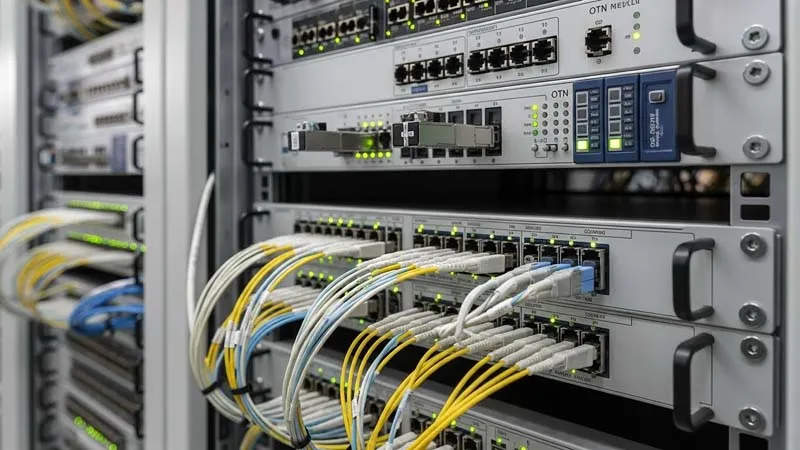
Moreover, HTF HT6000 is a compact, high-capacity, and cost-effective OTN optical transmission system. It adopts a CWDM/DWDM universal platform design and supports transparent multi-service transmission. With flexible networking and node capacities exceeding 1.6T, it is suitable for national backbones, provincial networks, and metro core networks. As a result, it offers IDC and ISP operators an efficient WDM expansion solution.