
DWDM Optical Module Technology Ignites the Digital Era
DWDM optical module technology powers the internet like a blazing engine. It rockets data through fiber-optic highways. With dense wavelength division multiplexing (DWDM), a single fiber carries countless data streams. The arrival of electro-absorption modulated lasers (EML) supercharges this technology. Suddenly, data leaps thousands of miles instantly. This article explores how DWDM optical module technology transforms networks, its applications, market trends, and future potential. Buckle up for a thrilling ride into the future of connectivity!

DWDM Optical Module Technology: The Network’s High-Octane Core
DWDM optical module technology thrives on dense wavelength division multiplexing. It packs multiple data streams into one fiber. Unlike coarse wavelength division multiplexing (CWDM), DWDM uses tight wavelength spacing (0.4-0.8nm). This allows 80-192 channels, boosting capacity to 64Tbps per fiber. It’s a bandwidth beast! Meanwhile, EML technology turbocharges DWDM optical module technology.
Compared to traditional directly modulated lasers (DML), EML is a game-changer. It’s like swapping a bicycle for a racecar. Here’s why:
- High-Speed Transmission: EML handles 400G and 800G rates effortlessly. It powers 5G and data center interconnects.
- Long-Distance, Low Distortion: EML minimizes signal distortion, reaching 80km with error rates as low as 10^-12.
- Energy Efficiency: EML cuts power use by 30% (2.8W vs. 4W). It’s green and mean.
For instance, Huawei’s 400G DWDM module with EML boosts range by 50%. It slashes power consumption too. Thus, DWDM optical module technology redefines network performance with EML leading the charge.
Applications: DWDM Optical Module Technology, A Speedy Superhero
DWDM optical module technology isn’t just lab tech. It’s a real-world hero. From 5G to data centers, it shines. Here’s how it transforms key sectors:
5G Core Networks: Fueling Instant Connectivity
5G demands massive bandwidth and minimal lag. DWDM optical module technology delivers. In 2024, Huawei deployed 800G DWDM systems in China Mobile’s 5G network. Spanning 20 provinces, it achieves 64Tbps per fiber. This powers smart driving and telemedicine seamlessly.
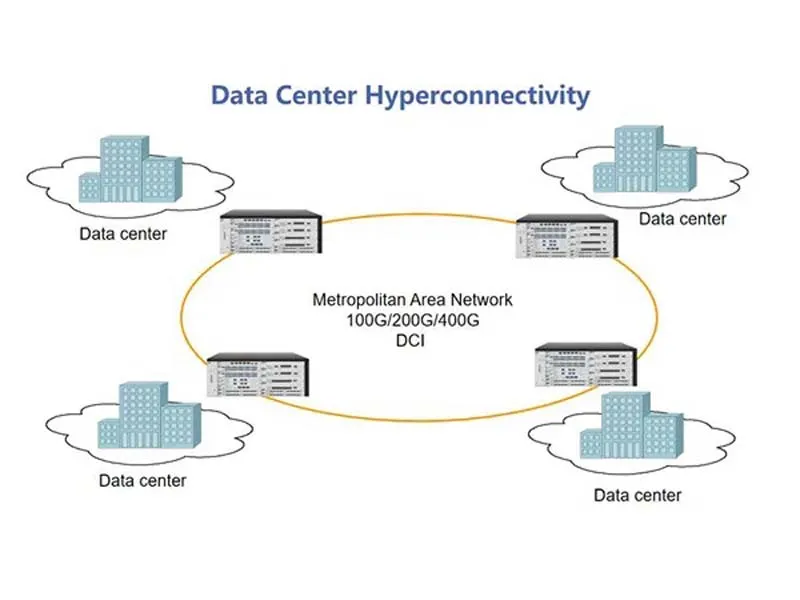
Data Center Interconnects (DCI): Cloud’s Fast Lane
Cloud giants like AWS and Alibaba rely on DWDM optical module technology. Ciena’s 400G EML-based modules enable 100km transmission with 1ms latency. They’re perfect for AI training and cloud computing. In 2023, China’s DWDM module market hit $1.5 billion. By 2030, it’s expected to reach $2.4 billion (CAGR 5.5%).
Metro and Backbone Networks: Smart City Backbone
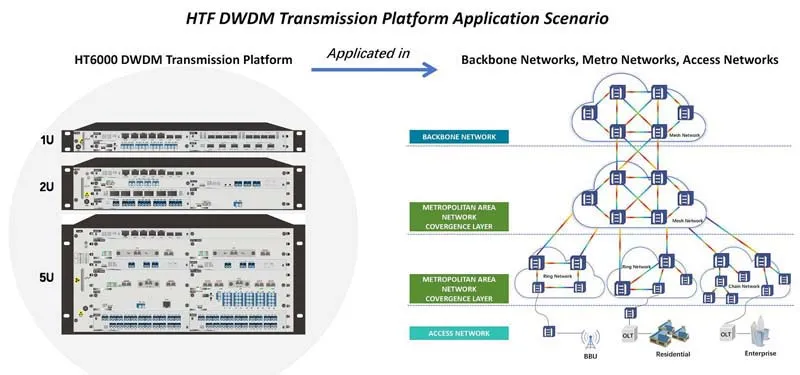
In metro networks, DWDM optical module technology excels. Accelink’s EML modules power Shanghai Telecom’s network with 4Tbps capacity. For backbone networks, DWDM supports global internet traffic. It’s the digital world’s central nervous system.
Like a superhero, DWDM optical module technology zips data across vast distances. It fuels cloud computing, AI, and 8K streaming with ease.
Market Trends: DWDM Optical Module Technology, A Global Race
DWDM optical module technology drives a fierce tech race. The global market is booming. In 2023, it reached $1 billion. By 2030, it’s projected to hit $1.6 billion (CAGR 5.5%). China leads, holding 35% of the global share. By 2030, it may exceed 40%.
Global Competition: Titans and Rising Stars
Ciena, Infinera, and Nokia dominate globally. Yet, Chinese firms like Huawei and Accelink are catching up fast. Huawei’s 800G DWDM system, showcased at MWC 2024, outpaces competitors by 1.5 times in capacity. Accelink’s EML modules claim 30% of China’s market and export to Asia and Europe.
Policy and Green Push
China’s 14th Five-Year Plan boosts DWDM optical module technology. In 2024, the Ministry of Industry backed EML research with grants. Globally, carbon neutrality drives low-power designs. EML’s 18.3% better efficiency makes it a green champion.
Smarter, Faster Networks
DWDM optical module technology is evolving. It’s heading toward 800G and 1.6T rates. AI and software-defined networking (SDN) enable dynamic bandwidth allocation. Ciena’s AI-driven DWDM cuts operating costs by 30%. Huawei’s smart optical solutions are already global.
Challenges and Outlook: DWDM Optical Module Technology, Racing to the Future
DWDM optical module technology faces hurdles. EML’s complex production raises costs by 20-30% over DML. CWDM’s affordability still rules short-range markets. Global standards for wavelengths and protocols lag behind.
However, the future is bright. DWDM optical module technology will hit 1.6T rates, exceeding 100Tbps per fiber. AI and SDN will make networks smarter, like ordering bandwidth on demand. Green designs, led by EML, align with carbon goals. By 2030, Chinese firms may dominate the global stage.
HTF: Your Partner in Optical Innovation
To harness DWDM optical module technology, you need a trusted ally. HTF (Shenzhen HTFuture Co.) delivers top-tier fiber products and WDM solutions. Its team, with over a decade of expertise, builds and optimizes fiber infrastructure. HTF serves data centers, 5G, cloud, metro, and access networks worldwide.
HTF’s HT6000 is a compact, high-capacity, low-cost OTN system. It supports CWDM and DWDM, offering flexible multi-service transmission. Perfect for national, provincial, and metro backbone networks, it handles over 1.6T capacity. For IDC and ISP operators, HT6000 is a cost-effective WDM expansion solution.
Conclusion: A Bright, Lightning-Fast Future
DWDM optical module technology, powered by EML, reshapes connectivity. It drives 5G, cloud, and global networks. With HTF’s solutions, this technology lights up the digital era. Join the race. Embrace DWDM optical module technology. The future is here, and it’s blazing fast!