
- The Eve of Change in the DWDM Industry
The DWDM industry is entering a new era of transformation. As global data traffic grows exponentially, cloud computing, AI, and IoT drive demand for faster, simpler, and more efficient networks. Traditional DWDM (Dense Wavelength Division Multiplexing) systems have been the backbone of global communication for decades, offering high capacity and reliability.

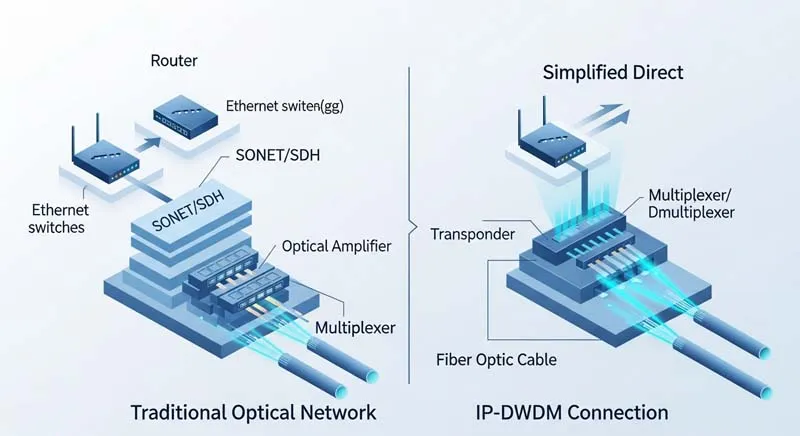
However, as cloud data centers expand, the traditional multi-layer network design (IP–OTN–DWDM) has become complex, costly, and energy-hungry. In this context, IPoDWDM (IP over DWDM) emerges as a breakthrough — a symbol of the shift toward openness and simplicity in optical networking. This technology is redefining how IP and optical layers interact.
- From Complexity to Simplicity: The Core of IPoDWDM
In traditional DWDM industry architecture, OTN or other intermediate devices convert signals between IP and optical layers. Though reliable, this design adds delay, power use, and maintenance costs.
IPoDWDM breaks that barrier by sending IP traffic directly into the optical network. Its main features include:
Direct connection – IP routers connect to DWDM systems through coherent modules like 400G ZR/ZR+, removing OTN layers.
Smart control – SDN (Software Defined Networking) and AIOps allow unified management and automation.
Open ecosystem – Open Line System (OLS) standards make equipment from different brands work together.
The result: a flat, direct, and efficient network instead of a multi-layered one.
- Cloud and Data Centers: The Power Behind the Shift
Cloud and hyperscale data centers are the main drivers of this DWDM industry evolution. They need high bandwidth, low latency, low power use, and intelligent control.
IPoDWDM delivers exactly that:
- Lower cost: removing OTN layers cuts Capex by 30–40%.
- Less delay: IP connects directly to optical fibers, reducing latency by about 25%.
- More flexibility: unified control for wavelength and routing allows instant traffic changes.
- Simpler maintenance: real-time monitoring adjusts power and bandwidth automatically.
For cloud providers, IPoDWDM means faster deployment, lower costs, and more stable operation — a true change in both technology and business models.
- New Trends in the DWDM Industry: Open, Integrated, Intelligent
The rise of IPoDWDM is driving the DWDM industry toward three main trends:
(1) Open Architecture
Old optical systems were “closed boxes.” Now, groups like Open ROADM and Telecom Infra Project (TIP) promote open standards that allow multi-vendor interoperability. This makes the industry more collaborative and competitive.
(2) Layer Integration
The IP and optical layers are merging into one intelligent network. The optical layer handles transport; the IP layer handles control. Together, they form a learning, adaptive, self-healing system.
(3) Intelligent Operations
AI and AIOps help networks self-monitor, predict failures, and automatically optimize power and wavelength use — turning maintenance into a smart, data-driven process.
- Real-World Use Cases
Cloud Data Center Interconnection (DCI)
A global cloud provider used 400G ZR+ modules for city-to-city connections. The setup cut energy use by 35% and reduced latency to 70% of the original.

Metro Backbone Networks
A telecom operator merged IP/MPLS and optical layers through IPoDWDM. Equipment layers dropped from three to two, bandwidth use rose by 20%, and maintenance time halved.
5G and IoT Backhaul
In 5G and industrial IoT, IPoDWDM enables flexible wavelength management, allocating channels based on real-time traffic priority for ultra-low-latency communication.
- Challenges and Solutions
While the shift is unstoppable, the DWDM industry still faces several challenges:
Lack of unified standards – Different vendors’ systems use different interfaces and protocols.
Skill gap – Engineers must now master both IP and optical technologies.
Legacy network transition – Existing OTN systems will take time and budget to phase out.
But these challenges also bring opportunity. The future DWDM industry will be more open, skilled, and intelligent.
- The Future: Smart Networks Built on Light
The DWDM industry restructuring is more than a hardware upgrade — it’s a mindset shift. IPoDWDM makes light not just a passive medium but an intelligent part of the network.
In the next five years, as coherent optics become cheaper and AI more embedded, IPoDWDM will become the default design for backbone, data center, and 5G networks.
Open, simplified, and intelligent — these will be the defining traits of the next-generation optical network.
Simplicity, Openness, and Intelligence Lead the Way
The DWDM industry is moving from complex to simple, from closed to open, from static to smart. IPoDWDM allows light and IP to work as one — faster, greener, and more efficient.

Amid this transformation, leaders in optical networking are driving progress through innovation.
HTF, a professional supplier of fiber optic products and WDM system solutions, brings over ten years of R&D and manufacturing experience to serve global telecom and data clients. Its flagship product, HTF HT6000, is a compact, high-capacity, and cost-effective OTN transport platform supporting CWDM/DWDM and multi-service transmission. It’s ideal for backbone, metro, and data networks demanding scalability beyond 1.6T.

HTF is dedicated to helping customers build, connect, and optimize fiber infrastructure for data centers, 5G, cloud computing, and metro access networks worldwide.
As the DWDM industry embraces intelligent direct connection, HTF continues to power the future of optical communication with innovation, expertise, and trust.