
DWDM Industry Evolution is entering a decisive transformation phase. What once focused mainly on expanding telecom bandwidth is now becoming a core infrastructure that enables artificial intelligence, cloud computing, and large-scale computing networks. As a result, DWDM is no longer just a transmission technology. Instead, it is evolving into a strategic foundation for modern digital economies.

At this critical point, understanding DWDM Industry Evolution is essential. It helps network operators, data center builders, and system vendors align their long-term strategies with the future of optical transport.
From Network Connectivity to Computing Power Transmission
For many years, DWDM primarily supported traditional telecom networks. Its main mission was simple: deliver more bandwidth over longer distances. However, as mobile and fixed broadband growth slows, this model alone can no longer sustain industry momentum.
Meanwhile, DWDM Industry Evolution is being reshaped by AI training clusters, cloud platforms, and high-performance computing. These environments generate massive east–west traffic. Therefore, they require not only high bandwidth but also ultra-low latency, strong reliability, and deterministic performance.
As a result, data center interconnection (DCI) has become the most critical growth engine for DWDM. Consequently, DWDM is no longer a passive “bit pipe.” Instead, it is becoming a digital artery that enables coordinated computing power across distributed locations. This shift represents the first fundamental driver of DWDM Industry Evolution.

Technology Direction: More Capacity, Faster Speeds, Lower Cost
Driven by computing-centric demand, DWDM Industry Evolution follows three clear technical directions.
More Spectrum and Higher Fiber Capacity
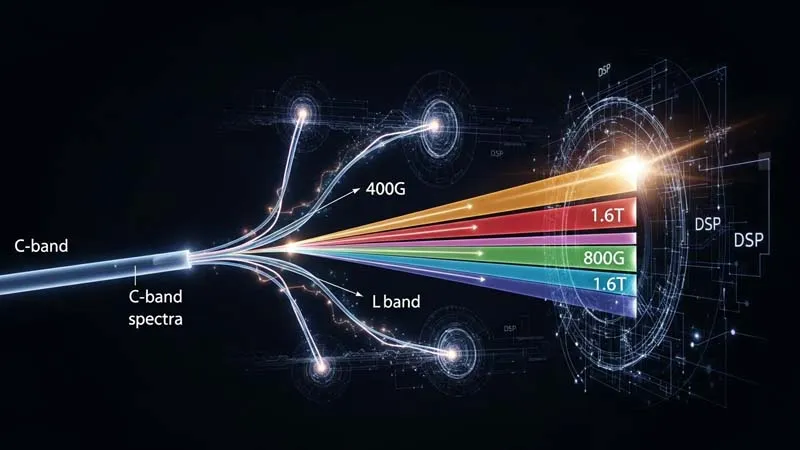
First, single-fiber capacity has become a top priority. Since the C-band is approaching practical limits, expansion toward the C+L band is inevitable. However, this move increases complexity in optical amplifiers, transceivers, and system design. Therefore, engineering capability is becoming a key differentiator.
Faster Single-Wavelength Transmission
Second, single-wavelength speeds continue to rise. The transition from 400G to 800G, and now toward 1.6T, clearly defines the technical path of DWDM Industry Evolution. These advances rely on higher-order modulation, stronger DSP performance, and improved optoelectronic components. As a result, networks gain higher efficiency and simpler architectures.
Lower Cost and Reduced Power Consumption
Third, cost per bit and power efficiency are now decisive. In data centers and cloud networks, energy constraints are strict. Therefore, silicon photonics integration, optimized O-band usage, and system-level efficiency improvements are essential. Without these factors, large-scale deployment would not be commercially sustainable.
Architecture Shift: From Closed Systems to Open and Disaggregated Networks
Beyond performance, system architecture is changing rapidly. Traditional DWDM platforms are tightly integrated and vendor-locked. While reliable, they lack flexibility.
In contrast, IPoDWDM and ZR/ZR+ pluggable optics are redefining network design. Optical transmission capabilities are becoming modular and moving closer to the IP layer. As a result, the boundary between routing and optical transport is fading.
Therefore, DWDM Industry Evolution is accelerating toward open, flat, and disaggregated network architectures. This change allows operators and cloud providers to combine components freely, reduce dependency, and optimize networks based on real needs.
Ecosystem Reshaping and Vertical Integration
Another defining trend in DWDM Industry Evolution is the rise of vertical integration. Cloud service giants such as AWS are developing their own optical transmission systems. This strategy reflects a demand for extreme performance, cost control, and full network visibility.
Meanwhile, this trend challenges traditional equipment vendors. Business models based on closed systems are under pressure. Consequently, long-term competitiveness now depends on core optical technologies, system engineering expertise, and scenario-driven solutions.
From Industry Trends to Real-World Deployment
Overall, DWDM Industry Evolution clearly shows a shift from bandwidth expansion to computing infrastructure enablement. This transformation is technical, architectural, and commercial.
In this context, solution providers with strong engineering depth play a vital role. HTF is a professional supplier of optical fiber products and WDM system solutions, supported by a team with over ten years of experience in optical communication R&D, component development, and manufacturing.

HTF’s HT6000 compact OTN optical transmission system adopts a CWDM/DWDM universal platform design. It supports transparent multi-service transmission and flexible networking. Moreover, it delivers node capacity exceeding 1.6T, making it suitable for national backbone networks, metro core networks, IDC environments, and ISP deployments. In the era of DWDM Industry Evolution, such cost-effective and scalable platforms are becoming essential to next-generation optical networks.
Conclusion: DWDM as the Digital Artery of the Future
From bandwidth growth to computing power enablement, DWDM Industry Evolution is reshaping the optical communication landscape. Looking ahead, DWDM will continue to expand its role across AI, cloud, and data center ecosystems. At the same time, openness, efficiency, and engineering execution will define future competition.
Understanding this evolution is no longer optional. Instead, it is a strategic requirement for anyone building the networks that power tomorrow’s digital world.