
The DWDM industry is transforming rapidly. CMOS silicon photonics drives this change. It integrates modulators, detectors, and DSPs into one chip. This shrinks equipment size and cuts power use. Thus, it boosts data transmission efficiency. As a key path in the DWDM industry, this innovation sparks a new, sustainable era.

DWDM Industry Overview: Core Principles and Market Drivers
The DWDM industry powers modern optical networks. Dense Wavelength Division Multiplexing sends multiple light signals through one fiber. This boosts data capacity dramatically. Since the 1990s, the DWDM industry has evolved from coarse to dense multiplexing. Now, it supports 5G, data centers, and cloud computing.
Market data predicts the DWDM industry will hit billions by 2025. Annual growth exceeds 10%. AI, IoT, and edge computing fuel this surge. For instance, data centers rely on DWDM for terabit-per-second speeds. Yet, challenges persist. Traditional systems are bulky and power-hungry. This raises costs and energy use. In data centers, large equipment limits scalability. High power use also conflicts with carbon neutrality goals. Therefore, the DWDM industry seeks solutions. Silicon photonics emerges as the answer.
CMOS Silicon Photonics Explained: Principles and Benefits
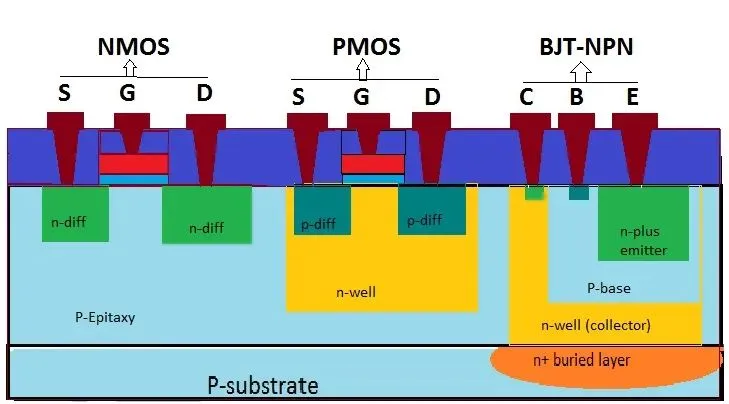
Silicon photonics revolutionizes the DWDM industry. It uses CMOS processes to integrate optical components. Modulators, detectors, lasers, and DSPs fit on one chip. Silicon waveguides transmit light signals. Electro-optic effects enable modulation and detection. This simplifies production.
Silicon’s compatibility with CMOS is key. It leverages existing semiconductor lines. Consequently, costs drop significantly. Unlike III-V semiconductors like gallium arsenide, silicon photonics uses standard silicon wafers. This enables mass production.

The benefits are clear. First, size shrinks dramatically. In DWDM applications, silicon photonic modules are 1/10th the size of traditional ones. A 400Gbps DWDM transceiver fits in a few square centimeters. Second, power consumption falls. Silicon photonics cuts energy use by 30%-50%. Reports show single-channel power drops from 5W to under 2W. This saves energy in data centers. Third, performance improves. Silicon photonics supports coherent detection and advanced modulation like QAM-64. This boosts spectrum efficiency in the DWDM industry.
Compared to III-V materials, silicon photonics wins on cost and compatibility. Recent advances address challenges. In 2025, efficiency hits 95% with germanium doping and nanostructures. Patent filings for silicon photonics rose 20% this year. However, issues remain. Material compatibility needs work to reduce signal loss. Thermal management is critical for high-power scenarios. AI-driven design and new materials like silicon nitride tackle these hurdles.
Silicon Photonics in DWDM: Applications and Case Studies
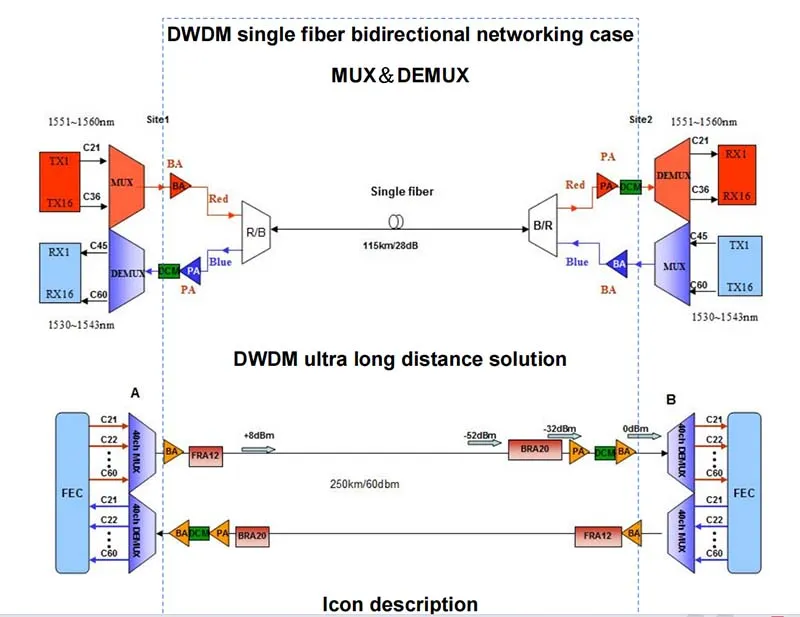
Silicon photonics reshapes DWDM applications. In data center interconnects, compact modules enable high-density setups. This supports seamless data transfer. For long-haul transmission, integrated amplifiers extend distances to thousands of kilometers. Performance remains stable. In 5G backhaul, silicon photonics lowers costs and speeds responses. Edge computing benefits too. Smaller DWDM devices suit remote nodes, aiding IoT growth.
Real-world cases highlight success. Huawei’s OptiX series uses silicon photonics for 400G transmission. It cuts power by 40% and size by 50%. Cisco’s Nexus platform saves 30% energy in data centers. Intel’s silicon photonic transceivers deliver 1.6Tbps capacity. These support AI-optimized networks. Such examples prove silicon photonics boosts efficiency and reduces costs in the DWDM industry.
Economically, silicon photonics impacts the entire DWDM industry chain. Upstream material suppliers gain from silicon demand. Downstream manufacturers benefit from standardized production. Moreover, silicon photonics fuels integration with AI and cloud computing. AI-driven DSPs optimize signals in real time. This empowers smarter networks and digital transformation.
Opportunities and Challenges in the DWDM Industry
The DWDM industry has vast potential. Silicon photonics drives growth. Forecasts predict a 12% annual growth rate through 2030. 6G and quantum communication will amplify demand. Silicon photonics supports multi-wavelength transmission, enabling terabit-scale networks. Its low power aligns with green computing goals.
Yet, challenges loom. Standardization lags, slowing adoption. Supply chains depend on silicon foundries, risking geopolitical disruptions. Technology maturity needs time. Intellectual property battles intensify. Additionally, environmental regulations demand lower emissions. Outdated high-power systems face obsolescence.
Solutions exist. Governments can offer R&D subsidies. Companies should invest in joint labs. International collaboration can unify standards. These steps will strengthen the DWDM industry.
Future Outlook: A Sustainable DWDM Industry
Silicon photonics ushers in a new era for the DWDM industry. It slashes size and power use. This solves key pain points. The future promises higher integration and multi-wavelength systems. The DWDM industry will power smarter, faster global networks.
Choosing the right partner is vital. HTF, a leading optical fiber and WDM solution provider, excels here. Its team boasts over a decade of expertise in optical communication, solutions, and device manufacturing. HTF builds, connects, and optimizes fiber infrastructure. It serves global data centers, 5G networks, cloud computing, metro, and access networks with tailored solutions and support.
Notably, HTF’s HT6000 system stands out. This compact, high-capacity, low-cost OTN platform uses CWDM/DWDM designs. It supports multi-service transmission and flexible networking. Ideal for national, regional, and metro core networks, it meets 1.6Tbps node demands. It’s a cost-effective choice for IDC and ISP operators, enabling scalable WDM solutions.
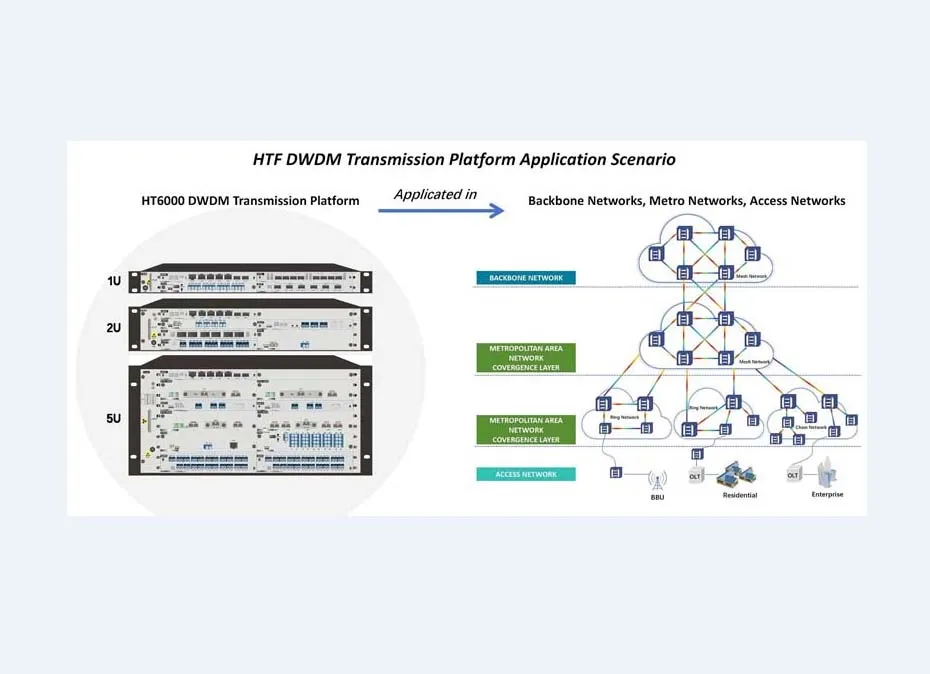
In the DWDM industry’s evolution, HTF drives progress with expertise and innovation.