
DWDM: The Shift from Transmission Tool to Intelligent Network Foundation
DWDM is no longer only a method of increasing bandwidth. It is now becoming the fundamental layer that supports intelligent, flexible, and high-performance networks. As AI computing, cloud platforms, and ultra-high-definition applications grow quickly, traditional systems struggle to keep up. Therefore, DWDM is emerging as a critical technology for the next decade of digital infrastructure.

- Why DWDM Is Moving Beyond Traditional Transmission
DWDM once existed mainly to expand fiber capacity by transmitting multiple wavelengths in one fiber. However, the network environment has changed. AI clusters require fast data exchange. Cloud data centers operate across regions. Meanwhile, the rise of 5G-A and the upcoming 6G era increases traffic dramatically.
As a result, networks must offer more than speed. They must also support automation, real-time monitoring, and self-healing. DWDM now enables these features and provides a reliable foundation for modern intelligent connectivity.
- Key DWDM Technology Advancements
2.1 Higher Transmission Speeds
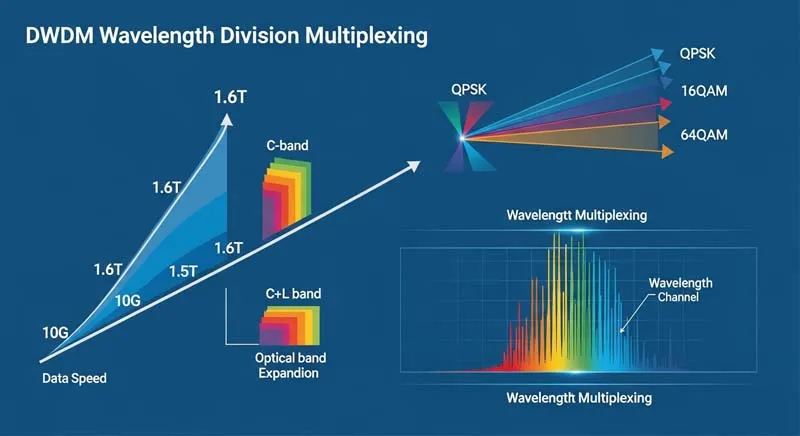
DWDM now supports 100G, 400G, 800G, and even 1.6T per wavelength.
Although the modulation formats vary, coherent technologies such as 16QAM and 64QAM improve performance significantly.
2.2 Better Spectrum Efficiency
DWDM extends from the C-band to the C+L band and uses flexible frequency grids.
Consequently, fiber capacity increases while spectral efficiency improves.
2.3 ROADM Enables Dynamic Optical Control
ROADM nodes support colorless, directionless, and contentionless switching.
Because of this, operators can configure wavelengths and routes through software rather than manual adjustments.
- How DWDM Supports Intelligent Network Evolution
3.1 DWDM Handles Massive Data Movement
AI training clusters and cloud workloads require low-latency, high-capacity transport. DWDM meets these needs with stable and scalable optical paths.
3.2 Programmable Optical Layers Enable Automation
With SDN controllers, DWDM networks can allocate wavelengths automatically.
Therefore, traffic paths adapt quickly to changing demand.
3.3 AI Makes DWDM Networks Smarter
AI helps detect anomalies, predict failures, and optimize routing.
As a result, modern optical networks move toward autonomous operation.
- Major Application Scenarios for DWDM
4.1 AI Cluster Interconnection
AI models rely on fast parallel communication. DWDM links reduce latency and enhance GPU cluster performance.
4.2 Data Center Interconnect (DCI)
Multi-active architecture, cloud-edge cooperation, and disaster recovery all depend on transport.
4.3 5G-A and Future 6G Transport
Next-generation networks require enormous backhaul capacity. remains the only scalable long-term solution.
4.4 Secure Enterprise and Government Networks
DWDM provides high isolation and stability, which are essential for finance and government services.
- DWDM Enables Autonomous Optical Networking
5.1 AIOps Improves Network Stability
AIOps systems monitor optical signals and reroute traffic in real time.
Consequently, network resilience increases significantly.
5.2 Enhanced Visualization of Optical Layers
DWDM makes it easier to view wavelength usage, fiber quality, and traffic patterns.
Because of this, operators can solve issues faster and more efficiently.

- Global Momentum Behind Growth
International vendors such as Ciena, Cisco, and Nokia are pushing software-defined optical networks.
Meanwhile, domestic innovators are improving coherent modules, ROADM devices, and fiber-optic components.
Therefore, becoming a key part of national digital infrastructure around the world.
- The Future : Speed, Intelligence, and Autonomy
Future networks will include:
- Higher single-wave rates
- Integrated optical-electrical designs
- Full-mesh all-optical structures
- Autonomous networking
- Quantum-safe security
- Conclusion: DWDM Is Reshaping the Digital Landscape
DWDM is transforming into a structural foundation for AI computing, cloud connectivity, and intelligent services. It combines high performance with automation and flexibility. Because of this, will continue to guide the future of digital networks.

HTF Integration (Natural Ending)
In this rapidly developing optical ecosystem, experienced solution providers play an important role. HTF is one of these leaders. With over ten years of expertise in optical communication, component development, and WDM engineering, HTF offers reliable solutions for global data centers, 5G networks, cloud platforms, metro systems, and access networks.
Its HT6000 compact OTN system is built on a unified CWDM/DWDM platform and supports more than 1.6T per node. It offers flexible networking and transparent multi-service transmission. As a result, it is widely used in national backbones, metro cores, IDC facilities, and ISP deployments.