
In 2025, AI training has entered the “lightspeed computing” era. A single cluster’s peak performance now exceeds 10²⁰ FLOPS. Pretraining large models with tens of billions of parameters consumes over 100 PB of data. Therefore, cross-region and cross-facility transmission speed has become the key to training success. Traditional electrical interconnects have reached their limits. Now, DWDM (Dense Wavelength Division Multiplexing), with a verified 100 Tbps per fiber, is leading a true bandwidth revolution for AI infrastructure.

Single-Fiber 100T: A Fusion Breakthrough in DWDM Technology
DWDM is no longer exclusive to backbone networks. In October 2025, OpenAI and Meta jointly released a cross–data center verification report.
In a 400 km loop between three mega data centers on the U.S. West Coast, the DWDM system achieved 100.8 Tbps net load, 50 μs end-to-end latency, and only 0.0001% packet loss. As a result, a GPT-5-scale pretraining task that once took 42 days was completed in 7.2 days—a sixfold improvement in training efficiency.
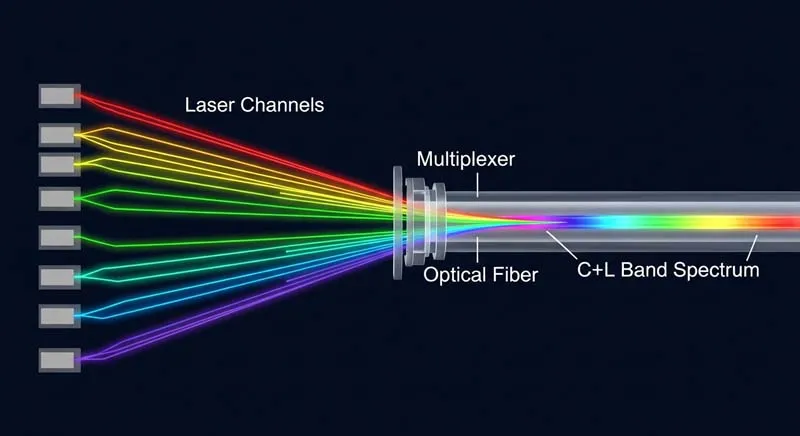
This breakthrough came from four key fusion technologies in DWDM:
- Full C+L band utilization: 192+ channels × 1.2 Tbps per λ, theoretical capacity near 230 Tbps.
- Ultra-low-loss fiber with distributed Raman amplification: attenuation reduced to 0.14 dB/km, achieving 1000 km spans without electrical regeneration.
- 6th-gen coherent DSP: PSE-6s chip, 192 GBaud symbol rate, spectral efficiency approaching the Shannon limit.
- Silicon photonics PIC integration: single-chip packaging of 32×400G transceivers with power efficiency of 1.8 pJ/bit, an 85% reduction versus legacy systems.
Now DWDM is expanding from long-haul networks into metro DCI (Data Center Interconnects) and campus spine layers.
With 400G ZR/ZR+ coherent modules in mass production, per-port cost drops to $1.2/Gbps. The IPoDWDM architecture allows routers to drive optical signals directly, simplifying network layers by 40%.
Green Compute Power: DWDM Redefines AI Infrastructure Efficiency
AI training’s carbon footprint is nearing that of the entire aviation industry. DWDM, by replacing electrons with photons, cuts transmission energy per bit from 12 pJ to 1.8 pJ.

Combined with liquid cooling and electro-optical synergy, data center PUE approaches 1.05.
Tests show that one 100 Tbps DWDM link saves as much electricity per year as 2800 tons of standard coal, reducing 7200 tons of carbon emissions.
Industrial Transformation: DWDM Empowers Three Core Ecosystems
- Compute Giants: OpenAI, xAI, and Anthropic use DWDM to build “global single-cluster” AI training networks.
- Optical Network Vendors: Ciena WaveLogic 6, Infinera ICE-X, and Huawei OptiXtrans race toward 1.6 Tbps/λ transmission.
- Chip Innovators: Broadcom Tomahawk 6, Marvell Teralynx 10, and Acacia Cirrus DSP push coherent processing to new limits.
Hence, DWDM is evolving from a transmission pipeline to a computing substrate, reshaping the global AI infrastructure landscape.
2026–2028: Toward Pb/s Fiber and Hollow-Core Experiments
Labs have achieved 1.6 Tbps per λ in stable transmission.
Hollow-core fibers now reach 0.14 dB/km attenuation, making 1000 km spans possible without repeaters.
AI-driven self-healing DWDM networks can dynamically reconfigure wavelengths, ensuring 99.9999% availability.
Consequently, bandwidth is no longer scarce but becomes an infinitely scalable optical utility.
Bandwidth Is Compute — DWDM Rebuilds the Foundation of AI Civilization
100T is not the end, but the beginning of the “infinite bandwidth” age.
Next-generation AI training will be measured in speed of light.
Thus, DWDM is laying the most solid physical foundation for humanity’s next leap in intelligent evolution.

As a professional provider of optical fiber products and WDM system solutions, HTF is built by a team with over 10 years of experience in optical R&D, device manufacturing, and fiber infrastructure design.
HTF helps global data centers, 5G networks, and cloud computing providers build and optimize optical infrastructures, offering full-chain services from design to deployment and technical support.
Among them, the HTF HT6000 is a compact, high-capacity, and cost-efficient OTN optical transmission system.

It features a CWDM/DWDM-compatible platform, supports multi-service transparent transmission, and offers flexible network configurations.
It is ideal for national, provincial, and metro backbone networks, supporting capacities beyond 1.6T per node.
HTF’s solution empowers IDC and ISP operators to achieve the most cost-effective DWDM transmission expansion.
Contact HTF now to customize your 100T single-fiber era transmission solution → Explore the HT6000 Series