
Disaggregated WDM is reshaping the future of optical transport, giving networks a new path toward efficiency and scalability. As data traffic grows rapidly and application demands become more diverse, traditional integrated systems show clear limitations.
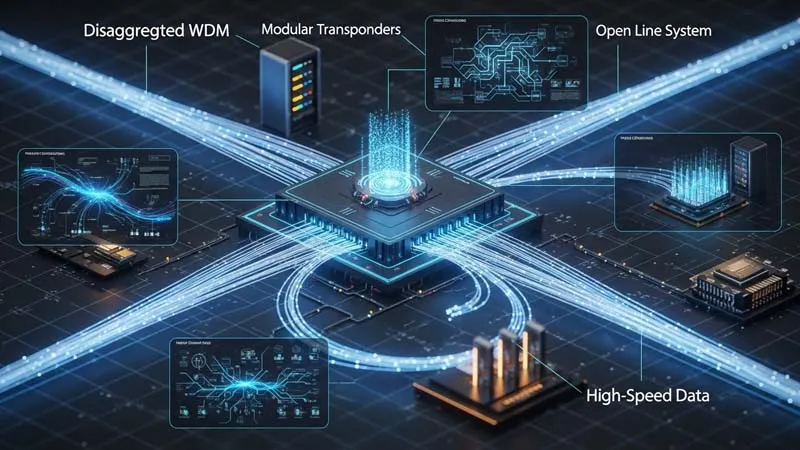
Their closed design, slow upgrade cycles, and high expansion costs no longer match the needs of operators, cloud providers, and enterprise networks. Therefore, disaggregated WDM has emerged as a strategic solution that supports lower costs, faster innovation, and more flexible deployment.
Today, optical networks hold a central role in cloud computing, edge collaboration, and large-scale data center interconnection. Because of this shift, networks must deliver stronger bandwidth elasticity, shorter upgrade cycles, and higher automation. They must also remain cost-efficient to support long-term infrastructure growth. Disaggregated WDM enables these capabilities by opening the optical layer and allowing independent evolution across system modules.
1.From Closed Systems to Open Architecture
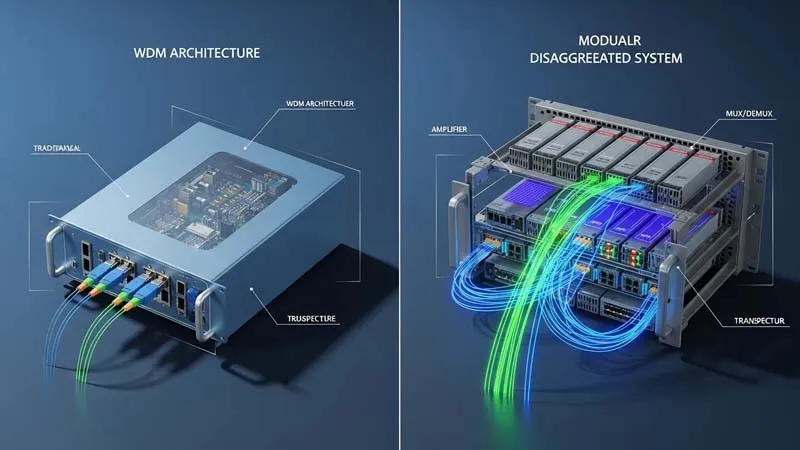
For many years, traditional WDM systems relied on tightly integrated hardware and software. This model simplified early deployment but eventually created multiple constraints.
Moreover, upgrades often required full system replacement, which increased both cost and risk.
In addition, limited interoperability prevented operators from choosing the best components from different vendors.
However, disaggregated WDM addresses these challenges through modular design. It separates transponders, open line systems, amplifiers, ROADMs, and control software into independent units. As a result, networks gain architectural flexibility and stronger long-term scalability. This transition marks a shift from closed “black-box” systems to open, customizable platforms that support continuous innovation.
2.Dual Value: Cost Efficiency and Performance Growth
A. Lower Total Cost of Ownership
Disaggregated WDM significantly reduces capital and operating costs. Operators can choose hardware based on performance, price, or availability. This flexibility increases procurement efficiency.
Furthermore, capacity can be added gradually, reducing upfront investment.
Because the architecture avoids vendor lock-in, it also lowers long-term maintenance costs.
Therefore, for telecom operators, cloud companies, and IDC service providers, disaggregated WDM delivers measurable financial advantages.
B.Continuous and Independent Performance Evolution
Performance can improve without replacing the entire system. Newer technologies, such as 400G or 800G wavelengths, can be adopted quickly.
In addition, line systems and transponder layers can evolve independently, which strengthens upgrade agility.
Moreover, SDN-based software introduces automation, real-time optimization, and rapid issue detection.
Consequently, networks become more resilient, more flexible, and more intelligent.

C. High Adaptability to Future Network Models
As cloud computing, distributed workloads, and data-intensive applications expand, network demands grow more complex.
Disaggregated WDM supports a wide range of deployment models and integrates smoothly with open optical modules such as ZR and ZR+.
Therefore, it creates a future-ready foundation that adapts to emerging connectivity needs.
3. Key Use Cases.
A.Telecom Networks
The rise of 5G and cloud-network integration requires a transport system that evolves quickly.
Disaggregated WDM supports phased upgrades, helping operators reduce cost while improving capacity.
B .Data Center Interconnect (DCI)
Hyperscale data centers need fast expansion and cost-efficient bandwidth.
Because disaggregated WDM offers vendor flexibility and compatibility with pluggable optics, it is becoming a preferred solution for DCI deployments.
C.Government and Enterprise Networks
Industries such as finance, transportation, and public safety require secure and customizable optical transport.
Disaggregated WDM enables these networks to achieve independent control, scalable design, and clear upgrade paths.
4. Industry Challenges and Future Trends
Although disaggregated WDM is advancing quickly, certain challenges remain.
For instance, multi-vendor interoperability must continue to improve.
In addition, optical-layer visibility and automated operations require deeper integration with intelligent software systems.
Even so, global open projects like OpenZR+, OpenROADM, and TIP OOPT are accelerating progress.
As a result, disaggregated WDM is expected to become the mainstream design of next-generation optical transport.
5.A Strategic Framework for the Next Era of Networks
Disaggregated WDM reflects a new design philosophy for optical networks.
It brings openness, agility, and long-term scalability to modern infrastructure.
As data demands expand and digital transformation progresses, this architecture will continue to support high-performance and cost-efficient growth.
HTF contributes to this evolution as a global provider of optical fiber products and WDM solutions. The company has more than ten years of experience in optical R&D, device engineering, and manufacturing.
It delivers transmission solutions for data centers, 5G networks, cloud platforms, metro systems, and access networks. Its HTF HT6000 system is a compact and cost-efficient OTN platform designed for CWDM/DWDM applications. It supports multi-service transparent transport and offers more than 1.6T per node, making it a strong choice for IDC and ISP operators seeking scalable WDM capacity.
As the industry moves toward open and intelligent infrastructure, HTF will continue to support reliable and efficient optical transport worldwide.