
Chromatic Dispersion (CD) is a critical challenge in high-speed DWDM transmission. It stretches optical pulses and increases bit-error rates. As a result, DWDM links lose stability and reach. A DCM (Dispersion Compensation Module) reverses this distortion. Consequently, modern DWDM networks depend on DCMs to preserve signal integrity over medium- and long-haul fiber routes.
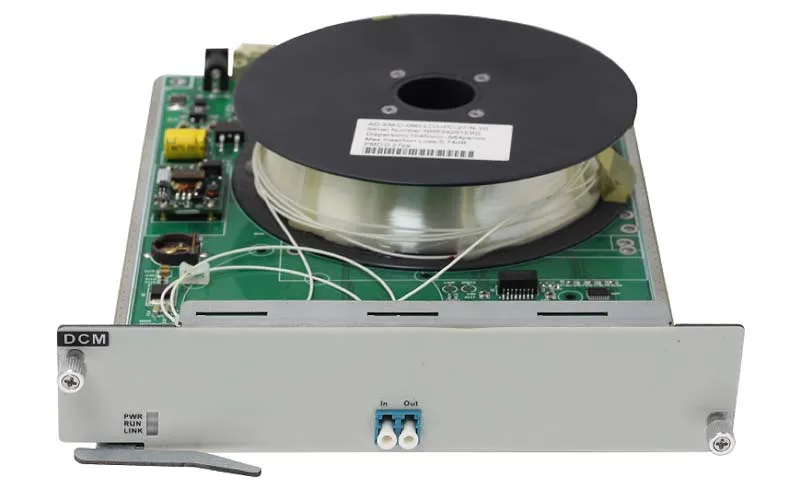
1. DCMs Reduce Chromatic Dispersion in Standard Fiber
CD occurs because different wavelengths travel at slightly different speeds. This time-shift spreads optical pulses. Without a DCM, DWDM channels—especially at high speeds—quickly become distorted.
Legacy G.652 fiber has high CD levels. A 100 km span accumulates roughly 1700 ps/nm, which easily exceeds the tolerance of many DWDM formats. However, a DCM uses negative-dispersion fiber to counteract this effect. For instance, a 25 km DCM can cancel the CD of nearly 200 km of G.652 fiber. Therefore, the original pulse shape is restored and system BER returns to acceptable levels.
2. DCMs Enable Long-Haul DWDM Networks
Although EDFAs boost optical power, they do not correct CD. If a DWDM system relies on amplification alone, even a 10G signal can fail after 80 km. This is why long-haul systems combine EDFA + DCM stages.
Every 80–120 km, an EDFA increases signal strength while a DCM removes accumulated CD. With this coordinated design, DWDM networks can reach 200–800 km or more, making long-distance backbone and inter-city links practical and stable.
3. DCMs Support High-Speed DWDM Channels (100G and Above)
Higher data rates tolerate far less dispersion. A 10G channel can survive several thousand ps/nm of CD. However, a 400G 16QAM coherent signal may tolerate only around 1500 ps/nm.
Here, the DCM becomes essential. It offers either fixed or tunable compensation to match real fiber conditions. Moreover, tunable DCMs adapt to link variations in dynamic DWDM networks, which is particularly useful when channel speeds or routes change.
4. DCMs Offset Fiber-Type Limitations
Because fiber types differ in dispersion characteristics, a DCM helps unify performance across varied infrastructures. For example, G.655 and G.657 fibers have lower CD than G.652, yet they still require correction for ultra-long or high-capacity routes.
Some DCMs also integrate PMD-mitigation elements. While DSP helps compensate PMD in coherent systems, legacy fibers with high PMD still benefit from hybrid DCM-PMD modules. Thus, operators gain greater stability even on aging fiber routes.
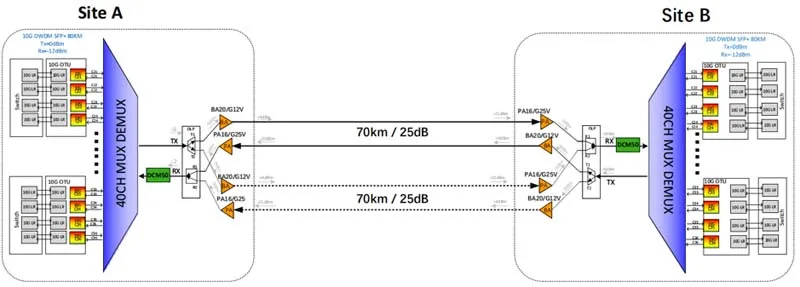
5. DCMs Prevent Distortion in Amplifier Chains
As EDFAs amplify signals, they introduce nonlinear effects. When CD is high, pulse spreading amplifies these distortions and increases bit overlap. A DCM placed between amplifier stages restores proper pulse shape. Therefore, EDFAs operate at optimal power levels, and the entire DWDM chain maintains consistent quality across multiple spans.
When DWDM Systems Do Not Require a DCM
A DCM is not always necessary. Two common exceptions include:
Short-Reach DWDM (≤40 km)
Short spans accumulate far less CD. Furthermore, modern coherent optics (such as ZR+ modules) include digital dispersion compensation. Therefore, the physical DCM may be redundant.
Ultra-Low-Dispersion Fiber (e.g., ZBLAN)
ZBLAN fiber features extremely low CD values. As a result, a DCM would provide minimal benefit. However, ZBLAN’s high cost restricts its use to specialized projects.
Although certain short-haul or specialty deployments can operate without them, DCM units remain essential for most long-haul, high-capacity, or legacy DWDM systems. They correct CD, stabilize nonlinear effects, and extend network reach. More importantly, they ensure that DWDM channels—especially 100G to 400G signals—remain clear and reliable across diverse fiber infrastructures.