
In today’s hyper-connected digital era, optical networks must evolve faster than ever. As digital transformation accelerates, data traffic continues to surge due to cloud computing, AI workloads, and high-definition streaming. Therefore, operators increasingly rely on CWDM & DWDM to deliver scalable, reliable, and cost-effective transmission.
As a result, understanding how these two technologies complement each other becomes essential for building future-ready networks.
Wavelength Division Multiplexing (WDM) enables multiple optical signals to travel simultaneously over a single fiber. Among all WDM technologies, It stand out as the most practical and widely deployed solutions. Together, they form the technological backbone that supports everything from enterprise access networks to global optical backbones.
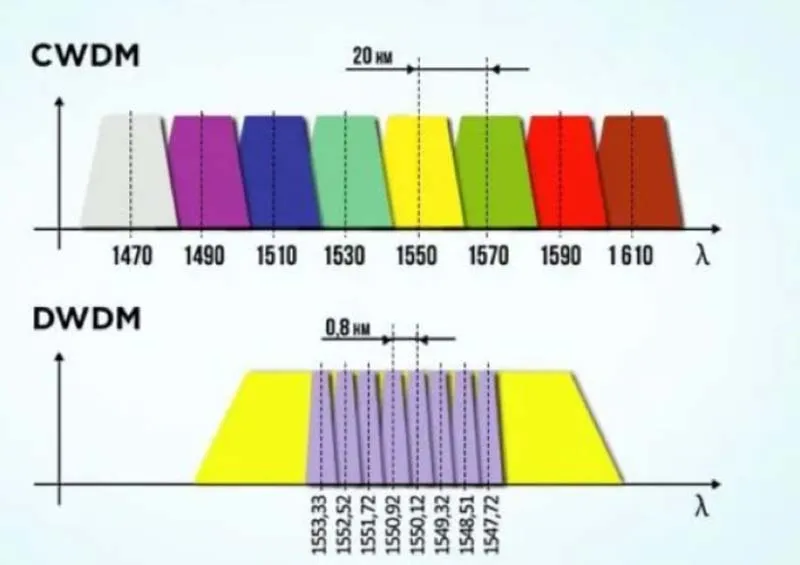
CWDM & DWDM Explained: Why Both Matter
Although both technologies use wavelength multiplexing, their design goals differ. However, rather than competing, It address different network layers and distance requirements.
CWDM focuses on simplicity and affordability, while DWDM prioritizes capacity and reach. Consequently, modern networks often deploy both technologies in parallel to achieve optimal performance and cost balance.
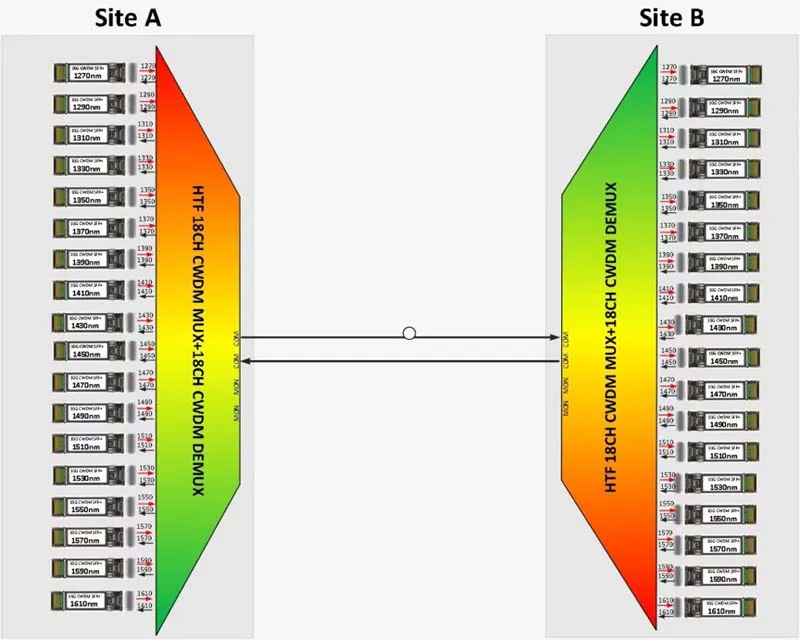
CWDM & DWDM in Access and Regional Networks
CWDM: A Cost-Efficient Choice for Short-to-Mid Distances
CWDM is designed for organizations that need bandwidth expansion without excessive cost. Because of its wide 20nm channel spacing, CWDM modules do not require active cooling. As a result, power consumption and hardware complexity remain low.
Typically, CWDM supports transmission distances between 10km and 40km. For this reason, It architectures often assign CWDM to access and aggregation layers.

CWDM is widely used in:
- Data center inter-cabinet connections
- Enterprise campus and regional office links
- 5G fronthaul and backhaul deployments
Moreover, popular optical standards such as CWDM4 and LR4 rely on CWDM principles, making deployment straightforward and highly scalable.
DWDM: The High-Capacity Engine of Optical Backbones
While CWDM excels at cost control, DWDM dominates long-distance and high-capacity environments. By contrast, DWDM uses ultra-dense channel spacing of 0.8nm or even 0.4nm, allowing dozens of wavelengths to coexist on a single fiber.
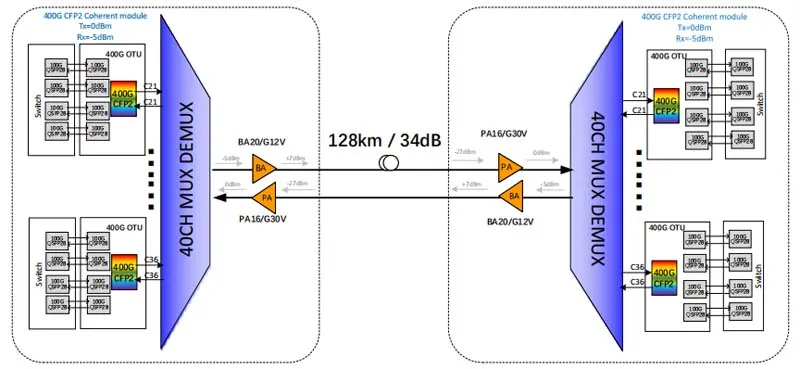
As a result, DWDM systems can deliver terabit-level capacity across hundreds or even thousands of kilometers. This capability makes it an ideal combination for layered network architectures.
DWDM is essential for:
- Metro and long-haul backbone networks
- Data Center Interconnection (DCI)
- Subsea and cross-border optical links
- Coherent transmission systems for ultra-long reach
Furthermore, coherent optics enhance signal quality and spectral efficiency, reinforcing DWDM’s role as the backbone of global digital infrastructure.
CWDM & DWDM Use Cases Across Modern Networks
Because network demands vary by application, It are often deployed together in a structured manner.
For example:
- Data Centers: CWDM for short links, DWDM for DCI
- Metro & Long-Haul Networks: DWDM as the core transport
- 5G / 6G Transport: CWDM for access, DWDM for aggregation
- AI & Cloud Infrastructure: High-density DWDM with coherent optics
Thus, rather than choosing one over the other, operators gain maximum flexibility by integrating both technologies.

Designing the Right CWDM & DWDM Strategy
Selecting the right optical architecture requires careful evaluation of distance, capacity, scalability, and budget. Fortunately, well-designed it solutions allow networks to grow incrementally without disruptive upgrades.
HTF / HTFuture provides customized WDM solutions that address rising traffic demands. By analyzing real-world deployment scenarios, HTF helps design suitable CWDM and DWDM architectures that balance performance, reliability, and cost efficiency.
Conclusion: CWDM & DWDM as the Foundation of Future Networks
In conclusion, CWDM & DWDM are not alternatives but complementary technologies. Together, they enable optical networks to scale seamlessly from local access links to global backbones.
Ultimately, as digital transformation continues to accelerate, networks built on CWDM & DWDM will remain resilient, efficient, and ready for the demands of tomorrow.