
In terms of long-distance communication, under the same conditions, incoherent optical communication has a communication distance of tens of kilometers, while coherent optical communication can reach thousands of kilometers.
Coherent optical communication is a fiber-optic communication technology that uses coherent modulation at the transmitter and heterodyne detection at the receiver, making it suitable for long-distance, high-capacity information transmission. Coherent modulation uses the transmitted signal to change the frequency, phase, and amplitude of the optical carrier; heterodyne detection uses the local oscillator (LO) light to mix with the input signal light to generate an intermediate frequency (IF) signal that matches the frequency, phase, and amplitude of the signal light.
A coherent optical communication system primarily consists of a transmitting-side DSP (digital signal processing), an ECL (external cavity laser), an IQ modulator, an AWG (arbitrary waveform generator), an optical mixer, an oscilloscope, and a receiving-side DSP. In operation, at the transmitter, the signal is modulated onto an optical carrier and transmitted via optical fiber to the receiver, where mixing is performed to generate an IF signal for information reception.

According to the “2025-2029 China Coherent Optical Communications Market Feasibility Study Report” released by the Xin Shijie Industry Research Center, compared to incoherent optical communications, coherent optical communications boast high spectral efficiency, high dispersion tolerance, excellent selectivity, large communication capacity, wide single-channel bandwidth, high sensitivity, and long relay distances, enabling high-capacity, long-distance signal transmission. In terms of long-distance communication, under the same conditions, incoherent optical communications have communication distances in the tens of kilometers, while coherent optical communications can reach distances in the thousands of kilometers.
Research on coherent optical communication technology began in the 1980s and 1990s, but progress has been slow. Around 2010, with the rapid development of the mobile internet and a surge in data generation, traditional fiber-optic communication technologies gradually became unable to meet demand, creating an urgent need for new technologies. In the past two years, the artificial intelligence industry has grown rapidly, with data generation doubling, further increasing pressure on backbone networks. Against this backdrop, coherent optical communications has become a crucial technology for achieving long-distance, high-bandwidth fiber-optic communications, and research interest continues to grow.
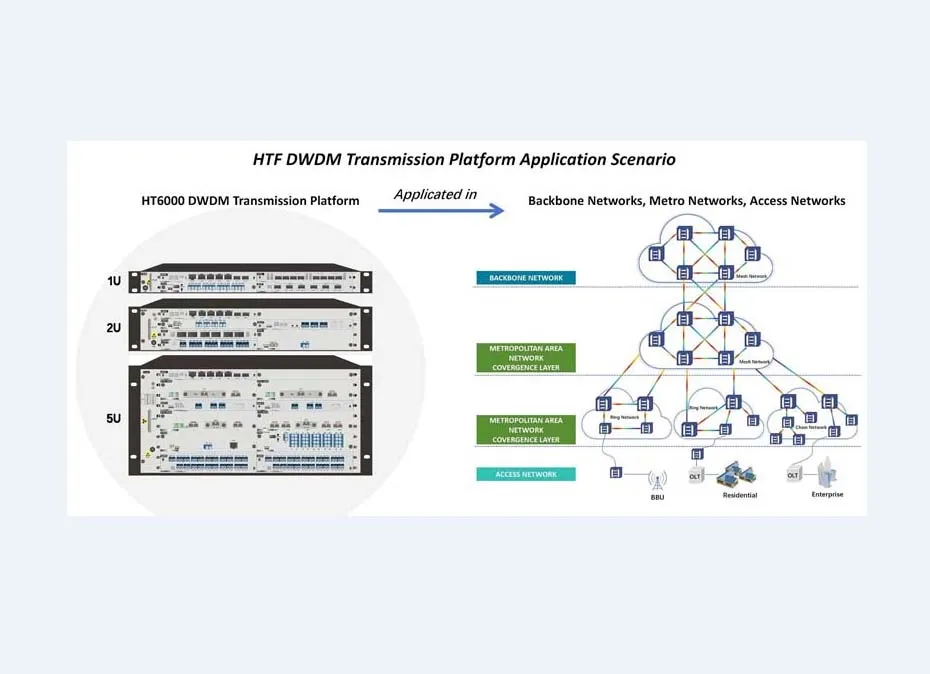
One of the primary applications of coherent optical communications is data center interconnection. According to data released by the Ministry of Industry and Information Technology, by the end of June 2024, the number of data center racks in use in my country will reach 8.3 million standard racks, with a total computing power of 24.6 billion flops. Another important application of coherent optical communications is satellite communications. With its advantages of high bandwidth, low power consumption, and interference resistance, it has great potential for development in intersatellite free-space optical communications. Therefore, the prospects for my country’s coherent optical communications industry are promising.
my country currently has extensive optical communications coverage, and coherent optical communications can be deployed within existing fiber and cable networks, reducing costs. HTF designs coherent solutions with ultra-large transmission capacity for communications industry clients.