
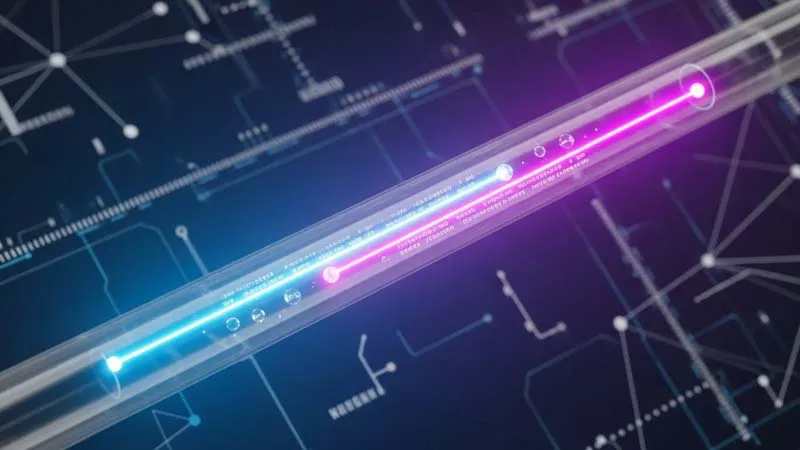
BIDI technology, short for Bidirectional Optical Fiber Communication, reshapes the way networks transmit data. It enables two-way communication through a single fiber by assigning different wavelengths to upstream and downstream signals. Because of this design, operators can greatly reduce fiber consumption while keeping performance stable.
1. Core Concept of BIDI Technology
BIDI technology builds its operation on wavelength division multiplexing. When light travels inside an optical fiber, multiple wavelengths coexist without interfering with one another. Therefore, the system sends and receives signals simultaneously through a single fiber.
Common wavelength pairs include:
- 1310 nm (TX) / 1550 nm (RX)
- 1490 nm (TX) / 1550 nm (RX)
- 1270 nm (TX) / 1330 nm (RX), widely seen in 5G fronthaul
Because these wavelengths stay independent, BIDI technology increases the efficiency of fiber usage and simplifies network design.
2. How BIDI Optical Modules Work
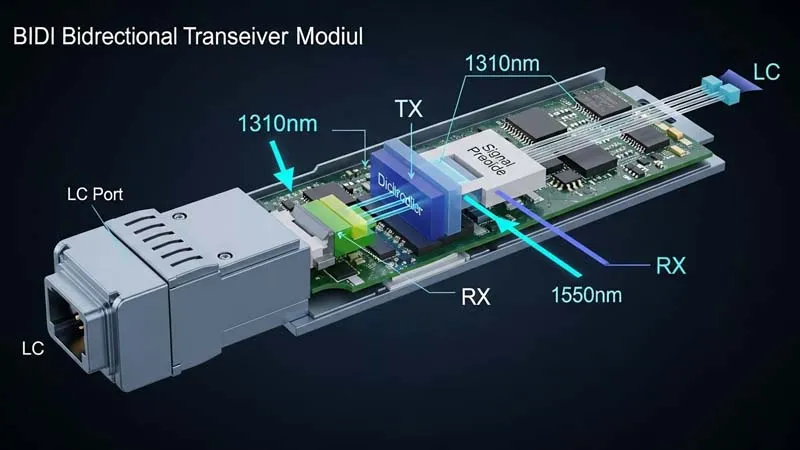
Traditional optical modules rely on two fibers: one for transmission and one for reception. In contrast, a BIDI module uses only one physical port. Inside the module, an optical filter separates wavelengths so the device can send and receive signals through the same connector.
Paired Operation Requirement
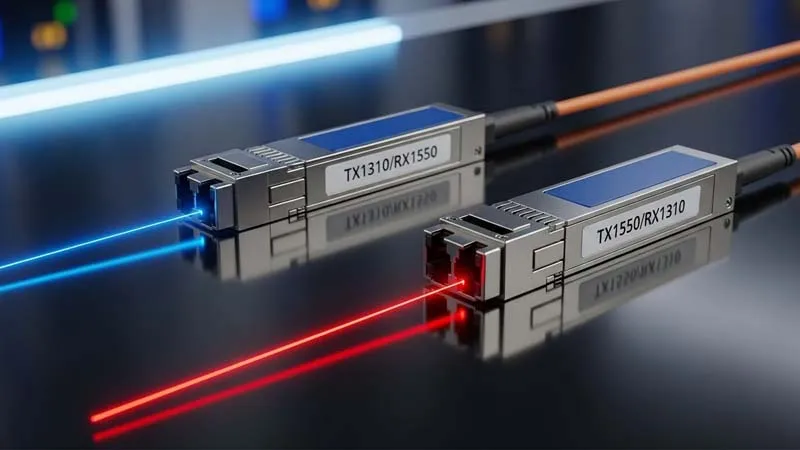
To establish a functional link, BIDI modules must operate in matched pairs:
- End A: TX 1310 nm / RX 1550 nm
- End B: TX 1550 nm / RX 1310 nm
Each transmitted wavelength from one side corresponds to the receiving wavelength on the opposite side. Because of this pairing, the two devices complete a stable bidirectional link over one fiber.
3. Key Advantages of BIDI Technology
BIDI technology offers multiple benefits that make it suitable for modern, fiber-tight environments.
• Reduced Fiber Usage
A single fiber handles bidirectional data, cutting fiber demand by half. This advantage is especially valuable in urban areas or long-distance deployments.
• Lower Overall System Cost
Although a BIDI module costs slightly more than a conventional module, operators save on fiber installation, splicing, and routing work. As a result, the overall project cost usually decreases.
• Smooth Network Upgrades
When networks expand, engineers can deploy BIDI modules without laying new fibers. Consequently, network upgrades become faster and less disruptive.
• Higher Reliability
Networks use fewer fibers and connectors, which reduces potential failure points. Therefore, operation stability increases.

4. Challenges and Deployment Considerations
Despite its strengths, BIDI technology requires careful planning.
• Strict Wavelength Pairing
Incorrect module pairing will break the link. To avoid issues, wavelength matching must stay consistent across the network.
• Tighter Power Budget
Internal filters introduce additional insertion loss, usually about 0.5–1.0 dB. Because of this, power budget calculations must be more precise.
• Higher Module Price
The more complex optical design raises the unit price, yet the total network cost still declines when fiber savings are considered.
BIDI technology delivers an efficient and flexible solution for optical communication. Through wavelength division multiplexing and single-port module design, it enables stable bidirectional transmission on just one fiber. By reducing fiber demand and simplifying deployment, BIDI technology continues to support cost-effective network growth and long-term scalability.