
In the dynamic realm of optical transmission, technological progress unfolds through distinct generations, each marked by advancements in speed, modulation, and application. Let’s take a journey through these generations to understand their unique features.
1st Generation: Laying the Foundation
The first generation is centered around a max speed of 100G. It employs the 100G QPSK modulation scheme with a baud rate of 34 GBd. A notable trait is that it doesn’t support speed adjustment. In terms of application, it relies solely on the 100G QPSK modulation mode. This makes it versatile for various distance transmissions, be it long – haul trunk lines that span vast geographical areas or metropolitan area network scenarios within a city. It serves as a fundamental building block for optical communication, providing a reliable yet basic transmission capability.
2nd Generation: Expanding Capabilities
Moving on to the second generation, the max speed reaches 200G. The modulation schemes diversify to include 200G PM – 16QAM and 100G QPSK, operating at a baud rate of 45 GBd. A key improvement is the support for adjustable speed. For applications, the main modulation mode here is 200G PM – 16QAM. This shift makes it particularly well – suited for short – distance transmission scenarios. Data center interconnections, where rapid and efficient data transfer between facilities is crucial, and metropolitan area networks benefit from this generation’s capabilities. It bridges the gap between the basic first – generation and more advanced subsequent generations, enhancing the flexibility of optical transmission.
3rd Generation: Long – Distance Prowess
The third generation pushes the envelope with a max speed of 400G/600G. Its modulation schemes are 200G QPSK and 40G PM – 16QAM, with a baud rate of 64 GBd, and it supports adjustable speed. The main modulation mode, 200G QPSK, is a game – changer for long – distance transmission. Long – haul trunk lines that are the lifelines of cross – region communication and submarine optical cables that enable undersea data transfer over large distances are the primary beneficiaries. This generation showcases the ability of optical transmission to meet the demands of extensive, high – speed data transfer across vast and challenging terrains.
4th Generation: High – Capacity and Versatility
The fourth generation represents the cutting – edge, with a max speed of 800G/1.2T. The modulation schemes are diverse, including 400G QPSK, 40G PS – 16QAM, and 800G PM – 16QAM, operating at baud rates of 96 GBd (with a note) and 130 GBd, and it supports adjustable speed. The main modulation mode, 400G QPSK, is tailored for long – distance, large – capacity transmission scenarios like long – haul trunk lines. Additionally, the 800G speed opens up new frontiers. It is mainly used for super – large data center interconnections, where massive amounts of data need to be transferred between huge data facilities, and for scenarios with high bandwidth demands that require seamless and high – speed data flow.
It’s important to note that early 96 GBd modules are fixed – mode, tested and applied by only a few manufacturers. However, the future holds promise, as pluggable 96 GBd modules are expected to gain more traction, mainly adopting the 400G PS – 16QAM modulation scheme. As we look at these generations, it’s evident that each one builds on the last, driving the optical transmission industry towards higher speeds, greater flexibility, and broader applications.
Optical module form factor
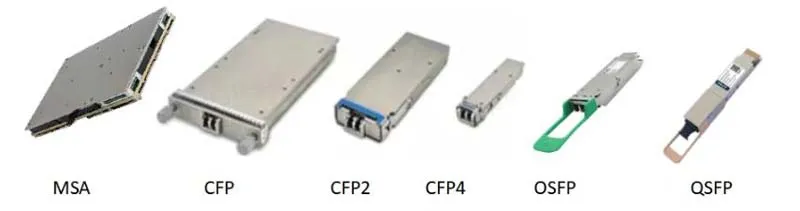
Optical modules are classified into two types: fixed (MSA) optical modules and pluggable optical modules.
Fixed optical modules (MSA): Installed inside the device, they are not pluggable or removable. They consume more power and are larger than pluggable modules.
Pluggable optical modules: They offer low power consumption, flexible adaptability, and easy deployment, resulting in a larger market. Based on package type, they can be categorized as CFP (Centum Form-factor Pluggable), CFP2, CFP4, QSFP (Quad Small Form-factor Pluggable), and OSFP (Octal Small Form-factor Pluggable).
Currently, coherent optical modules are entering the 800G/1.2T era.
HTF coherent optical module can help you save cost and stable transmisison.