The explosion of the internet and data centers has led to a rapid increase in network traffic, placing increasing pressure on optical networks. Traditional incoherent optical modules, due to their low bandwidth and simple modulation schemes, are no longer able to meet the demands of high-speed, long-distance, and high-density transmission.
With the continuous maturity of key technologies such as digital signal processing and optical device manufacturing, coherent optical modules are able to support higher transmission rates and longer distances, offering superior performance and broad application potential.
They support data rates of up to hundreds of Gbps or even Tbps, meeting the high-bandwidth demands of communication networks.
They support complex modulation techniques (such as QPSK) to overcome signal dispersion and attenuation in optical fiber transmission, enabling stable and reliable long-distance transmission. Furthermore, they can select the appropriate modulation scheme based on different network requirements and environments, providing flexible solutions.
Integration: Coherent optical modules utilize technologies such as photonic integrated circuits, silicon photonics, highly integrated packaging, advanced manufacturing processes, and integrated driver circuits, resulting in a higher level of integration.
Convenience: Coherent optical modules use DSP to compensate for fiber transmission impairments such as chromatic dispersion (CD), polarization mode dispersion (PMD), and nonlinear impairments. This eliminates the need for additional DCM modules, making network design and deployment more convenient.
Application Scenarios: Incoherent optical modules are primarily used in 2.5G, 10G, and 40G communication scenarios, while coherent optical modules are primarily used in 100G and beyond 100G communication scenarios.
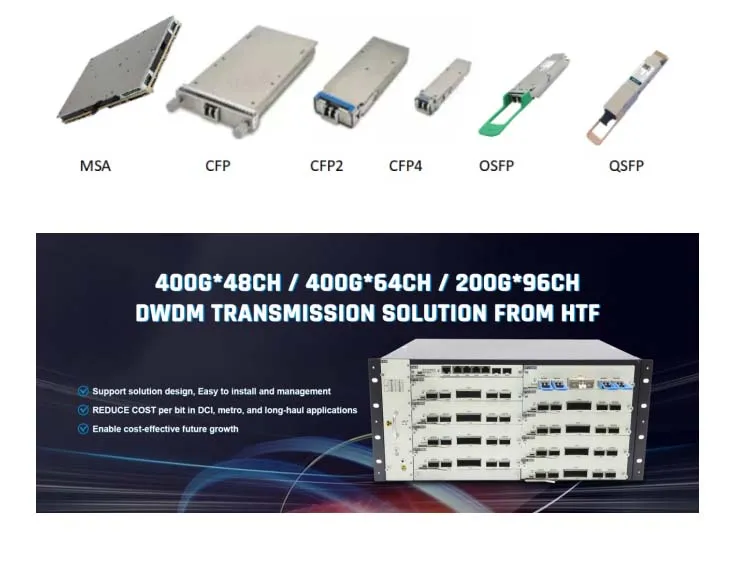
HTF can provide DWDM coherent solution, use 100G 200G 400G 800G coherent optical modules, help you upgrade the network capacity easisly and smooth.