
A Close Connection
MWDM and CWDM technologies are closely linked. Both play key roles in optical communications. MWDM, or Medium Wavelength Division Multiplexing, builds on CWDM’s foundation. CWDM, Coarse Wavelength Division Multiplexing, is known for low power and cost. This article explores their technical ties, applications, and future trends. Let’s dive into their relationship.
Technical Foundations: CWDM as the Base
CWDM uses 20nm wavelength spacing (1270-1610nm). It typically supports eight channels (1470-1610nm). Its strengths are clear:
- Low Power: CWDM’s uncooled lasers consume just 0.5W. This is far less than DWDM’s 4W.
- Low Cost: Equipment costs 30-50% less than DWDM (QYResearch, 2023). Maintenance is simple.
- Flexible: It supports Ethernet, SDH, and more. It works with G.652, G.653, and G.655 fibers.
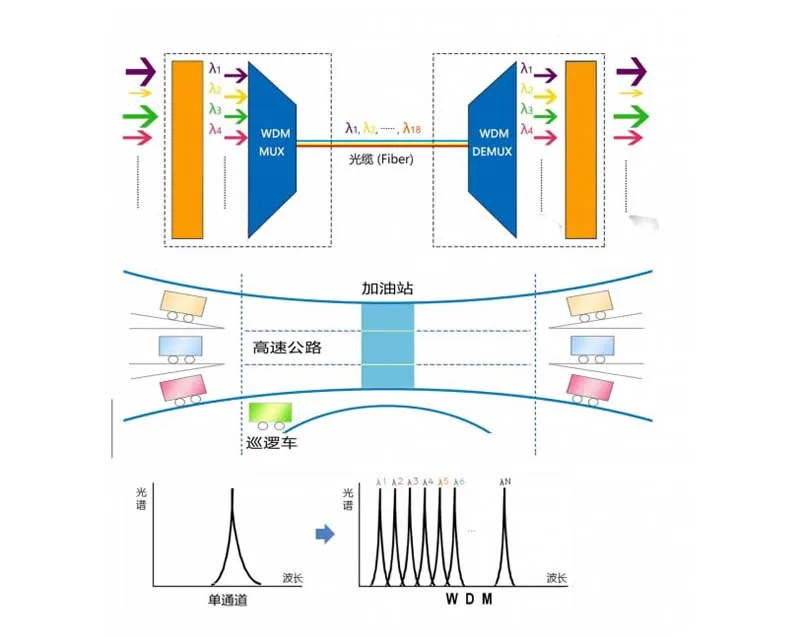
MWDM, however, extends CWDM. Developed by China Mobile, it refines CWDM for 5G fronthaul. MWDM uses finer wavelength splits, often within CWDM’s 1470-1610nm range. It adds more channels. Thus, MWDM boosts efficiency while keeping costs low. It’s a bridge between CWDM’s simplicity and DWDM’s capacity.
Application Scenarios: Shared Roots, Different Focus
CWDM serves small and medium-scale networks. These include metro, access, enterprise, and campus networks. Its key features fit:
- Short Distances: CWDM excels under 80km. It meets moderate bandwidth needs.
- Budget-Friendly: It’s ideal for cost-sensitive projects like FTTH and enterprise networks.
MWDM, in contrast, targets 5G fronthaul. It focuses on 10km distances. MWDM supports dense 5G base stations. It saves fiber by increasing channel counts. For example, China Mobile uses MWDM to optimize 5G fronthaul. It leverages CWDM’s ecosystem for quick deployment.
Thus, CWDM is versatile across scenarios. MWDM, however, specializes in 5G’s unique demands.
Industry Chain and Cost: A Shared Ecosystem
CWDM’s supply chain is mature. Its components, like uncooled lasers and filters, are affordable. Chinese firms like Accelink lead the market. In 2024, the global CWDM module market hit $3.86 billion (Lightcounting).
MWDM reuses CWDM’s supply chain. It adopts similar lasers and filters. Yet, it tweaks wavelength precision. This keeps costs low. MWDM equipment is about 20% cheaper than DWDM. However, it’s slightly pricier than CWDM due to advanced filters.
Consequently, MWDM benefits from CWDM’s cost-effective ecosystem. It scales quickly, especially with China Mobile’s support.
Technical Comparison: Strengths and Differences
| Feature | CWDM | MWDM |
| Wavelength Spacing | 20nm | 10nm or less (CWDM-based) |
| Channels | 8-18 | 12 or more |
| Power Consumption | ~0.5W (uncooled lasers) | Slightly higher, still low |
| Transmission Distance | <80km | Optimized for 10km (5G fronthaul) |
| Cost | 30-50% less than DWDM | ~20% less than DWDM |
| Applications | Metro, access, FTTH, enterprise | 5G fronthaul, midhaul |
MWDM enhances CWDM’s channel density. It retains low power and cost. Yet, it’s tailored for 5G’s high-density needs.
Real-World Examples: MWDM’s Practical Edge
China Mobile pioneered MWDM for 5G fronthaul. In 2023, MWDM cut costs by 20% compared to DWDM. It also boosted fiber efficiency by 30%. MWDM systems integrate seamlessly with CWDM networks. Operators can upgrade by swapping filters or modules. No major infrastructure changes are needed.
For instance, MWDM uses CWDM’s 1470-1610nm range. It adds channels via finer wavelength splits. This ensures compatibility and cost savings.
Future Trends: A Collaborative Path
MWDM builds on CWDM’s strengths. Future trends highlight their synergy:
- Technology Fusion: MWDM may adopt DWDM’s narrower wavelengths. This could create hybrid solutions.
- Market Growth: By 2030, China’s CWDM market may reach 40% globally (QYResearch). MWDM will drive 5G adoption.
- Green Focus: Both technologies use low power. They align with carbon neutrality goals.
Thus, MWDM and CWDM will evolve together. They’ll dominate small-scale and 5G networks.
Conclusion: A Powerful Partnership
MWDM is CWDM’s direct evolution. It refines CWDM for 5G fronthaul. Both share low power and cost benefits. MWDM boosts channel density, while CWDM offers broad versatility. Together, they meet diverse optical communication needs. As 5G and green tech grow, their partnership will shine.
Need deeper insights or case studies? Let me know!