
In the era of cloud computing, big data, and AI-driven applications, the DWDM DCI Box has become a critical solution for data center interconnects (DCI). Explosive growth in data traffic, combined with the rising demand for low-latency, high-bandwidth connections, has placed unprecedented pressure on traditional optical networks. As a result, the DWDM DCI Box leverages dense wavelength division multiplexing technology to provide scalable, high-capacity, and reliable optical transport, driving the evolution of modern data center networks.

What is a DWDM DCI Box?
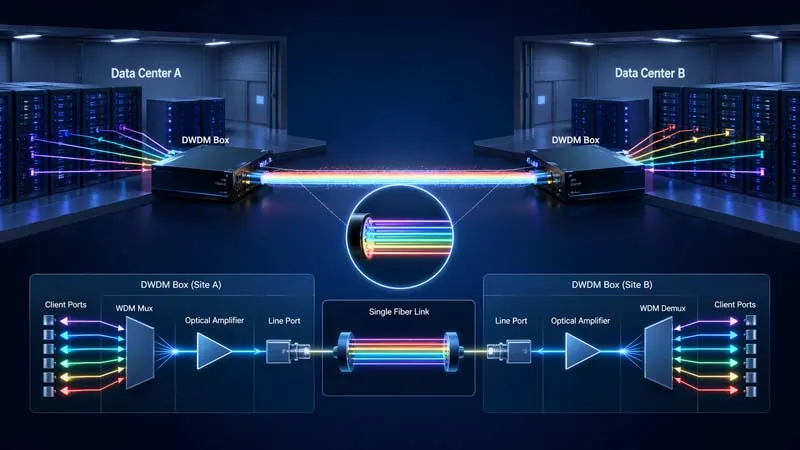
A DWDM DCI Box (Dense Wavelength Division Multiplexing Data Center Interconnect) allows multiple wavelengths to be transmitted simultaneously over a single fiber. This capability significantly increases bandwidth without additional physical infrastructure. Its key features include flexible deployment, high scalability, and low-latency transmission. Supporting dozens of wavelengths, modern devices can achieve data rates up to 400G or even 800G. Furthermore, they maintain reliable transmission across tens to hundreds of kilometers while minimizing signal degradation.

Technology Principles and Innovation
Dense wavelength division multiplexing forms the core technology behind a DWDM DCI Box. By combining optical signals of different wavelengths, a single fiber simultaneously carries multiple high-capacity channels. Modern boxes incorporate advanced components such as low-noise optical amplifiers, dispersion compensation modules, and precise wavelength management systems. Consequently, they deliver superior efficiency, preserve signal integrity over long distances, and reduce operational complexity. Compared with traditional optical solutions, these boxes also improve bandwidth utilization, enable modular expansion, and ensure consistent performance for demanding applications.
Key Applications and Industry Impact
Connectivity between data centers across cities and regions relies heavily on DWDM DCI Boxes. In large-scale AI clusters and cloud computing environments, these devices facilitate seamless communication between nodes and reduce network bottlenecks. Additionally, sectors such as finance, scientific research, and video streaming benefit from their low-latency, high-bandwidth capabilities. By optimizing fiber usage and reducing deployment costs, DWDM DCI Boxes enhance operational efficiency and support a wide array of modern network applications.
Market Trends and Future Prospects
Global demand for DWDM DCI Boxes continues to grow rapidly. Analysts project a compound annual growth rate exceeding 20% over the next five years. Next-generation solutions promise higher capacities, including 800G and 1.6T systems, coupled with AI-driven intelligent optical management. These innovations enable dynamic traffic optimization, predictive fault management, and flexible network scaling. Therefore, DWDM DCI Boxes are poised to remain central to the development of high-speed optical networks, providing reliable infrastructure for emerging technologies.

Integrating HTF Solutions
HTF offers professional fiber optic products and WDM system solutions to meet evolving market needs. With over a decade of expertise in optical communication, fiber solutions, and component manufacturing, the company supports global data centers, 5G networks, cloud computing, and metro/access networks. The HTF HT6000 is a compact, high-capacity, cost-effective OTN transport system built on a CWDM/DWDM platform. It provides multi-service transparent transmission, flexible network access, and supports node capacities exceeding 1.6T. Leveraging HTF solutions enables operators to efficiently expand WDM networks, ensuring scalable and high-performance data center interconnects.
Conclusion
The DWDM DCI Box transforms high-speed optical networking by providing scalable, low-latency, and high-capacity connections. Its advanced technology, extensive application potential, and future-ready scalability make it vital for modern data centers. Moreover, combined with solutions like HTF’s HT6000, organizations can build resilient, high-performance optical infrastructures capable of meeting both current and future data demands.