
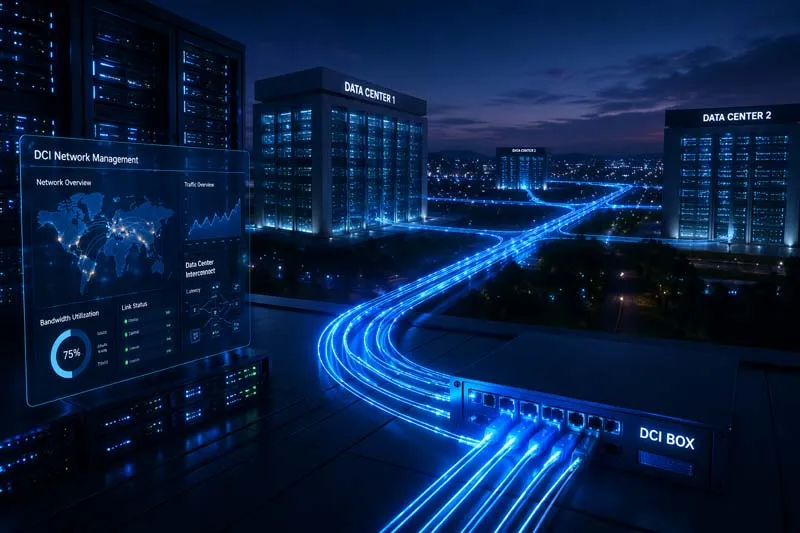
DCI Box is the central device in modern data center interconnect (DCI) solutions, providing high-speed, reliable data transmission between distributed data centers. With the exponential growth of cloud computing, artificial intelligence, and big data, global data traffic has surged; therefore, traditional network architectures alone cannot meet current requirements. In this context, DCI Box acts as a high-capacity, low-latency bridge that ensures seamless interconnection across data centers.
What Is a DCI Box and Its Core Functions
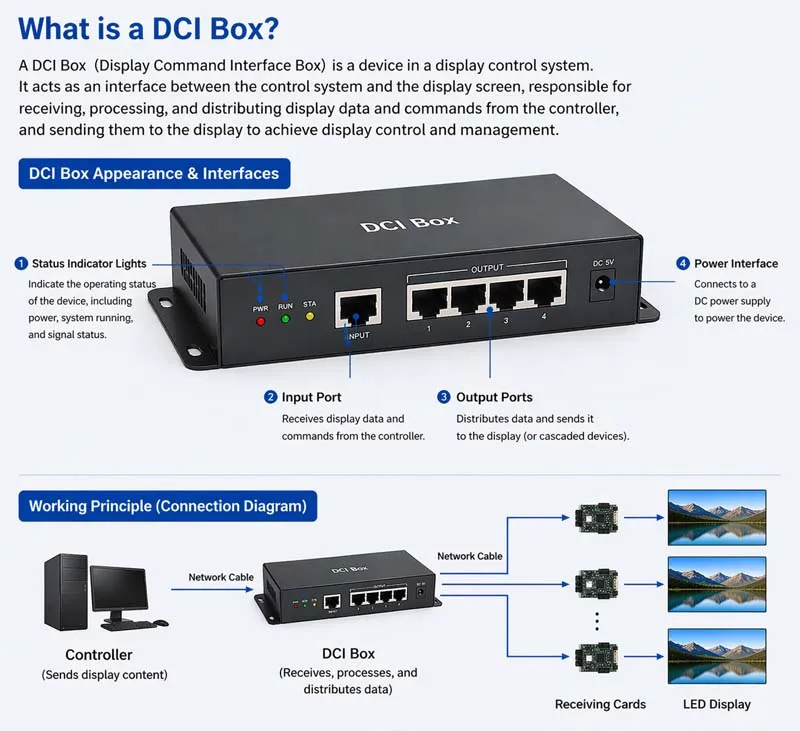
A DCI Box is a specialized optical transport device designed to connect multiple data centers. Its primary function is to deliver high-bandwidth, low-latency, and reliable interconnections. Unlike conventional optical transport equipment, modern DCI Boxes often integrate Muxponder and Transponder capabilities, allowing multiple signal wavelengths and speeds to share the same optical fiber.
Moreover, the DCI Box enhances network efficiency by consolidating multiple transmission streams into a single optical channel, which reduces complexity and operational costs.
Key functions include:
- High-speed interconnectivity: Supports 100G, 200G, 400G, and even 1.6T transmission rates.
- Protocol compatibility: Supports DWDM, OTN, and coherent optical transmission for transparent multi-vendor interoperability.
- High reliability: Provides redundant links, low-latency transmission, and forward error correction (FEC) mechanisms.
- Compact deployment: 1U or 2U rack-mounted designs enable easy installation and expansion in space-limited environments.
According to recent IDC reports, global inter-data center traffic grows over 25% annually; consequently, DCI Box effectively addresses this demand, ensuring uninterrupted cloud services, financial transactions, and research data transfer.
Technical Architecture and Working Principles
A DCI Box consists of transceiver modules, multiplexers, optical wave management units, and a control system. During transmission, the transceiver converts incoming data into standardized optical signals. Furthermore, the Muxponder combines multiple wavelengths into a single fiber, enabling high-capacity transmission across long distances.
Coherent optical transmission enhances signal stability and long-range reliability. In addition, FEC significantly reduces error rates, while OTN encapsulation allows network monitoring, capacity planning, and service quality management. Thus, inter-data center connections become both efficient and manageable.
Applications of DCI Box
DCI Box finds use in cloud computing, AI training clusters, financial services, and research centers:
- Cloud data center interconnects: Connects global cloud infrastructure for real-time data synchronization and load balancing.
- AI training clusters: Provides low-latency, high-bandwidth channels for transferring large-scale datasets between GPU/TPU clusters.
- Enterprise disaster recovery: Ensures fast cross-regional backup and data restoration.
- Financial and research networks: Supports latency-sensitive trading and high-precision experiment data transfers.
For instance, cloud leaders like AWS and Google Cloud deploy DCI Boxes across global regions to synchronize data centers within seconds. Meanwhile, these deployments ensure high service availability and robust data security.
Comparing DCI Box with Other Networking Equipment
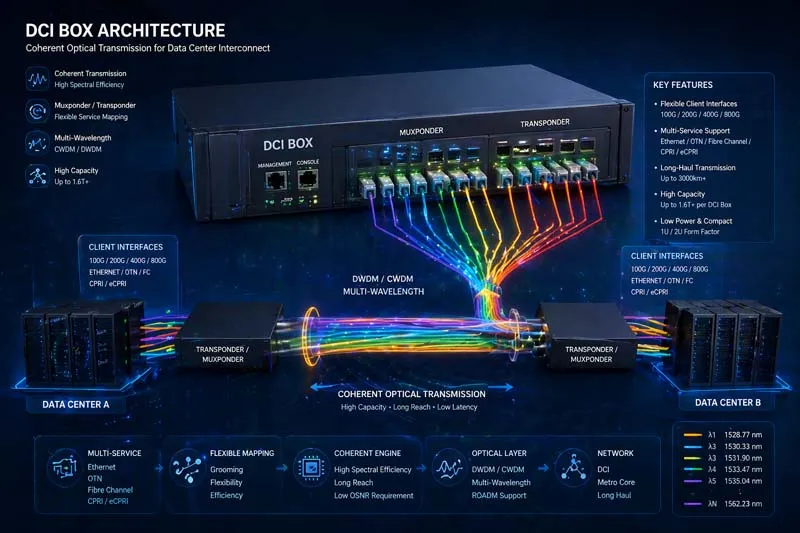
Compared to conventional optical transport devices, DCI Box offers notable advantages:
- Integrated design: Eliminates the need for additional multiplexers for multi-wavelength and multi-speed traffic.
- Low latency, high throughput: Optimized for inter-data center transmission, outperforming standard DWDM systems.
- Scalable deployment: Compact form factors enable rapid installation and flexible network expansion, reducing operational costs.
Furthermore, these advantages position DCI Box as the preferred solution for high-performance, multi-site data center connectivity.
Future Trends in DCI Box Technology
Looking ahead, DCI Box technology will evolve along several directions:
- Higher bandwidth: 400G, 800G, and 1.6T+ commercial implementations are on the rise.
- AI-driven network management: Predictive maintenance and automated link optimization will enhance reliability while reducing operational costs.
- Green and energy-efficient designs: Lower power consumption and renewable energy integration support sustainable data center operations.
- Edge interconnect applications: DCI Boxes will increasingly serve edge data centers, thus enabling low-latency connectivity for smart cities and edge computing environments.
Conclusion
DCI Box serves as the backbone of modern data center interconnections, delivering high-speed, low-latency, and reliable data transport. In addition, its integration of multiplexing, coherent transmission, and OTN encapsulation enables seamless multi-vendor interconnectivity across regions.
Supporting this ecosystem, HTF provides professional optical fiber products and WDM system solutions. With over ten years of experience in optical communication, HTF offers the HTF HT6000 compact, high-capacity, and cost-effective OTN system. Moreover, the HT6000 features CWDM/DWDM universal platform design, multi-service transparent transmission, and flexible networking capabilities. Suitable for national, provincial, and metro backbone networks, it supports over 1.6T capacity, making it an ideal solution for IDC and ISP large-scale WDM network expansion.
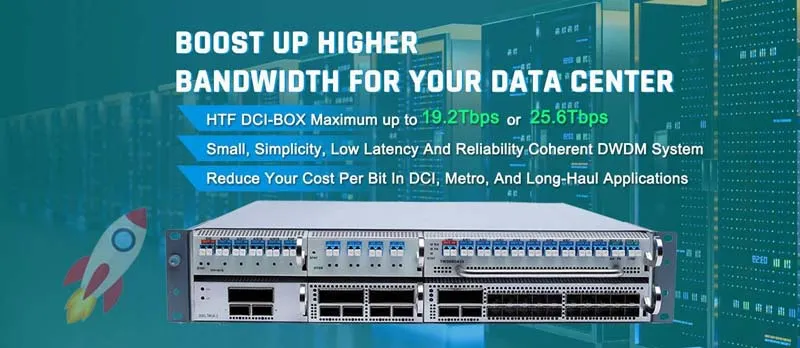
HTF is dedicated to helping global data centers, 5G networks, cloud computing, and metropolitan networks optimize their optical infrastructure, providing complete solutions, products, and services. Consequently, organizations leveraging advanced DCI Box deployments alongside HTF solutions can achieve seamless, high-performance data center interconnectivity.