
In today’s data-driven world, the demands for bandwidth, energy efficiency, and network reliability are rapidly increasing. Data centers, cloud computing platforms, and emerging 5G and 6G networks face unprecedented challenges. Parallel Fiber + AI Scheduling has emerged as a transformative solution.
By combining multiple parallel fiber strands with intelligent AI-based traffic management, networks can achieve linear bandwidth scaling, reduced per-bit power consumption, and enhanced fault tolerance. Consequently, this approach ensures stable, high-performance communications for modern digital infrastructure.
Understanding Parallel Fiber Technology
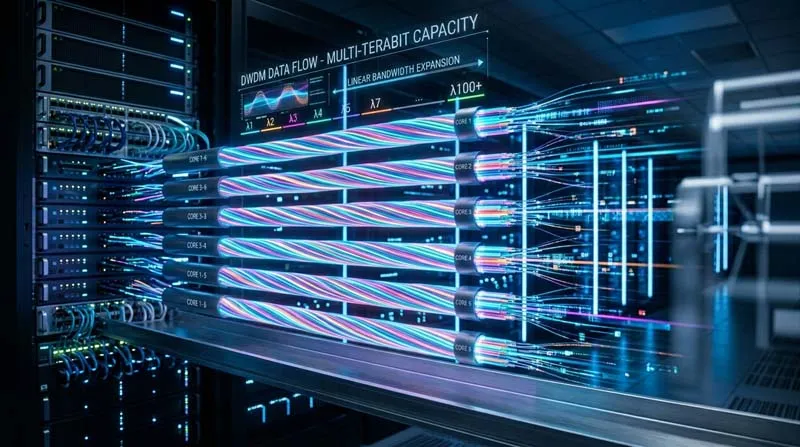
Parallel Fiber + AI Scheduling begins with the concept of parallel fiber deployment. Multiple fiber strands operate in parallel, each capable of carrying dense wavelength division multiplexing (DWDM) channels. As a result, overall bandwidth can scale almost linearly: adding fibers directly increases capacity. At the same time, per-bit energy consumption decreases due to distributed load and optimized signal propagation.
Moreover, parallel fibers naturally provide redundancy. If one fiber fails, traffic can seamlessly continue through remaining fibers. Therefore, this architecture is critical for industries such as finance, healthcare, and cloud services, where uninterrupted connectivity is essential. In addition, parallel fiber deployment ensures scalable, energy-efficient, and highly resilient network infrastructure.
The Role of AI Scheduling in Network Optimization
AI scheduling complements parallel fiber by dynamically managing traffic flow. Using real-time analytics, predictive modeling, and adaptive routing, AI can allocate bandwidth efficiently across multiple fiber paths. Consequently, network congestion is minimized, latency is reduced, and throughput is optimized.
Furthermore, AI scheduling provides proactive fault management. Predictive algorithms identify potential network failures and reroute traffic within milliseconds. By integrating AI intelligence, operators achieve improved reliability and operational efficiency, while maximizing the utilization of parallel fiber infrastructure. Additionally, this intelligent approach supports better network planning and capacity expansion.

Achieving Low-Power Network Operation
Energy efficiency is a core advantage of Parallel Fiber + AI Scheduling. Parallel fiber distribution reduces the energy required per transmitted bit. Moreover, AI-driven traffic optimization further decreases redundant transmissions and the need for excessive optical amplification.
Studies show that, compared to traditional single-fiber networks, parallel fiber systems with AI scheduling can reduce per-bit energy consumption by 20–30%. As a result, large-scale AI training centers, high-performance cloud platforms, and data centers benefit from significant cost savings. Additionally, this approach supports sustainable operations and aligns with the global trend toward greener data centers.

Enhancing Reliability and Fault Tolerance
The combination of parallel fibers and AI scheduling significantly improves network resilience. Multiple fiber strands create redundant paths, while AI intelligently reroutes traffic in the event of failures. Consequently, networks can achieve near-instant recovery, maintaining high availability for mission-critical applications.
For example, financial transactions, medical systems, and cloud-based services benefit from consistent uptime and minimal disruptions. In addition, by deploying Parallel Fiber + AI Scheduling, network operators ensure continuity, reduce maintenance intervention, and enhance overall user experience.
Key Applications of Parallel Fiber + AI Scheduling
- Data Center Interconnects (DCI): Enables large-scale, high-speed data transfers between centers while maintaining energy efficiency.
- Cloud and AI Training Platforms: Supports massive data flows for model training with lower energy costs.
- 5G/6G Backbone and Edge Networks: Ensures low latency and high throughput for next-generation communications.
- Critical Industries: Financial, healthcare, and government sectors gain high reliability and rapid fault recovery.
Furthermore, these scenarios illustrate how Parallel Fiber + AI Scheduling meets the growing demands for bandwidth, efficiency, and fault tolerance across diverse infrastructures.
Challenges and Future Trends
Despite its benefits, Parallel Fiber + AI Scheduling faces several challenges. Firstly, AI algorithms require substantial computational resources for real-time scheduling. Secondly, deploying multiple parallel fibers involves significant upfront investment. Additionally, integration with existing network hardware must be carefully managed.
Looking ahead, AI algorithms will become more sophisticated, fiber technologies such as silicon photonics and CPO will advance, and networks will gain enhanced self-healing capabilities. Therefore, the trend observed at OFC 2026 indicates that parallel fiber combined with AI scheduling will become mainstream, setting the standard for next-generation networks.
Conclusion
Parallel Fiber + AI Scheduling offers a compelling solution for modern network challenges. By combining linear bandwidth expansion, low per-bit power consumption, and robust reliability, this architecture supports data centers, cloud platforms, and next-generation communication networks. As technology evolves, AI-driven management and advanced fiber systems will ensure more efficient, resilient, and sustainable infrastructures.

In practical deployments, solutions from providers such as HTF demonstrate the potential of advanced fiber architectures. HTF delivers optical fiber and WDM systems designed by a team with over ten years of experience in optical communications and component development. Their HT6000 OTN transmission system supports CWDM/DWDM, flexible network topologies, and high-capacity nodes exceeding 1.6T. Consequently, HTF solutions empower data centers and ISPs to expand WDM networks efficiently while maintaining cost-effectiveness and high performance.