
Silicon Photonics and CPO are driving a new era in data center optical interconnects. As AI workloads expand, bandwidth demand grows exponentially. Consequently, traditional copper and pluggable optical modules are reaching physical and economic limits.
The integration of photonics into silicon substrates and co-packaged solutions reduces power consumption, improves density, and ensures scalable, reliable deployment. Moreover, leading companies are demonstrating commercial-scale readiness. This signals that the next generation of optical modules is no longer a conceptual promise but an industrial reality.
Why Silicon Photonics and CPO Matter Now
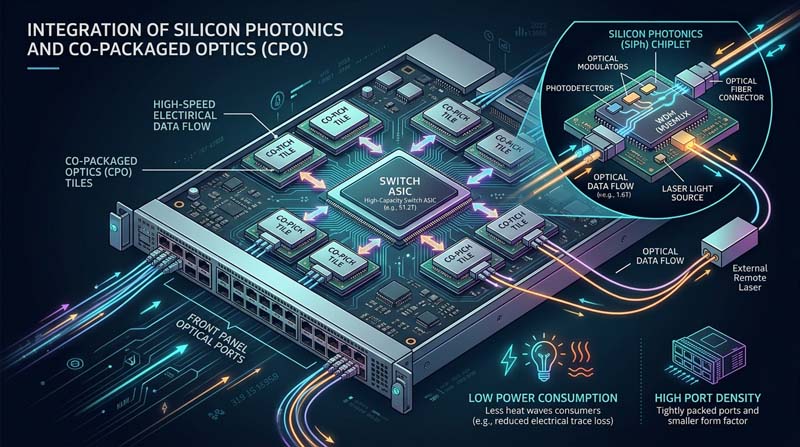
The current momentum for Silicon Photonics and CPO comes from both technical and system-level pressures. Data centers require high-bandwidth, low-power interconnects to support scale-out AI clusters. Intel’s Silicon Photonics platform has shipped over 8 million PICs and more than 32 million on-chip lasers. These shipments demonstrate both reliability and high-volume manufacturing capability. Additionally, these advancements enable integrated photonics to meet performance, cost, and density requirements that traditional solutions struggle to achieve.
TSMC and other foundries are concurrently advancing the Compact Universal Photonics Engine (COUPE™). Moreover, they are optimizing power, performance, and area (PPA), which further supports co-packaged optics integration. Therefore, ecosystem maturity indicates that 2026–2027 will be a pivotal period for large-scale adoption.
Yield Improvements and Cost Efficiency
For Silicon Photonics and CPO, yield improvements and cost reductions are crucial. Higher manufacturing yields translate into lower unit costs. Consequently, large-scale deployment becomes economically viable. Coherent’s 2x400G FR4 Lite modules illustrate how streamlined silicon photonics designs reduce power consumption. At the same time, they offer a practical alternative to traditional EML-based solutions. As yields approach industrial thresholds and wafer-scale testing matures, the total cost of ownership for data centers decreases, enabling faster adoption across hyperscale deployments.
Co-Packaged Optics and NPO: Next-Generation Interconnects
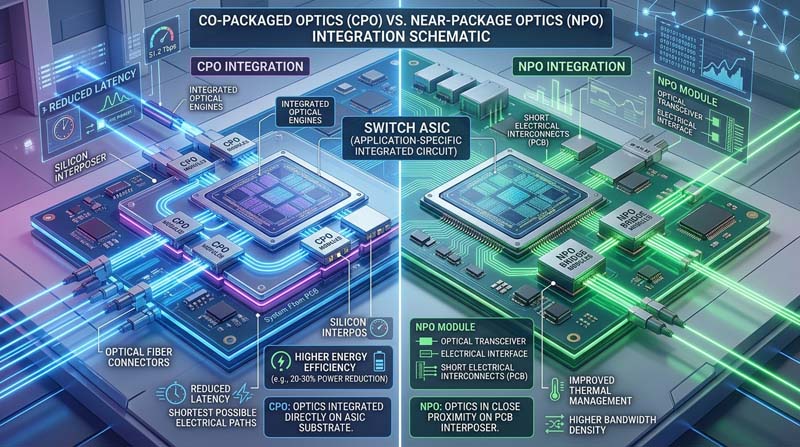
CPO integrates optical engines directly with switch ASICs. This improves energy efficiency and reduces latency. NVIDIA’s Spectrum switches leverage co-packaged optics to enhance system reliability and throughput for large AI clusters. At the same time, Near-Package Optics (NPO) serves as a transitional solution. It bridges conventional pluggable modules and full CPO integration. Together, CPO and NPO address bandwidth, power, and latency challenges. Therefore, they enable scalable, high-speed AI data center networks.
Transforming the Optical Module Industry
The rise of Silicon Photonics and CPO does not only improve individual modules. It also redefines the optical module value chain. Enterprises capable of combining silicon photonics design, advanced packaging, thermal management, and system-level integration will dominate future deployments. AMD and Broadcom are scaling photonics and CPO solutions across next-generation AI systems. Moreover, TSMC continues to optimize COUPE for PPA and cost. Therefore, these developments mark a fundamental shift in designing, manufacturing, and deploying high-bandwidth, energy-efficient interconnects.
From Data Centers to Transmission Infrastructure
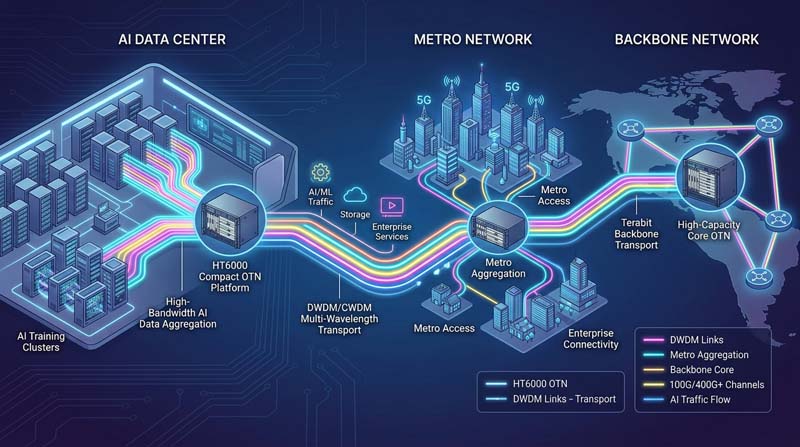
Beyond individual servers and racks, Silicon Photonics and CPO enable continuous optical pathways extending to metro and backbone networks. Companies like HTF provide solutions such as the HT6000 compact OTN system. Moreover, it integrates CWDM/DWDM platforms for multi-service, high-capacity optical transport. Consequently, operators, ISPs, and data center providers can scale seamlessly while optimizing bandwidth and power efficiency. This supports AI infrastructure growth from the compute layer to the network edge.