
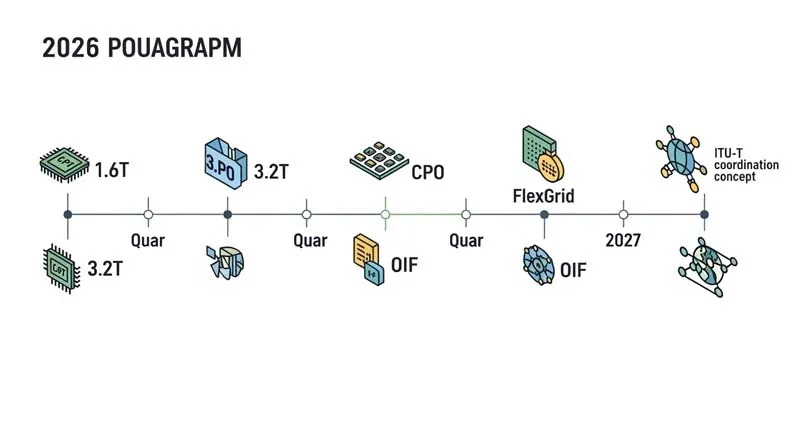
DWDM industry standards are entering a decisive consolidation cycle. In the next two years, the industry will align faster on interoperable 1.6T/3.2T transport, practical CPO roadmaps, and scalable FlexGrid rules. As a result, network planners can shift from “pilot-by-pilot tuning” to repeatable engineering.

At the same time, DWDM industry standards are no longer a paperwork exercise. Instead, they define the operating limits for spectral efficiency, reach tiers, and multi-vendor interoperability. Therefore, the 2026–2027 freeze window matters to operators, cloud builders, and system vendors alike.
Why Standard Unification Becomes Urgent at 1.6T/3.2T
In the 400G/800G era, many networks tolerated mixed implementations. However, 1.6T/3.2T pushes optics and line systems closer to tight margins. Consequently, small differences in FEC thresholds, shaping, and symbol rate choices can amplify penalties across real ROADM chains.
Moreover, higher baud rates raise sensitivity to filtering and passband ripple. As a result, “it works in the lab” does not guarantee stable field behavior. DWDM industry standards reduce this gap by setting enforceable boundaries for interoperability and performance.
In addition, procurement cycles demand predictability. Therefore, a unified baseline helps shorten qualification time and lowers the cost of multi-supplier sourcing.
OIF and ITU-T: Two Layers That Must Lock Together
DWDM industry standards move fastest when interface and network rules converge in parallel. On one hand, OIF focuses on implementation agreements that enable real interoperability. For example, OIF work often emphasizes coherent pluggables, electrical interfaces, and test methods.
On the other hand, ITU-T sets the broader transport foundation. Meanwhile, ITU-T work guides spectrum grids, network architectures, and performance definitions used in planning and operations. Therefore, alignment between the two organizations prevents “module-ready, network-uncertain” outcomes.
Because of this dual-track approach, DWDM industry standards can translate quickly into products, test plans, and deployable designs.
1.6T/3.2T DWDM: Where the Key Convergence Happens
For 1.6T and 3.2T, DWDM industry standards concentrate on system-level feasibility, not headline rate alone. First, the industry must define workable combinations of modulation, shaping, and FEC for specific reach tiers. Next, vendors must map those choices to practical thermal and front-panel limits.
Reach Tiering That Reflects Real Networks
Short-reach DCI and metro differ from long-haul. Therefore, a single “one-size” coherent profile rarely fits all. Instead, DWDM industry standards typically converge around tiered profiles, each with clear constraints and expected performance.
Electrical-to-Optical Interface Matching
Higher throughput increases dependence on high-speed SerDes and host electrical lanes. Consequently, interface alignment becomes essential for density and stability. DWDM industry standards help define these constraints, so product teams avoid incompatible assumptions.
DSP and FEC Interoperability Baselines
Interoperability hinges on measurable thresholds. Thus, the industry pushes for consistent FEC framing, overhead expectations, and performance test cases. As a result, operators can validate multi-vendor behavior with fewer bespoke scripts.
Coexistence With Line Systems and ROADMs
Coherent signals interact with amplifiers, WSS filters, and cascaded ROADMs. Moreover, shaping choices influence tolerance to filtering and nonlinearities. Therefore, DWDM industry standards must describe acceptable spectral occupancy, power constraints, and system interactions.
CPO: Efficiency Gains Must Come With Operability
CPO promises major improvements in bandwidth density and energy efficiency. However, it also changes how networks repair and monitor optics. Consequently, DWDM industry standards need to address both performance and lifecycle operations.

Interface Models and Diagnostics
When optics sit closer to switching silicon, link behavior depends on new electrical paths and new monitoring models. Therefore, standards must define telemetry, alarms, and diagnostic semantics that operations teams can trust.
Field Service and Replaceability
Traditional pluggables support quick swaps. By contrast, CPO can shift replacement to system-level processes. As a result, DWDM industry standards should set expectations for redundancy, failure isolation, and service procedures.
Thermal and Reliability Constraints
CPO designs must manage heat and long-term reliability. Moreover, qualification must reflect real environmental and workload stress. Therefore, common test conditions and reliability metrics accelerate confidence and reduce hidden risk.
FlexGrid: Making Spectrum Programmable at Scale
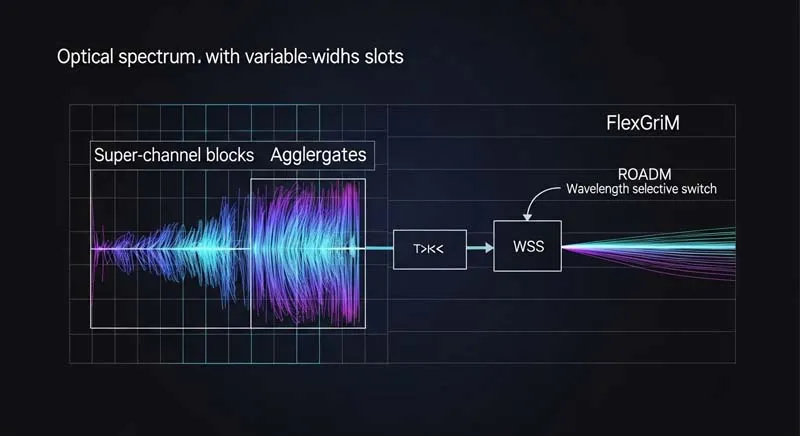
FlexGrid allows variable-width channels and finer spectrum slots. Therefore, it improves efficiency for super-channels and high-rate coherent profiles. At 1.6T/3.2T, FlexGrid becomes a practical requirement, not a luxury.
Grid Granularity and Guardband Rules
Operators need predictable allocation rules. Thus, DWDM industry standards should clarify slot width, guardband guidance, and adjacency constraints. As a result, networks can reduce fragmentation while keeping margins under control.
ROADM and WSS Constraints
Hardware filtering limits shape spectrum decisions. Moreover, cascaded ROADMs can narrow effective passbands. Therefore, FlexGrid guidance must align with realistic ROADM behavior across multi-hop paths.
Control-Plane Coordination
Spectrum planning relies on automated path computation. Consequently, FlexGrid benefits from consistent models for provisioning and recovery workflows. DWDM industry standards help align the operational “language” between controllers and optical layers.
What “Freeze in 2026–2027” Really Means
A freeze milestone signals stable parameters, test methods, and interoperability expectations. Therefore, vendors can invest with less uncertainty, and operators can standardize acceptance tests.
In addition, component ecosystems benefit directly. As a result, DSP vendors can optimize for known targets, and optical sub-assemblies can ramp with clearer requirements. Meanwhile, test labs and plugfests can build reusable certification playbooks.
Most importantly, DWDM industry standards freeze reduces deployment friction. Consequently, project timelines shorten and interoperability risk declines.
Remaining Challenges: What Could Still Slow Adoption
Even with fast convergence, several realities remain. First, different reach tiers will coexist, so profiles will not collapse into a single mode. Second, interoperability includes management semantics, not only physical behavior. Therefore, telemetry and alarm consistency will matter more than ever.
Third, cost and yield can constrain advanced packaging. Consequently, CPO adoption may follow staged deployment patterns. DWDM industry standards can guide this evolution, yet the supply chain must still mature.
Practical Takeaways for Operators and Vendors
If you plan upgrades toward 1.6T/3.2T, you can act now.
- Align roadmaps to tiered profiles. Therefore, you can match capacity upgrades to DCI, metro, and long-haul constraints.
- Build interoperability test plans early. As a result, you reduce integration surprises during scale-out.
- Treat FlexGrid as an operational program. Moreover, invest in spectrum planning and fragmentation management.
- Evaluate CPO with service models in mind. Consequently, you avoid efficiency gains that create operational debt.
Above all, keep procurement tied to testable requirements. Thus, DWDM industry standards become a tool for predictable delivery, not a checklist.
A Natural Note on HTF
As networks evolve under DWDM industry standards, solution partners that combine optical expertise with system delivery can simplify deployment. HTF is a professional supplier of fiber products and WDM system solutions, built by a team with more than 10 years of experience in optical communications R&D, fiber solutions, and component development and manufacturing. Moreover, HTF supports global data centers, 5G networks, cloud computing, metro networks, and access networks with design, products, and service.
In addition, HTF HT6000 is a compact, high-capacity, cost-effective OTN optical transport system. It uses a CWDM/DWDM universal platform design, supports transparent multi-service transport, and provides flexible networking and access. Consequently, it fits backbone and core network scenarios and supports node capacities beyond 1.6T for scalable WDM expansion in IDC and ISP environments.