
Common WDM technologies play a critical role in modern optical communication networks. By enabling multiple wavelengths to travel over a single optical fiber, It significantly increases bandwidth utilization while reducing infrastructure costs. Therefore, understanding the structural types, performance characteristics, and application scenarios of it is essential for network designers, system integrators, and telecom operators.
This article provides a clear and practical overview of it structures, while also offering guidance on technology selection and future development trends.

What Is Common WDM and Why It Matters
Common WDM (Wavelength Division Multiplexing) refers to widely adopted multiplexer technologies that combine or separate multiple optical signals at different wavelengths. As a result, network capacity can be expanded without deploying additional fiber.
Moreover, It solutions are extensively used in metropolitan area networks, backbone transmission systems, and data center interconnections. Because of their scalability and reliability, they have become foundational components in optical networking.
Major Structural Types of Common WDM
Different Common WDM structures are designed to meet diverse network requirements. However, their working principles and application focus vary significantly.
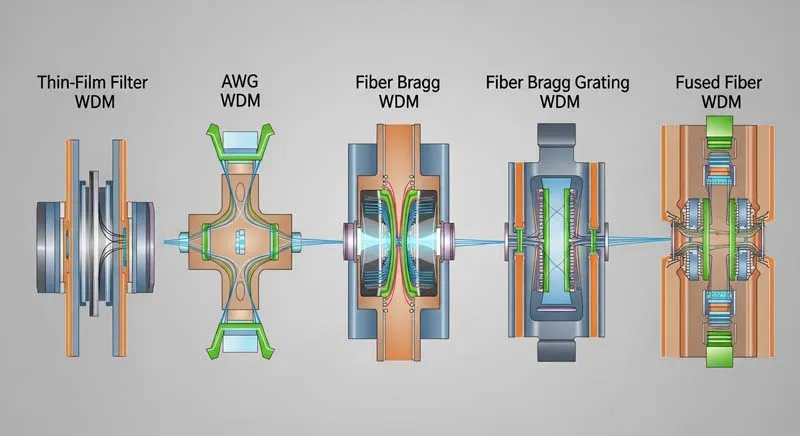
Thin-Film Filter (TFF) Based Common WDM
Thin-Film Filter technology uses multilayer dielectric coatings to selectively transmit or reflect specific wavelengths. Through cascaded filter stages, wavelength separation is achieved efficiently.
As a result, this Common WDM structure supports a moderate channel count, typically between 4 and 32 wavelengths. Insertion loss usually ranges from 1.5 dB to 4 dB, which remains acceptable for most metro and enterprise networks.
Because of its mature manufacturing process and stable performance, TFF-based it is widely deployed in cost-sensitive and space-limited environments.
Arrayed Waveguide Grating (AWG) Based Common WDM
AWG-based it relies on planar lightwave circuit technology and optical interference principles. By using waveguides with precisely controlled path-length differences, wavelength routing becomes highly accurate.
Consequently, AWG structures can support high channel counts, often exceeding 96 wavelengths. In addition, their high level of integration makes them suitable for mass production.
For this reason, AWG-based it is the preferred choice for backbone networks and high-capacity data center interconnections.
Fiber Bragg Grating (FBG) Based Common WDM
Fiber Bragg Grating technology introduces periodic refractive index variations directly into the fiber core. When combined with optical circulators, specific wavelengths are reflected or transmitted.
This type of it offers very low insertion loss, typically between 0.5 dB and 2 dB. However, temperature sensitivity remains a challenge. Therefore, precise thermal control is often required.
As a result, FBG-based it is mainly used in specialized scenarios with a limited number of channels and strict loss requirements.
Fused Fiber Common WDM
Fused fiber structures are created by heating and stretching multiple fibers to form a coupling region. Wavelength separation is achieved through evanescent field coupling.
Although this Common WDM structure is simple and cost-effective, it supports only a small number of channels, usually 2 to 4 wavelengths. Consequently, it is primarily applied in CWDM systems and short-distance transmission environments.
Technology Trends Shaping Common WDM
The evolution of it continues to focus on performance optimization and cost efficiency. At present, several trends are shaping future development.
First, silicon photonics integration is gaining momentum, as it enables miniaturization and large-scale manufacturing through CMOS processes. Second, tunable it devices are emerging, allowing flexible wavelength selection via thermo-optic or electro-optic effects. Finally, hybrid integration approaches are being adopted to balance performance, cost, and environmental adaptability.
How to Select the Right Common WDM Solution
Choosing the appropriate it structure depends on multiple factors.
If the required channel count is low, TFF or fused fiber solutions may be sufficient. However, for large-scale and high-capacity systems, AWG-based it is more suitable. In addition, transmission distance should be considered, as low insertion loss becomes critical for long-haul links.
Furthermore, environmental stability, cost constraints, and installation space must also be evaluated to ensure optimal network performance.

Conclusion: The Practical Value of Common WDM
Common WDM technologies continue to evolve toward higher capacity, better integration, and improved reliability. By understanding the strengths and limitations of each structural type, network planners can make informed decisions that align with real-world application requirements.
Ultimately, selecting the right it solution provides a solid foundation for building scalable, efficient, and future-ready optical networks.