
Optical Network technology is entering a decisive new phase.
Industry progress is no longer measured only by bandwidth growth or transmission distance. Instead, intelligence, predictability, and resilience now define long-term competitiveness.
Driven by data center interconnection, 5G transport, cloud computing, and AI workloads, traffic patterns continue to evolve rapidly. Under these conditions, traditional operations and maintenance models are reaching their limits. Manual troubleshooting and static thresholds struggle to respond in time. Consequently, AI-driven autonomous operations are becoming a foundational capability for next-generation it infrastructure.
Rather than representing a minor upgrade, this transformation signals a structural shift. Operations are moving away from reactive handling toward proactive, self-optimizing control.

Why Optical Network Operations Must Become Autonomous
Modern Optical Network environments grow more complex each year. Network scale expands continuously, service diversity increases steadily, and tolerance for downtime approaches zero. Meanwhile, many operators still depend on experience-based decisions and alarm-driven workflows.
In real-world deployments, most it failures do not occur abruptly. Instead, minor degradations accumulate gradually. Environmental variation, component aging, and traffic fluctuation interact over time. As a result, issues often become visible only after service quality has already declined.
At the same time, strong coupling exists across network layers. Optical-layer behavior directly influences OTN performance and end-user experience. Because of this interaction, single-point monitoring can no longer reflect true operational risk. Autonomous operations therefore move from being optional enhancements to operational necessities.
Coherent DSP: The Sensory Foundation of an Intelligent Optical Network
High-quality data forms the foundation of any AI system. Fortunately, coherent transmission technology provides unprecedented visibility into Optical Network conditions.
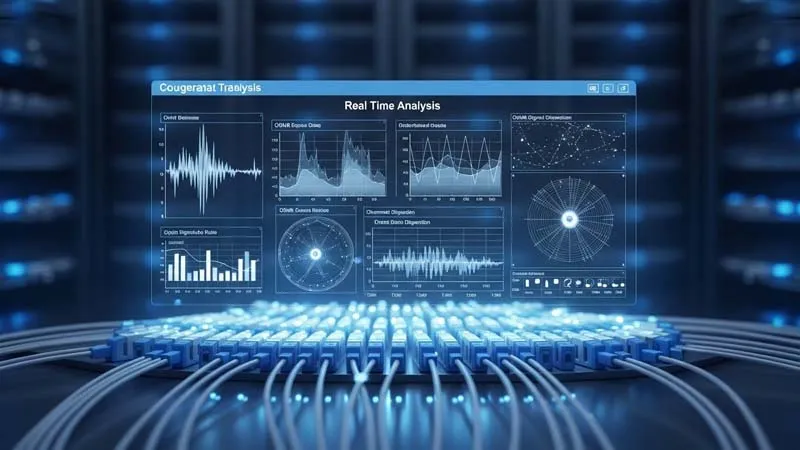
Through modern coherent DSP, networks continuously collect real-time metrics such as:
- OSNR
- Chromatic dispersion (CD)
- Polarization mode dispersion (PMD)
- Q-factor and BER
- Frequency offset and phase noise
Unlike periodic testing, these indicators originate directly from live traffic paths. Consequently, It gains persistent situational awareness instead of fragmented snapshots.
Beyond monitoring, coherent DSP changes the role of transmission modules. These components now act as distributed sensing nodes. As a result, the Optical Network evolves from passive infrastructure into an active, data-driven system.
The AI Closed Loop: Prediction, Decision, and Self-Healing
True it autonomy depends on a closed operational loop that tightly integrates perception, cognition, and execution.
Predictive Capability: From Alarms to Early Warnings
By analyzing time-series behavior and multidimensional correlations, AI models identify abnormal trends before thresholds are crossed.
For instance, gradual OSNR degradation, amplifier drift, or PMD instability can be detected at an early stage. Operators can then schedule maintenance proactively instead of reacting to failures. Consequently, emergency interventions decrease and service continuity improves.
Through prediction, Optical Network operations shift from firefighting toward foresight.
Intelligent Decision-Making: Beyond Rule-Based Optimization
Operational decisions in it rarely involve a single objective. Engineers must balance performance, capacity, energy efficiency, and stability simultaneously.
AI performs particularly well under these conditions. It evaluates large parameter spaces and produces optimized strategies, including:
- Transmit power tuning
- Modulation format adaptation
- FEC overhead selection
- Channel spacing optimization
- Path and wavelength reconfiguration
When integrated with SDN controllers, these decisions can be applied consistently across layers. As a result, Optical Network optimization becomes systematic rather than reactive.
Self-Healing Execution: From Manual Intervention to Closed-Loop Control
Once prediction and decision processes mature, self-healing becomes practical.
For minor degradations, the Optical Network can automatically adjust parameters to stabilize links. In cases of structural risk, the system initiates wavelength switching or path reconstruction. During sudden failures, recovery times shrink from hours to minutes—or even seconds.
This closed-loop execution significantly improves Optical Network resilience and makes SLA performance far more predictable.

Practical Scenarios Where AI Redefines the Optical Network
AI-driven autonomy already delivers measurable value across multiple deployment scenarios.
Backbone and Long-Haul Networks
Long-distance Optical Network links respond sensitively to OSNR margins and nonlinear effects. AI enables dynamic cross-span optimization. Therefore, operators achieve higher utilization without sacrificing stability.
ROADM-Based Dynamic Networks
Frequent reconfiguration increases operational uncertainty. However, AI-assisted path selection reduces conflicts and performance fluctuations. Consequently, the Optical Network gains agility while operational risk declines.
Data Center Interconnection
Traffic between data centers fluctuates sharply throughout the day. AI allows the Optical Network to adapt dynamically to peak and off-peak cycles. As a result, capacity allocation improves and expansion costs remain under control.
From Usability to Trust: Key Challenges in Autonomous Optical Network Deployment
Despite its advantages, autonomous operation requires careful implementation.
First, data integrity remains critical. Operators must ensure metric consistency, accurate timing, and traceable data sources. Without these safeguards, model accuracy deteriorates.
Second, decision transparency plays a central role. Engineers need to understand why the system recommends specific actions. For this reason, explainable AI is essential in Optical Network environments.
Finally, human-machine collaboration continues to matter. Gradual automation—beginning with recommendations and progressing to controlled execution—ensures stability, accountability, and long-term trust.

Autonomous Operations as a Core Optical Network Competency
When observability, intelligence, and automation form a closed loop, the Optical Network undergoes a qualitative transformation. Failure frequency decreases, recovery accelerates, and resource utilization improves.
More importantly, this foundation supports future evolution. Technologies such as 800G and 1.6T transmission, all-optical switching, and computing-network convergence depend heavily on intelligent operations. Without autonomy, large-scale Optical Network growth becomes unsustainable.
In this context, AI no longer acts as a simple enhancement. It increasingly functions as the central nervous system of the Optical Network.
Building on a Strong Transmission Foundation
While intelligence defines the future, a robust physical layer remains essential. HTF is a professional provider of optical fiber products and WDM system solutions focused on large-scale data transmission.
A dedicated team with more than ten years of experience in optical communication R&D, fiber solutions, and component manufacturing supports HTF’s continuous innovation.
HTF helps customers design, deploy, and optimize Optical Network infrastructure for global data centers, 5G transport networks, cloud platforms, metropolitan networks, and access networks. In addition, the HTF HT6000 OTN system delivers a compact, high-capacity, and cost-effective transmission platform. Based on a unified CWDM/DWDM architecture, it supports transparent multi-service transport and flexible networking.
With node capacity exceeding 1.6T, HTF HT6000 provides IDC and ISP operators with a scalable and efficient path toward next-generation Optical Network expansion.