
Why the Next Digital Era Depends on Light
The world is entering a new phase of technological disruption. Artificial intelligence, quantum computing, and immersive digital environments are evolving at unprecedented speed. However, behind every breakthrough lies an often-overlooked constraint: the network itself.
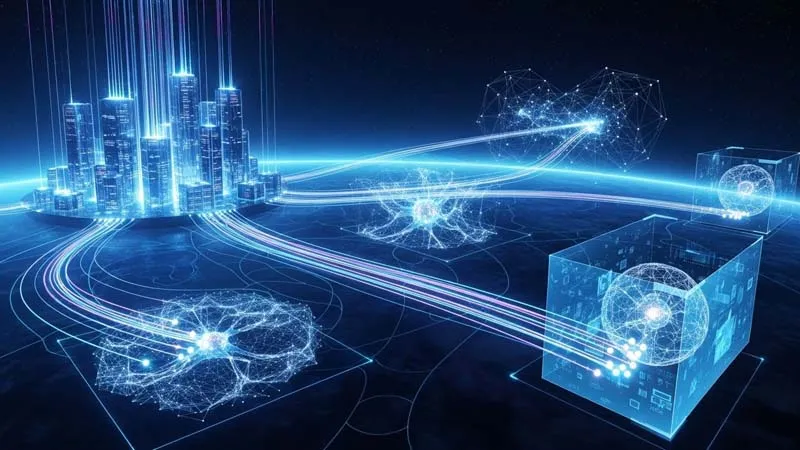
More specifically, these technologies depend on how efficiently data moves. As a result, traditional network architectures are reaching their limits. This is where Optical Networking 2.0 becomes essential.
Unlike previous generations, Optical Networking 2.0 is not just faster. Instead, it is smarter, more adaptive, and fundamentally designed for the data-intensive future.
The Bandwidth Explosion Driving Optical Networking 2.0
AI Workloads Are Redefining Network Demand
Artificial intelligence systems require enormous data flows. Training large models involves moving petabytes of data between distributed compute clusters. Consequently, network bottlenecks directly slow innovation.
Optical Networking 2.0 addresses this challenge by enabling ultra-high-capacity transmission over fewer wavelengths. More importantly, it supports flexible bandwidth allocation, which allows networks to adapt dynamically to AI workloads.
As AI scales, static networks simply cannot keep up. Therefore, intelligent optical infrastructure becomes a competitive advantage.
Latency Sensitivity in the Metaverse Era
At the same time, the metaverse introduces a different constraint: latency. Immersive environments require near-instant response to user interaction. Even small delays break the experience.
Because of this, Optical Networking 2.0 prioritizes deterministic performance. Through advanced coherent optics and intelligent routing, it minimizes delay across long distances.
In other words, realism in virtual worlds depends on precision in optical networks.
From Capacity to Cognition: The Core Shift of Optical Networking 2.0
Networks That Think Before They Fail
Traditional optical networks react to failures after they occur. In contrast, Optical Networking 2.0 is predictive by design.
Using real-time telemetry and analytics, the network continuously evaluates signal quality, fiber conditions, and traffic patterns. As a result, it can reroute traffic before degradation becomes visible.
This self-healing capability dramatically improves reliability. More importantly, it reduces downtime without human intervention.
Self-Optimization Through Data Intelligence
Beyond resilience, Optical Networking 2.0 focuses on efficiency. By analyzing historical and live data, it optimizes modulation formats, power levels, and routing paths.
Therefore, capacity is used more effectively. At the same time, operational costs decline because manual tuning is no longer required.
This shift transforms optical infrastructure from a passive transport layer into an active intelligence layer.
Open Line Systems: Breaking the Limits of Legacy Architecture
Eliminating Vendor Lock-In
Another defining feature of Optical Networking 2.0 is openness. Traditional systems often lock operators into a single vendor ecosystem. This restricts innovation and increases long-term costs.
Open line systems change this model. They allow transponders and optical components from different vendors to coexist on the same fiber infrastructure.
As a result, network operators gain flexibility. They can adopt new technologies faster and negotiate more effectively.
Accelerating Innovation Across the Ecosystem
Because interfaces are standardized, innovation accelerates across the supply chain. New coherent optics, advanced modulation schemes, and software-defined controls can be introduced independently.
Consequently, It evolves continuously rather than in disruptive hardware cycles.
Coherent Optics at the Heart of Optical Networking 2.0
One Wavelength, Massive Capacity
Modern coherent optics are a cornerstone of it. A single wavelength can now carry hundreds of gigabits per second, and in some cases, multiple terabits.
This capability dramatically increases fiber utilization. Furthermore, it reduces the need for physical infrastructure expansion.
In long-haul and subsea networks, coherent optics enable transoceanic data flows with unprecedented efficiency.
Enabling Global-Scale Connectivity
Because of these advances, It supports global AI training, distributed cloud architectures, and international digital platforms.
In essence, it turns the physical limits of distance into a manageable engineering problem.
Strategic Value: Why Optical Networking 2.0 Is Not Optional
Infrastructure as a Competitive Weapon
Building advanced optical infrastructure is no longer a luxury. Instead, it is a strategic decision that determines future readiness.
Organizations that invest early in it can adopt emerging technologies faster. They can scale AI workloads without redesigning their networks. Moreover, they can deliver consistent user experiences across regions.
Those who delay risk falling behind as data demands outpace legacy systems.
Preparing for Technologies Not Yet Deployed
Perhaps most importantly, Optical Networking 2.0 prepares organizations for technologies that do not yet exist. Quantum networking, for example, will require extremely stable and precise photonic channels.
By laying a flexible optical foundation today, enterprises future-proof their operations against unknown demands tomorrow.

The Future Is Not Just Connected, It Is Illuminated
Every major digital transformation depends on one fundamental element: light. As AI, quantum computing, and immersive platforms evolve, their success hinges on how data moves through optical infrastructure.
Optical Networking 2.0 represents a decisive shift. It moves beyond raw bandwidth toward intelligence, adaptability, and openness. More importantly, it aligns network design with the realities of the next decade.
The future will not wait for networks to catch up. Those who invest now will lead. Those who hesitate will follow. The next era of innovation will travel on light—and Optical Networking 2.0 is the path it will take.